“Kashmir?”

kashmir

Before I started studying my family’s genealogy, I had very little ability to retain the dates of important events in United States history. Then, once it became personal, I began to connect particular relatives with particular larger events. A depression explained one family’s relocation. The Chicago fire dislocated a great-grandfather. History came alive for me.

Right now the same thing is happening to me because of this blog and the readers and writers I have connected with. One wrote about the impact of the sudden travel ban by our new President. Another is being affected by the government in The Philippines. I correspond with a graduate student in Turkey and avoid any political discussion lest I cause her trouble.

But the turmoil I was completely ignorant about is in the Indian province of Kashmir. I have been following a thoughtful Muslim young man from there who posts beliefs of Islam. That in itself has been very helpful. Even though I thought I was fair minded, I had been negatively affected by all the anti-Muslim rhetoric pervading our country. I had fallen for the negative generalizations more than I realized.

The fighting in Kashmir has been going on for a very long time, but it is at a peak right now. The Indian government has been responding with measures that are chilling. You don’t have to have a position on Kashmir independence to be distressed by cutting off internet access, shutting down Facebook and closing universities. So I am now praying for the safety of the people of Kashmir, for the freedom of their press, universities and air waves. If you know as little as I did about Kashmir, take ten minutes and check it out.



“Singing Satire”

gilbertandsullivan

One of the musical constants in my life has been the work of Gilbert and Sullivan, 19th century British operetta composers. As a child, I learned many songs from the phonograph records my mother often played of their work performed by the famous D’Oyly Carte Opera Company. I learned the songs to “H.M.S. Pinafore,” “Pirates of Penzance,” and “Iolanthe.” I was particularly intrigued by the “patter songs,” mainly spoken ditties sung very quickly with tongue twisting challenges. One of my favorites was about insomnia from “Iolanthe“. I missed most of the humor as a child, but I loved how fast the singer could go. Another parallel delight was from “Pirates” about the model of a modern major general.

When my mother went to her 15th college reunion at Oberlin, she took my brother and me along and we all say “Princess Ida,” a musical I have never seen or heard since. When I was in high school, Reed College put on one operetta a year, which is where I first saw “Patience,” made even funnier by inserted lines ridiculing some aspects of Reed.

When my daughter was in 8th grade, her school put on “Ruddigore,” a story unknown to me until then. She had broken her leg, but still played Mad Margaret. The injury actually enhanced her role, as she thumped across the stage. She and two others sang a wonderful patter trio “It Really Doesn’t Matter.

There continue to be productions of Gilbert and Sullivan today, mostly from local groups which put on one or two a year. While much of the humor was topical and might seem to be irrelevant 140 years later, it still applies. The ignorance of the modern major general seems very parallel to the ignorance of the U.S. newly appointed Secretary of Education. And insomnia will never go out of style. Many of us will finally be ready to go to sleep just when the alarm sounds for us to rise.


“Patriots’ Day”

IMG_0105
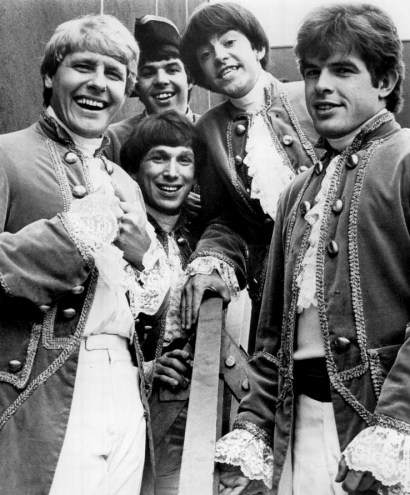
Paul Revere and The Raiders

Holy Week is over, and I am returning to the very long saga of my life with music. Serendipitously enough, today is Patriots’ Day in our neighboring state of Massachusetts, a holiday which commemorates the first battle of the Revolutionary War at Lexington and Concord, Massachusetts. And I am here, as promised to one of my readers, to write about Paul Revere and the Raiders–the band.

In high school after football games featured local bands, usually not much better than what you might think of as a garage band today. But we didn’t really care about the music because we were obsessing about who would or wouldn’t dance with whom. I endured one whole year of these trials without dancing once. Whatever spark had led me to win that grade school dance contest had gone out when I failed to reach maturity until 16. I was still 4’10” as a freshman, and I looked about 11. Not a prime candidate for a dance partner, apparently.

But the one band which did grab my attention was Paul Revere and The Raiders. They played actual music and had semi-coordinated dance steps while they played. Curious to see if my memory was accurate that they would have been playing in my high school cafeteria, I looked up their history before writing this post. Sure enough,”Around this time,(1962)(I think it was 1961) KISN(remember KISN). DJ Roger Hart, who was producing teen dances, was looking for a band to hire. Hart had a casual conversation with a bank teller who told him about a band called “Paul Revere-something”. Hart obtained Revere’s phone number and they met for lunch. Hart hired the band for one of his teen dances.”(Wikipedia)

So my one of my first live band performances actually featured a group that went on to some acclaim. I can’t say theĀ  same for any of the other musical acts!

“Get With It”

vineyard

A major change in leadership in our Friends Church led us to seek another place to worship. This time it was in a dramatically different setting called The Vineyard, where a student of mine was active. The adjustment was jarring, but we became comfortable in a very different setting. But the differences!

First, we were at least 25 years older than most of the attendees. We became parent figures, for better or worse. (Usually better.)

Second, by now we had been Christians for quite a while and were meeting many young adults with no faith background. So we became elders(in an informal sense.)

Third, the music was live and LOUD. So loud in fact that we bought economy sized packages of foam earplugs and kept them in the car to use at each service.

Fourth, there was no physical church, so each Sunday chairs were set up in a school gym and taken down and put away at the end. Fortunately most attendees were in their 20’s and handled this task.

And finally, their music went on for a very long time. And in the culture of this community, people stood, usually with their hands in the air and sang and sang. I usually sat after a few minutes and let the music be a backdrop for my silent reflection.(You can take a Quaker out of meeting, but you can’t take the meeting out of a Quaker.)

While this might seem, at first, to be very similar to the gospel worship at Maranatha, it really wasn’t. Reflecting on the reason, I conclude that the gospel songs at Maranatha were informed by a different theology–that of overcoming together with God’s help. They seemed communal. The Vineyard songs seemed to stress an individual relationship with Jesus. So even though everyone was singing together, it seemed to me that many individuals were having their own personal experiences.

I didn’t find my soul refreshed in the way that it had been both with gospel music and the old hymns, but I treasured the chance to get a glimpse into a contemporary Christian setting. And they served great doughnuts and coffee.

“Singing Quakers?”

hymnals

After leaving the community at Maranatha, I began attending a Friends(Quaker) Church at the invitation of a fellow graduate student. I knew very little about Quakers, but what I did know I valued. They had led other churches in opposition to slavery, were committed to peace, and had always valued women in worship. I also thought they were silent. In the Western United States, however, most of the Quakers are Evangelical Friends, and their service is a combination of a sermon, singing and 20 minutes of silence. During the silence, if someone feels truly led by the Spirit, that person may stand and speak what they believe God has said for the gathered group. Despite how that might sound, in general words given are few, timely and appropriate.

I enjoyed the silence, but the music was something very different from the free joyous singing I had left at Maranatha. There were hymnals in the back of each pew, and the number we were to sing would be announced. Then we would sing together through the verses and stop when the printed text ended. It still felt Spirit-led, but in a very much quieter(these were Quakers after all!) way.

After I had attended there, had been joined by the man who would become my husband, and been married in a Quaker ceremony, some of the elders took an interest in our lack of musical knowledge. They loved old hymns, and they thought we were missing something by not knowing them. To my enduring gratitude, they gathered us with a group of about ten and, as one played the piano, they taught us many classic songs.

Those hymns included “The Old Rugged Cross,” “In the Garden,” and my all time favorite “It Is Well With My Soul.” The theology in all of these songs comforted and reassured me in the same way that “Jesus Loves Me” had done years before. This Easter season, I pause to thank them, now all passed, for their gift to us.

“Make a Joyful Noise”

Gospel-choirs-1728x800_c

Unfortunately, this is not an image of the choir I knew, but it captures the spirit and intensity of the music at Maranatha Church in Portland, Oregon that I attended for several years when my daughter was young. Although my marriage to their son had ended, his family embraced me at the integrated, but majority African American, church they all attended. The church welcomed me wholeheartedly, and I joined a single mothers group which sustained me through some difficult times.

While it is impossible to capture even a hint of the music in such a church, I will try to tell you what I learned from such worship. First of all, there were no hymnals. It was expected that you would pick up the songs as you heard them. Fortunately, there were often refrains that I could learn quickly while I waited to absorb the rest.

Secondly, the songs had no set length. The choir would begin to sing, the drummers and piano playing behind, and the choir leader standing with a microphone. Then as the song progressed, the better everyone was singing, the longer the song went on. Even when I thought the song was over, someone would often start it up again and we were off for another few minutes. A soloist might be settling down, and a choir member would pick up the tune again.

Thirdly, it was very unfortunate that I had listened to a great deal of rock and soul music before I ever set foot in such a church. At first, I thought church sounded like the radio. Finally, to my deep chagrin, I realized that church had come first. Many of the singers I liked from Diana Ross to Aretha Franklin had come from deep church backgrounds.

Today you can hear large gospel choirs in concert settings. While they are wonderful, there is nothing like genuine gospel music sung where it came from and where it truly belongs, in church. After all it is Gospel music, and like the Bible, it spreads good news.


“Song and Dance”

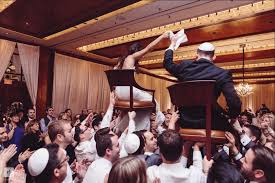
jewishwedding

When I was a junior in college, my dear friends Ellen and David, who were graduating seniors, got married in their home town of Cleveland, Ohio. I was invited to their wedding, which took place in what, to me, seemed a very strange location. It was a large banquet hall, nothing like the church settings I was used to.

Great joy filled the hall, however, bringing the same spirit that I had experienced at Christian weddings. I was intrigued by many things that evening, including a canopy under which they wed, and a glass that David stomped on while everyone cheered.

The best part of the evening for me, however, was the singing and dancing after the ceremony. While David and Ellen were hoisted up on chairs and carried around the room, the band began to play. It was my first, though not at all my last, introduction to the wonderful tune “Hava Nagila.” I tried in vain to find a good link to this tune, but came up short. If you don’t know the song, I encourage you to find a copy of it.

As the music played, and as we all sang along, we formed a long snaking line and danced the hora around the room. I mumbled along with the words, imitating the sounds I heard. The dance steps were easier since I had done a lot of folk dancing in high school.

Many years later, I attended a wedding of a dear friend, marrying for the first time in her early 40’s. It was in an equally secular setting, this time the Oregon Forestry Center. But when the band struck up the tune “Hava Nagila”, we all joined hands and sang and danced and sang and danced. Celebrating the joy of life. Love may have come late, but it had at last arrived.

“This I Know”

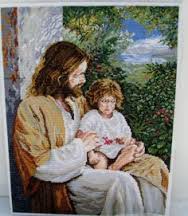
jesuswithchild

In my faith tradition, this is Holy Week between yesterday’s celebration of Palm Sunday and this Sunday’s celebration of Easter. I thought I would write this week about music I have encountered in various faith settings. There has been a wide variety, as I think back about it, and worth a week’s worth of postings.

My parents were not religious, and I had minimum exposure to church. My grandfather was an Episcopal priest, but he lived 3000 miles away and was not a direct influence on my faith. The summer I was 11, however, we spent a month with my grandparents in the small town of Pike, New York where they had a summer farm. Pike was so small that our visit was announced in the town paper. My friend Gwen, with whom I daily rode bikes and swam in Wiscoy Creek, invited me to come with her to Vacation Bible School at the local Baptist Church. My grandmother was slightly suspicious of Baptists, but she agreed I could go with my friend.(Grannie was a religious snob!)

I remember little of that time, but I know I really enjoyed myself. We made great pictures with cotton balls glued to colored paper to represent the sheep that Jesus cared for. I am not sure that I understood the metaphor, but I loved those little fuzzy sheep. The one tune that stuck was “Jesus Loves Me.”(I have not inserted a link to this since the online versions have troubling lines we never learned.) We sang it every day and it sunk deeply into me. I didn’t make much sense of the line “the Bible tells me so,” that supports the idea that “Jesus loves me,” but I really grabbed onto the idea that God loved me.

My faith journey was interupted many times in the years to come, but that song stuck with me. When I moved to Connecticut and saw signs for Vacation Bible School, I called the little church in Pike. I asked them if they still did Vacation Bible School. When they said yes, I asked them what the program cost them. I sent them the $100 to run the camp that summer, to pay them back in some tangible way for the truth they had planted in me. I would never succumb to “hell fire and damnation” preaching in life because “this I know,” “Jesus loves me.”

“My Country ‘Tis of Thee”

stamp

My generation was born at the end of World War 2. There was no question about patriotism for the children of the soldiers who had fought across the world and were victorious. No nuanced understanding of history entered our schoolrooms or our textbooks. The United States and God’s will were synonymous. When I was in third grade, in fact, the Pledge of Allegiance, which we recited every morning, was changed to include the phrase “one Nation, under God.”

The songs we sang in chorus repeated the theme of freedom and God. The two songs we belted out every year were “America the Beautiful” and “America.” What I most remember about singing those songs was total joy as we all agreed that America was the best place on earth and God was for us. In “America the Beautiful” the lyrics state, “America, America, God shed his grace on Thee.” And that same idea shone from our postage stamps, shown above.

We never could have imagined that some of the kids across the country, growing up singing the same songs, would some day chant,”Hell no, we won’t go.” Nor that some would go to Cuba to harvest sugar cane in solidarity with “the masses.” Our more complex understanding of U.S. history lay years ahead. For now, we joined with our dads in celebrating the war they had won and the peace they believed they had secured for us, their beloved children.

“Every Good Boy Does Fine”

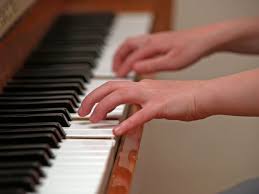
pianoplaying

Meanwhile, while all that dancing was going on, I was taking weekly piano lessons. When we moved into our big home in 1955, there was a large upright piano in the living room. It stayed and I began taking piano lessons. I walked down the road for about 20 minutes to the home of Mrs. Pipes and learned music.

She was much more serious about music than I was, but no one ever asked me if I wanted to play the piano, so I dutifully went week after week. I practiced half-heartedly for the first few years, struggling through such uninspiring tunes as “Here We Go, Up a Row, To the Birthday Party.” I had to practice scales, and she taught me memory tricks such as the title of this post to remember the names of the notes. That phrase was for the treble lines. The bass lines were “Good Boys Do Fine Always,” and the white keys were FACE.

I did learn to play the piano enough to enjoy tunes from Rodgers and Hammerstein and Gilbert and Sullivan. I also mastered enough Christmas carols to be able to play them in subsequent years. But mainly the piano followed me from home to home, usually being used to display pictures on its top.

But, to my delight, my granddaughter is quite good on the piano, and a couple of years ago the upright made its way to her home where she practices on a regular schedule because she wants to get better. I went to her first recital last summer, and she actually plays with a sure hand which I never accomplished.

As for me, I stick to recorded music of musicians who have talent and drive, neither of which I brought to that poor piano. I am sure it is grateful that someone is appreciating it after all these years.