“KINK The Underground Link”

klhradio
KLH FM Radio 1965

So I was now being introduced to new music on phonograph records and in person. The one place I was not meeting this kind of music in Portland, Oregon was on the radio. AM radio continued to play 2 1/2 minute songs. Occasionally they would play 2 1/2 minutes of a longer song, but then cut it off. Fortunately, both my brother at college in Ohio and I at college in Massachusetts had been introduced to FM radio. In Cambridge and in Oberlin, the radio to own was this small brown KLH model. Somehow, despite the fact that there was nothing for us to tune into, we convinced our mother to buy one so that she could listen to classical music.

But on Christmas Day, 1968, my brother and I turned on that radio and rejoiced together as station KINK, the underground link, went live. It was the first station in Portland to play the kind of music we had grown accustomed to in college. It played the whole song, not just 2 1/2 minutes of it. Here was the entire “Hey Jude,” not the AM truncated version. Here was the whole baffling “Whiter Shade of Pale.”(As I think about these long songs, I am reminded again that sans drugs I may have been having a less ecstatic experience than some of my friends.)

Car radio was still limited to AM, and most radios still had only an AM band. Even the KLH only tuned in FM, so we needed two radios in the house for other purposes. Still, we felt that Portland had begun to come of age. Hard as it is for the current enormous population of hipsters in Portland today to believe, Portland in 1968 was very much in the music backwater, along with the restaurant backwater and  the movie theater backwater. It was still a hamburger and drive-in theater town. But at least we finally had “an underground link.”
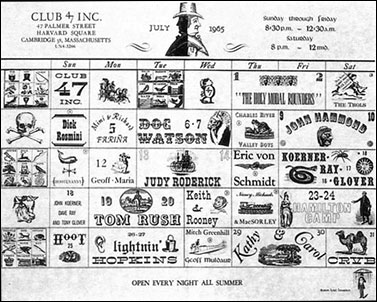
“Acoustic or Electric?”

club47calendar.jpeg

I retrace my musical steps to introduce my experiences in Cambridge at the Club 47. This  coffee house, in the basement of a building across the street from the Harvard Book Store(The Coop) presented live acoustic music most nights of the week. It was inexpensive, easy to walk to, and hosted wonderful singers.

Here I first heard Tom Rush, Eric Anderson, Phil Ochs, and Judy Collins. The atmosphere was quiet so that you could easily hear the words to the songs. Songs explored issues pertinent to the crowd, from love lost to political action. I felt at home there in a way I often didn’t feel in the intellectual climate at Harvard.

Reflecting on this time in my life, I realize it was then that I chose the “path less traveled” and stuck with acoustic music, eschewing the more popular amplified sound. The Rolling Stones were very popular at that time, but I found their music ugly and disturbing. Perhaps my disinterest in drugs helped me choose which musical path to follow. Perhaps it was my abhorrence of loud loud loud sounds. Perhaps it was a distaste for bad lyrics. At any rate, I was an English major because words mattered. I wanted to be able to hear the words, think about the words and remember the words.

In the last twenty years, I have enjoyed discovering a whole new group of what are now called “singer-songwriters” rather than folk musicians.  There exists a whole raft of excellent writers playing acoustic instruments whom I now follow. I will write about them later on in this musical odyssey. Suffice it to say, I don’t need to follow the very popular “tribute bands” now raking in millions from my generation. I don’t need to remember those old loud songs. I can peacefully listen to the new singers who choose their words as carefully as the ones I listened to in Cambridge in the late 1960’s.

“If You’re Going to San Francisco…”

janisjoplin
Big Brother and the Holding Company 1968

My boy friend and his best friend had stopped in Portland on their way to San Francisco for the “Summer of Love.” It turns out that there is now a celebration of the 50th anniversary of that summer in 1967. Many people had responded to the idea to go to Haight Ashbury that summer, and there was even a song that went,”if you’re going to San Francisco, be sure to wear some flowers in your hair.”

I joined them for a visit and we went to see an act at the Fillmore West. The room was filled with “psychedelic” light effects. I was sitting near where they were originating, and it appeared someone had poured colored oil on glass and was tilting it around as light shone through it. The band was very very loud and the woman singer was screaming basically. That was my introduction to Janis Joplin and the Holding Company about whom I knew nothing.

The major problem I had in San Francisco was that I didn’t use drugs. Of any kind. Not pot, not LSD, not mescaline, not mushrooms, not peyote. I barely even drank. I had no objections to other people using, but I had a fragile enough grasp on reality that I was terrorized at the thought that I could lose it. I spent my time trying to stay grounded, not trying to leave my body.

As you might guess, this made me somewhat of a drag around my friends in San Francisco. It really highlighted a chasm between us. Not only did they love any kind of mind altering drugs, they were also very politically involved in anti-war activities.  I was just trying hard to study and write papers. On the other hand, they were facing the draft and I wasn’t.

For several reasons, then, that summer brought an end to my romance. And by the time I returned to Cambridge, I was greeted on campus by my former roommate. She announced that since I had broken up with the man in August, they had gotten together in September. I was startled, but accepting. They shared a love of politics and of substances. Probably a better fit. But I had gotten to see Janis Joplin!