“A Home of My Own”

IMG_0127

After college, I returned to Portland, Oregon and got a job working for a travel agency. This job had nothing to do with my English major, but in the 1969 Portland job market I was expected to do female work, basically typing. I could not get my error-free word per minute rate high enough to qualify for most jobs. A father of an old school friend hired me to book Trailways bus tours.

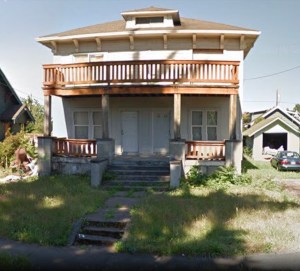
I earned $65 a week and a friend at work told me about her neighborhood’s affordable places. I was able to rent the entire first floor of this house for $90 a month including utilities except for heating oil. I bought some used furniture from a store on the corner and was set. My upstairs neighbor was very nice, but I suspect she earned her money “on her own,” since she went out in the evening dressed to the nines and had no day job.

The house had an old wringer washer in “my” basement and a clothesline in the back. I had a big kitchen and was able to keep cooking my “Italian” meals for friends.  I enjoyed my independent life with a neighborhood tavern around the corner, a grocery store near by and my own home. Finally I really felt grown up.

“Sort of Off Campus”

spl_32_20170605142324_2

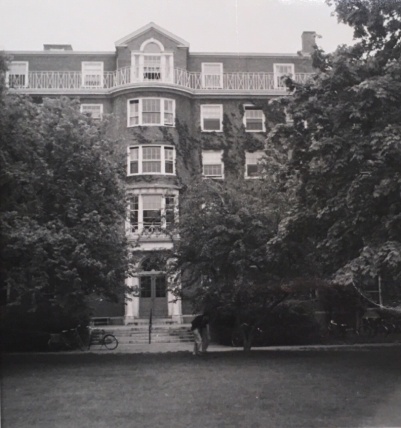
The dorm was a little overwhelming, but there was an alternative called “off campus.” This really wasn’t today’s meaning of the word, but rather housing that was outside the quadrangle of the big dorms. It was a privilege, and available only by seniority. Fortunately I had friends a year ahead of me who needed a fourth to apply. So I signed on with them and we were able to get two large rooms at 12 Walker Street called Coggeshall(another old Boston name.) I shared the corner room on the second floor left front of this photo.

We could still take our meals at Cabot, which was handy for dinner, only a block and a half away. However, there was a very large kitchen with an industrial sized refrigerator which we could use to store food. So I usually had a light breakfast here. I had learned about bagels and cream cheese for the first time, and I loved a toasted one in the morning.

i lived at 12 Walker for the remaining three years of college. Junior and senior years I had a single room which was the bay window on the second floor. Literally, it was the hall and bay window with a door to close it off. My bed was in the bay window and I always loved the snug feeling, rather like being in a boat’s cabin.

The bathrooms were large and individual with the original deep claw foot tubs, great for long soaks. We were able to have individual phones, and there was no “bells” work. The place was very homelike, and I actually had a couple of dinner parties, cooking veal Parmesan that I had learned from those wonderful “kitchen ladies.” “Sort of off campus” was a perfect life for me.

“Home Cooking, Italian Style”

spl_32_20170604161518_2

Before the large college catering companies like Sage took over, individual dorms had their own kitchens and cooks. Cabot Hall had a wonderful crew of kitchen workers who prepared lunch six days a week and dinner six days a week. On Sunday we had a formal dinner at 1pm and an assortment of cheese and fruit for supper. Our kitchen also served the dorm next door, so they fed about 180 girls a day.

I had grown up on a very bland, unvaried diet. We had frozen vegetables, considered a true step up from the canned vegetables of our parents. We had hamburgers, meat loaf, fish sticks, macaroni and cheese and roast chicken, in a seemingly endless rotation. No one I knew ate much differently. But the cooks at Cabot were local and cooked food with which they were familiar, and they introduced me to manicotti, lasagna, veal Parmesan, fish on Friday, roast beef and Yorkshire pudding. I often asked the cook what the food was, much to her amusement.

On Sundays, dinner was a formal sit down meal, unlike the steam tables of other days. Different girls took turns serving, and everyone was expected to be on time. In fact, if one was late, it was necessary to apologize to the dorm parents. I often rushed to get back from church in Boston to avoid that embarrassing routine.

I have always been grateful to those warm Cabot “kitchen ladies”who truly served every meal with love and care. And I only gained the “freshman five,” not ten!

“Bells, Bells, Bells, Bells”

spl_32_20170604161337_2

It’s hard to tell in this photo of the back of Cabot Hall, but it was covered with ivy, hence the name Ivy League(really I don’t know if that is the origin of the name!) Living in the dorm meant getting acquainted with 100 girls, dorm parents, and many specific rules and routines.

One practice that everyone had assigned to them was sitting on the “bells desk.” These shifts lasted three hours, usually a couple of times a month. You sat at a desk in the lobby and greeted anyone who came into the dorm. Girls were allowed to go upstairs at any time to visit with friends. Boys, however, were a whole other story. Boys were only allowed upstairs for 3 hours on Sunday afternoon. Otherwise, they had to announce their presence to the person on “bells.”

The desk person then rang the hall phone on the floor of the girl being visited and told whoever answered that someone had a “gentleman caller.” Yep, we actually had to say it that way. We also had the unpleasant assignment of letting a boy know that a girl was out. Bells also sorted the mail, answered the phone and took messages for girls that were out.

The building was locked at 11 on weekdays and 2 on weekends. If you were later than that getting back, you were out of luck. It was amusing on some evenings to see huddled pairs of students getting in their last few minutes of “conversation” before the building was locked.

As for those three hours on Sunday afternoon, alone in your room with a boy,  you were required to have three out of the four feet in question on the floor at any time. That rule continues to baffle and amuse me.

“The Cabots Speak Only to God”

img_0513.jpg
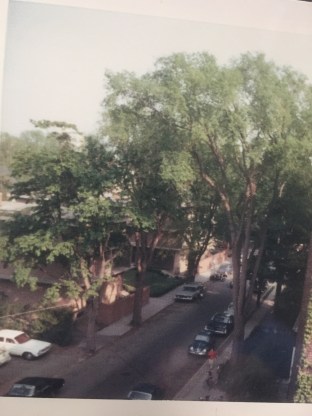
View From My Room In Cabot Hall

When I got my dorm assignment for my first year of Radcliffe College(now totally part of Harvard, then separate housing), it was for Cabot Hall. My grandfather, ever the wit, promptly told me a little ditty:

“Here’s to the town of Boston, The land of the bean and the cod, Where the Lowells speak only to Cabots, And the Cabots speak only to God.” He was quite amused that he finally had an audience for that poem. It took me a while to realize that it refers to the deep snobbery of the Boston elite.

I had a double room on the corner of the 4th floor. My roommate and I shared a bunk bed and a closet. We each had a dresser, a desk and a chair. We needed pole lamps, since there was no room for a floor lamp. The dorm had been built for single rooms, but had been changed into doubles, hence the bunk bed. The two sets of windows on the corner made positioning the bed challenging. We moved it around from time to time anyway.

The bathroom was down the hall with four stalls and three little rooms with bathtubs. I had shared bathrooms and bedrooms for most of my life, so it wasn’t too hard of an adjustment. However, some of my classmates were extremely wealthy, and I imagine it was a major step down for them.

Many aspects of dorm living were new for me, and I will post more about it. Suffice it to say that my first jolt came as I was moving in and heard a girl yell,”F____k” at the top of her lungs. I had never heard a girl use that word, and I knew I wasn’t in Oregon any more.


“You Say Creek; I Say Brook”

C4F131

The little stream that ran along the bottom of our property was called a brook by my mother, but a creek by some of my friends. Some people in Oregon even pronounced it “crick.” Writing about this spot yesterday made me think about the regional differences in words that still seem to persist, despite our national mobility.

I took a quiz a few months ago that gave me a series of noun groups and asked me to choose the one I was most likely to use. The groups included things such as “purse, handbag and pocket book.” I had fun completing the quiz and was interested to learn what part of the country my word usage represented. I had, remember, spent 50 years living in Oregon. Amusingly enough, my vocabulary positioned me in Buffalo, New York.  It is true that my mother grew up in Buffalo and my grandparents lived there for most of their lives, but I had only spent occasional visits there. Apparently, my mother’s vocabulary had the greatest influence on my word choices. No wonder I preferred “brook”  over the more  Western “creek.”

Now that I live in New England, I have had to adjust my vocabulary sometimes to be understood. “Pop” is called “soda” here. “Dark coffee” means “light cream,” not “dark roast.” When I say I don’t need a “sack” at the store, I have had clerks look at me with puzzlement. I have better luck with “bag.”

It’s time to put on my “sneakers” and take a walk. Let me know about your word choices.


“Happy Trails to You”

C4F138

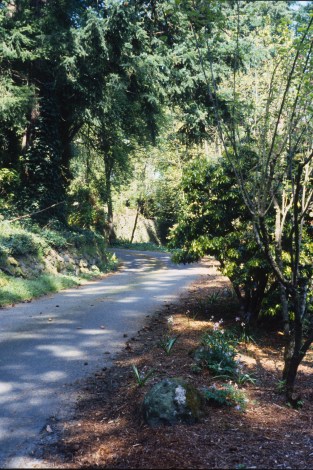
When I was a kid in this new neighborhood, the houses were far apart and kids were scattered over a much larger area than on my previous little street. I had to travel to see any of my new friends. I had two available modes of transportation: my feet and my bicycle. We lived at the bottom of a steep hill and many of my friends lived up the same hill, sometimes far up the same hill. The road below us sloped down to the river where one of my best friends lived. In between me and another good friend were woods.

I look back now and am amazed that we kids knew the trails throughout the neighborhood, allowing us excellent road-avoiding short cuts. One ran through the woods to my friend’s house, even though it meant I arrived in the middle of her rhododendron hedge. Another led down to the railroad tracks, across them, then along a cliff to the abandoned water works along the river. My feet were the best transportation on those outings.

The long hill up from our property provided a tough choice. It was easier to walk up it, but it took a long time walking back. If I could push my bicycle up it(most of it was too steep even standing up on the pedals to pump), I could very quickly coast all the way home. This allowed me to stay longer at my friend’s house, so I usually took my bike.

I usually walked to school, through the woods and across a highway to get there. Kids who lived closer, walked or biked. I knew no one  whose mother took them to school, nor anyone whose mother chauffeured them anywhere. We were expected to get ourselves places. So we did.