“Misheard”

Alexander Calder Mobile

I was exercising yesterday morning listening to Bob Dylan(remembering my college fitness level) when I heard a song from his Blonde on Blonde album. My vinyl copy of the set has “Tepperman” written on it. Since I know no one named Tepperman I assume I borrowed it from someone who had borrowed it. At any rate if you happen to read my blog, I have your album.

As Stuck Inside of Mobile With the Memphis Blues Again played I remembered that the lyrics always made me think of me caught inside one of Alexander Calder’s giant mobiles. It seemed an apt description of some states of mind and I never questioned the image.

Years later Charlie and I were at a Bob Dylan concert when he whispered to me “This is the only song about Mobile, Alabama.” Since Charlie is from Mobile I realized, much to my chagrin, that I had misheard the lyrics for years. The singer, stuck in Alabama, would have much preferred to be in Memphis, Tennessee.

I began to think of other words I have misheard. As a child I thought that the Pledge of Allegiance referred to “one country invisible” instead of “one country indivisible.” With the present state of things I may have been on to something. At Christmas I sang happily of the “round young virgin”(’round yon virgin) in the carol. Made sense to me.

I hope you will add some of your own misheard lyrics.
“Ginny or Barbie?”

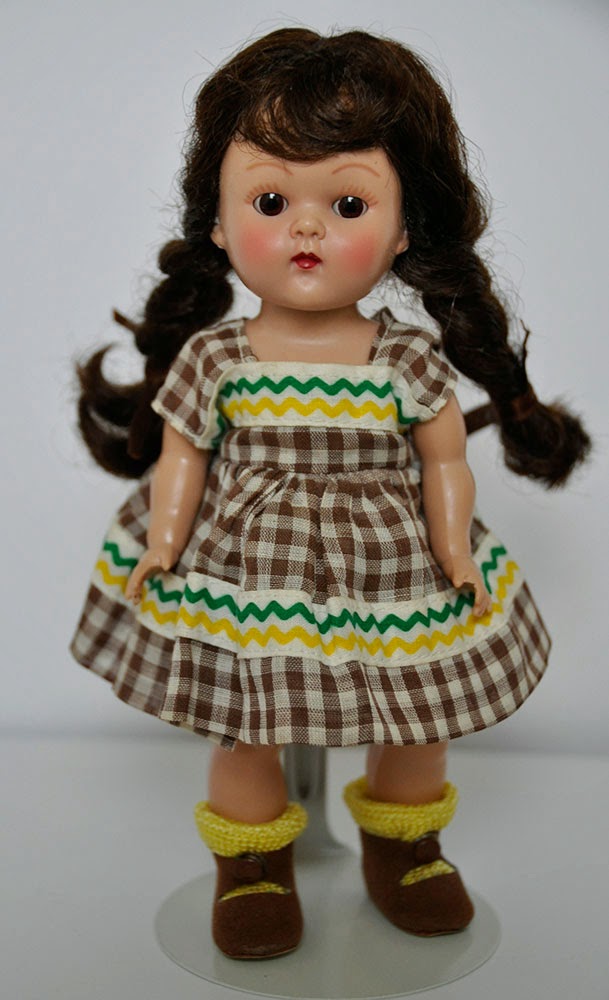
Ginny doll 1956

When I was a little girl I had a small collection of Ginny Dolls such as the one shown above. My favorite, a Christmas present when I was 9 looked like the one above. My earlier ones had an assortment of clothing hand made by me with the help of my then next door neighbor Grace. The outfits were little scraps of cloth held together with a stitch or two, but I was proud of them. One year I received a bunk bed for two of the dolls, and little scraps became the bedding. Beyond those accessories everything else about Ginny was in my imagination. She was clearly a little girl like me, so she enjoyed the things I enjoyed.

Barbie Doll 1959

I was 12 when the first Barbie came on the market. I found her startling to say the least. Who was she supposed to be? Why would any little girl want to have her as a friend? Fortunately I was too old for dolls, and my little sisters were uninterested. One loved horses. The other only wanted to play cowboy. The first time I encountered the doll in person was when I had daughters and they had friends. Still none of them were particularly enamored of Barbie. Even my granddaughter was more interested in the American Girl Dolls than in Barbie.

Needless to say, though I have no interest in the movie Barbie, I am amazed that she was central in many girls’ lives. Movie theaters fill with viewers crazy about the film. (Oddly, Oppenheimer seems equally popular. Talk about cognitive dissonance!)

I would love to know what dolls, if any, either my readers or their siblings held dear. If they were Barbies, help me understand the attraction.

“Reminiscence Bump”

Credit to John Medina

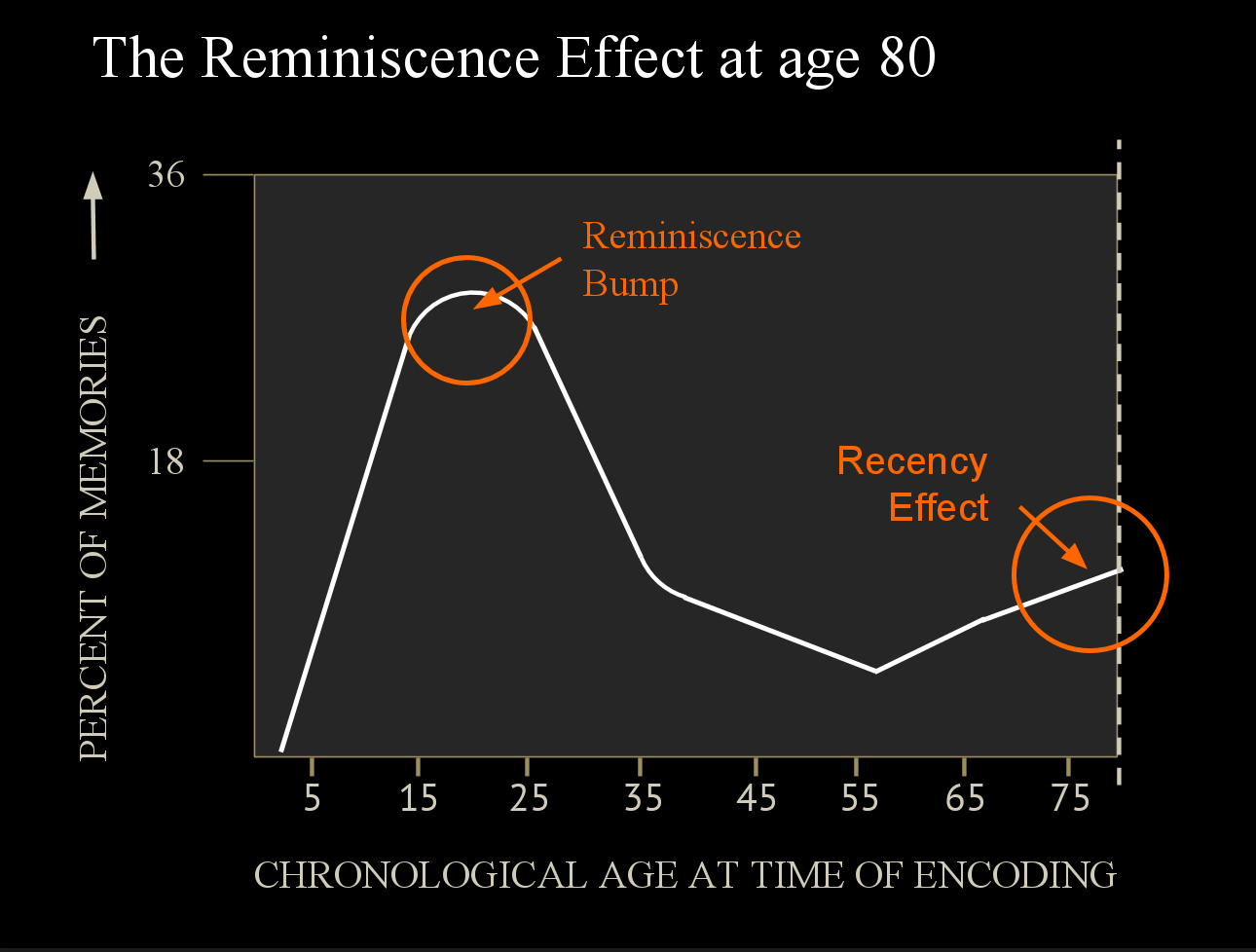
I am unsure where I first heard a reference to the “reminiscence bump,” but I was delighted to find a reason for the very clear memories now available from my life in my late teens and twenties. As you can tell from the above graph(and much more information is available on line) late in life memory retrieval takes a dramatic turn. It’s for the better as I have experienced. While one’s middle age remains a blur, experiences from 10 through 25 or so suddenly seem clearer than they have been in years.

This has been a Godsend for blogging. Some readers have commented on the clarity of some of my memories. I can attribute that clarity to the “bump” that apparently hits at about the time in my late 60’s when I began to write. As I have read up on the phenomenon, it apparently happens to older people around the world. That made me pause and reflect on the value of this quality arriving then.

At 76, my memories of being 16 are very clear. My 16 year old granddaughter has become the recipient of this trove of detail. But for her my tales are 60 years in the past and of real interest to her. I remember benefiting in the same way at 15 from my grandfather’s tales of his childhood. Taken together, my grandfather’s details held by me and shared with her and my own details handed on comprise over a century of stories. This, of course, was traditionally valued as the wisdom of the elders.

While the United States has declared youth a prize and old age a liability, I can see that it is missing one of the true gifts of the “reminiscence bump.” It gives the young perspective and gives the old the satisfaction of sharing wisdom. I had such a moment during the Watergate hearings in 1973. I was 27 visiting my 83 year old grandmother. She said “I don’t know why there is such a fuss. The Tea Pot Dome Scandal was worse.” The country had been there before, she assured me, and life would go on. It helped.

”Lasting Lessons”

Unsplash photo by Filipino Mroz

Reading a post about scalloped potatoes from a blogger friend I thought back about the lessons my mother thought essential. Four were paramount and I have no idea why she thought them imperative.

  1. Ironing a man’s dress shirt.
  2. Making white sauce.
  3. Making giblet gravy on Thanksgiving.
  4. Never learning to play Bridge.

I tried to find an image of ironing a dress shirt. Amusingly enough these were all instructions for men. I did learn this skill, but it has rarely been needed.

Learning to make white sauce, on the contrary, has proven invaluable. It was first key to making creamed tuna when the kids were young. With the knowledge of butter and flour thickening milk into sauce I have found similar recipes easy.

Giblet gravy is really a step up from white sauce. Instead of milk I use broth from simmering the parts with onion. Instead of butter I use fat from the roasted turkey. Thanksgiving wouldn’t be celebrated here without the giblet gravy. Sadly it seems to gross out younger generations. Charlie and I have it to ourselves!

And Bridge? I was never tempted since no one ever asked me to learn. I did however learn a wide variety of poker games. Perhaps they may have led me down the forbidden path Bridge opened. But the prohibition against Bridge specifically, shouted as I boarded the train for college, remains a mystery.


“Remembering Lahaina”

In 1978 I went with a friend and my 3 year old daughter from Portland, Oregon to Maui, Hawaii to spend a week at a friend’s condominium. Hawaii draws tourists from the West Coast of the United States in a way parallel to that of the Caribbean hosting visitors from the East Coast. At that time Maui had a population of around 60,000 in contrast to its recent count of 167,000. Maui was less frequently visited than Oahu(site of Honolulu) and was still fairly rural.

Lahaina served as the market town for the area and we bought fresh fruit there, amazed both at its abundance and its affordability. Imported food was expensive, but local produce delighted us for the week. Lahaina had a typical laid back beach town sense with casual seafood restaurants. We admired a huge banyan tree and learned of the missionary presence in the 1800’s. The town was authentically Hawaiian and not aiming to be something grander.

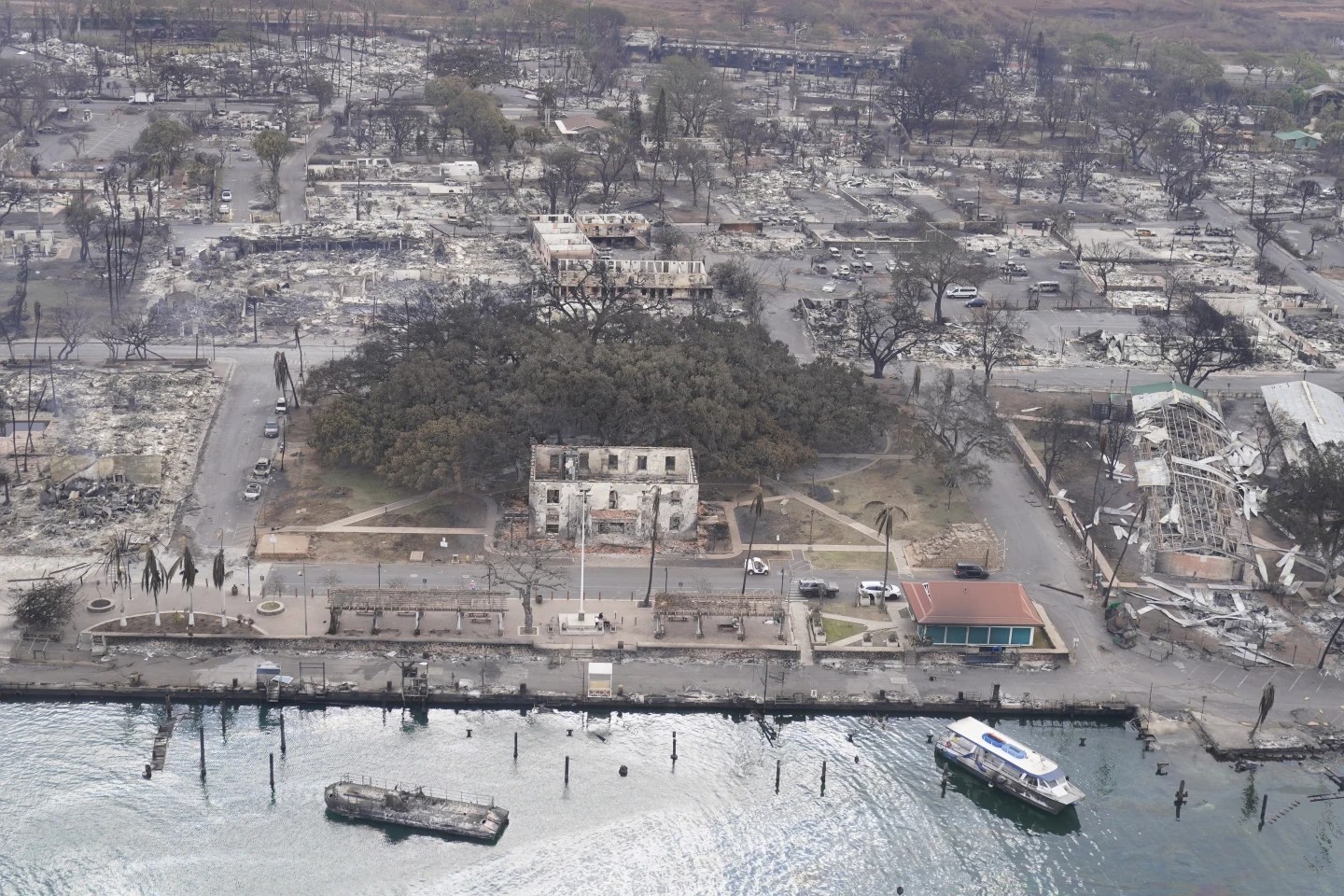
As fire destroyed the town this week I learned that it had changed into a real tourist attraction full of shops and people. I saw the photos of the devastation and grieved for the town. At the same time I realized that the Lahaina I remembered from years ago had been gone a long time. But as you can see in the color photo above, the banyan tree, scorched but alive, still stands.

Tourists are asked to stay away. The hotels may be a temporary way to house the residents. May the spirit of the Hawaiian people we experienced years ago carry them through as they grieve and rebuild.

“Wonderful Mistake”

Each spring I order seeds from the Burpee Seed Company and Charlie plants them in the bed he has carefully mulched and then worked up in June. I buy cosmos, sunflowers, zinnia and four o’clocks which bloom abundantly until the first freeze. The zinnia are a range of bright colors and the cosmos are pink, white and raspberry. Usually.

This year I first noticed the leaves in the foreground of the photo, unlike ones I knew. To the right of those are the feathery ones I know are the usual cosmos. I thought they might be weeds, but Charlie suggested waiting to see if they bloomed. (He later admitted he didn’t feel like pulling them out the day I spotted them.)

To my delight they turned out to be an orange cosmos the color of Icelandic poppies, a flower I have always loved. They have bloomed before their cousin cosmos, so right now they get to dazzle uninterrupted. I don’t know if some person at Burpee decided to jolt me out of my yearly routine by sending the seeds. At any rate, they are a welcome surprise. Now I just have to find the variety so I can order them next year.

“Going Blind”

Andrew Leland’s new memoir The Country of the Blind takes its title from an H.G. Wells short story in which an sighted explorer finds a civilization of the blind and declares that “In the Country of the Blind, the One-Eyed Man is King.” I picked up his book to learn more about retinitis pigmentosa(RP) which I first encountered in a blog I follow. In that instance the son of the writer has RP. In the memoir Leland himself is slowly experiencing loss of sight from the diagnosis.

Leland walks an uneasy path between the fully sighted and the fully blind, and he is clear that while he learns about the country of the blind he has yet to totally inhabit it. Instead he recounts both his deteriorating vision, its effects on him and his family and his attempt to learn as much as he can about blindness while he still has some, though limited, sight.

While I did learn more about RP, the book proved valuable beyond that initial impetus. He writes of the kinds of internal conflict that readers may be familiar with from the deaf community. Squabbles over using or not using canes, of using or not using Braille on crosswalks, of seeing blindness as a disability or not go on as he travels. His approach is always compassionate and it allowed me to see that there is no such thing as a blind person. There is always only one individual with vision impairments.

Most fascinating are the technological advances we now take for granted that originally were developed as assistive aids for the blind. These include optical readers, text to speech programs, and audio books.

The book avoids melodrama. At one point he addresses peoples’ fear of going blind. “Going blind is not dying;” it is adjusting to the world in a new way.

“It’s No Puzzle”

The World of Jane Austen by Barry Falls

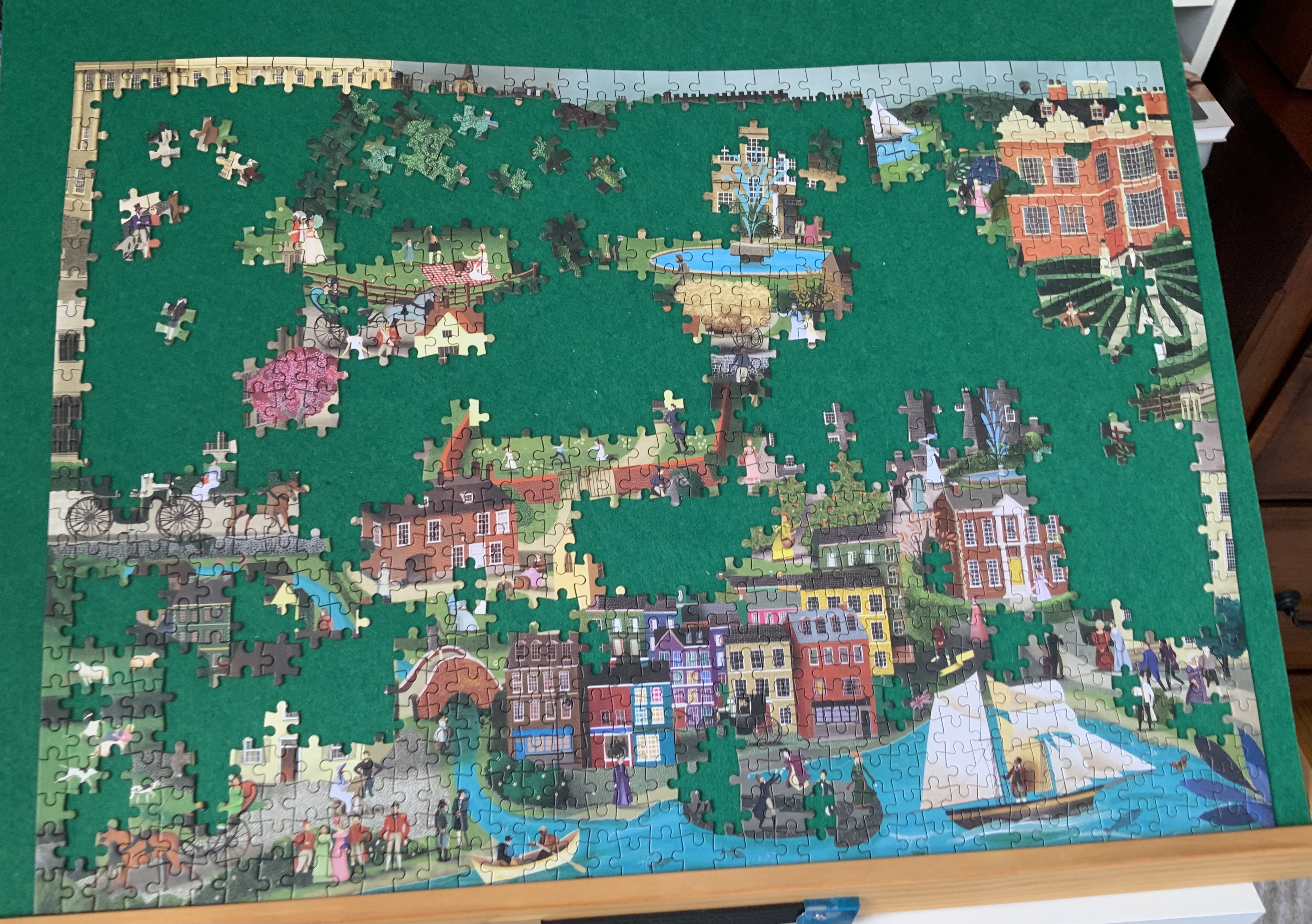
Every few years I seem to crave the time and patience required to put together a 1000 piece jigsaw puzzle. The one pictured above is my current project, a collage of various scenes from Jane Austen’s novels. Many characters people the scene and a guide to each is supplied in case there is any difficulty identifying anyone.

For the first time I am using a puzzle board covered with felt that can be propped at an angle making bending over less tiring. It also keeps the puzzle out of reach of the puppy who would be only too happy to devour one or more parts. Since she has become very stealthy I might not notice until the very end of the construction when I discovered a hole in the array.

I tend to work in little parts as you can see, and sometimes those need to be connected to other finished segments. I have found a serious drawback to the felt; it is impossible to easily slide sections together. However the tilt is easier on my back, so on balance the board is an improvement.

Putting together a jigsaw puzzle can’t be rushed. Careful attention to each piece means focus and calm. Periodically being drawn to assemble one lets me know that at any given time I must need both.