I am away from my blog for three weeks as I take an online course from Boston College on The spirituality of aging. It is highly interactive through challenging and engaging written answers and responses. It is rather like very focused blogging with equally polite participants. See you all again, perhaps with a bit more knowledge about aging(beyond personal experience!)
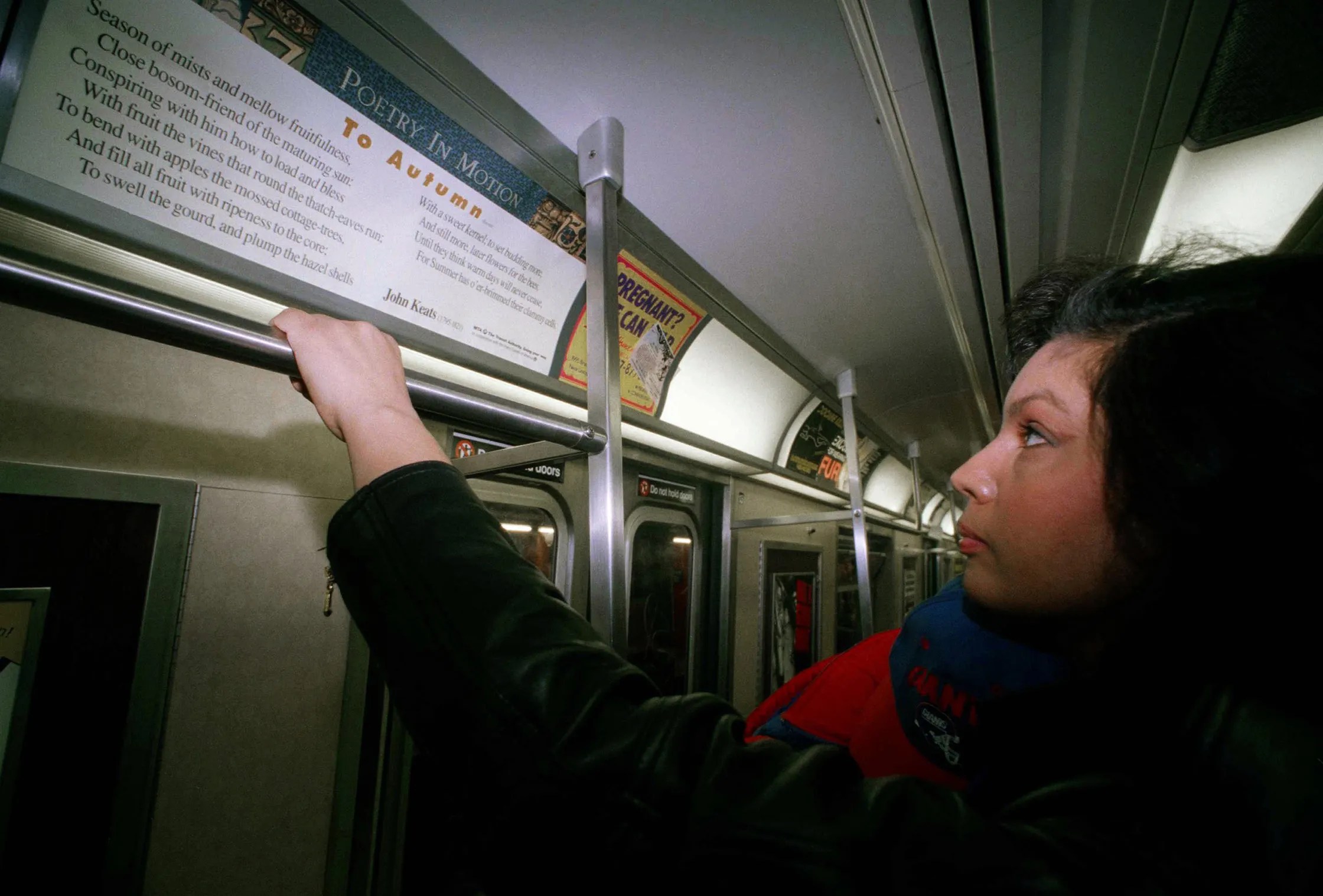
1993 photo of New York Subway rider reading Keats photo by Jim Cooper AP
I first encountered poetry in public on the New York subway. Along side of the usual signs for bail bondsmen and pain relief, I spotted a poem. I was pleasantly surprised and have continued to appreciate other times that localities place poetry in public spaces such as our local park.
But why is it there and what do the people who place it hope to have happen? I found a good explanation from the local town’s poet laureate Andrea Barton(at least fourteen Connecticut towns have one.)In her view, poetry can be used to build bridges among individuals from all walks of life. “I want to pull the community together using poetry,” Andrea says. “I see the world through poetry, and think it’s exciting to help others do that too.”
Her quote encouraged me after I had spent many years in a college classroom exploring poems with young people. Too often the love they had for rhythm and rhyme as children had been extinguished by high school. Here they seemed to learn that poetry had a “secret meaning” known only to the teacher. I had to do much “unteaching” to allow them to connect in their own ways to each writing, abandoning ones that didn’t ring true, treasuring those that did.
I often echo Marianne Moore when I encounter many contemporary poems “when they become so derivative as to become unintelligible, the same thing may be said for all of us—that we do not admire what we cannot understand.” But much poetry makes perfect sense to many people, putting thoughts and insights into words that provide connection and comfort. That poetry, placed in view of ordinary people, can enrich lives.
The park banner has just an excerpt of the poem. Here I am sharing the full text. In my next post I will explore the project in full.
What It Looks Like To Us and the Words We Use
BY ADA LIMÓN
All these great barns out here in the outskirts,
black creosote boards knee-deep in the bluegrass.
They look so beautifully abandoned, even in use.
You say they look like arks after the sea’s
dried up, I say they look like pirate ships,
and I think of that walk in the valley where
J said, You don’t believe in God? And I said,
No. I believe in this connection we all have
to nature, to each other, to the universe.
And she said, Yeah, God. And how we stood there,
low beasts among the white oaks, Spanish moss,
and spider webs, obsidian shards stuck in our pockets,
woodpecker flurry, and I refused to call it so.
So instead, we looked up at the unruly sky,
its clouds in simple animal shapes we could name
though we knew they were really just clouds.
disorderly, and marvelous, and ours.
The above photo shows only a small part of the playground designed for older kids. I had difficulty getting a picture with no children in it(to preserve their privacy.) This large area, across the sidewalk from the toddler playscape, attracts a constant flow of children, mostly from ages 3 to around 12. The structure pictured above is a combined rope and bar set up for climbing. The area also includes a large multilevel platform, slides, climbing bars, and swings. Since adults are mostly uninvolved as the kids play, benches around the perimeter allow them to sit and watch.
A few weeks ago I learned from a sports physician that for many children organized sports are their only physical activity. As a result many children lack an overall healthy physical development that can come from free play. Growing up in the 1950’s when unstructured play was normal, I had never considered how we ended up with flexibility and strength that a sport focused on a particular set of skills might not have provided.
After talking with him I gained new appreciation for the local park’s “big kid” play area. I watch children invent challenges and games since the structures invite but don’t dictate their use. No wonder that so many over programmed kids run free of uniforms and rules into the place. Their squeals and laughter accompany them each time I walk by revealing that they don’t have be taught how to play.




 Saved By Words