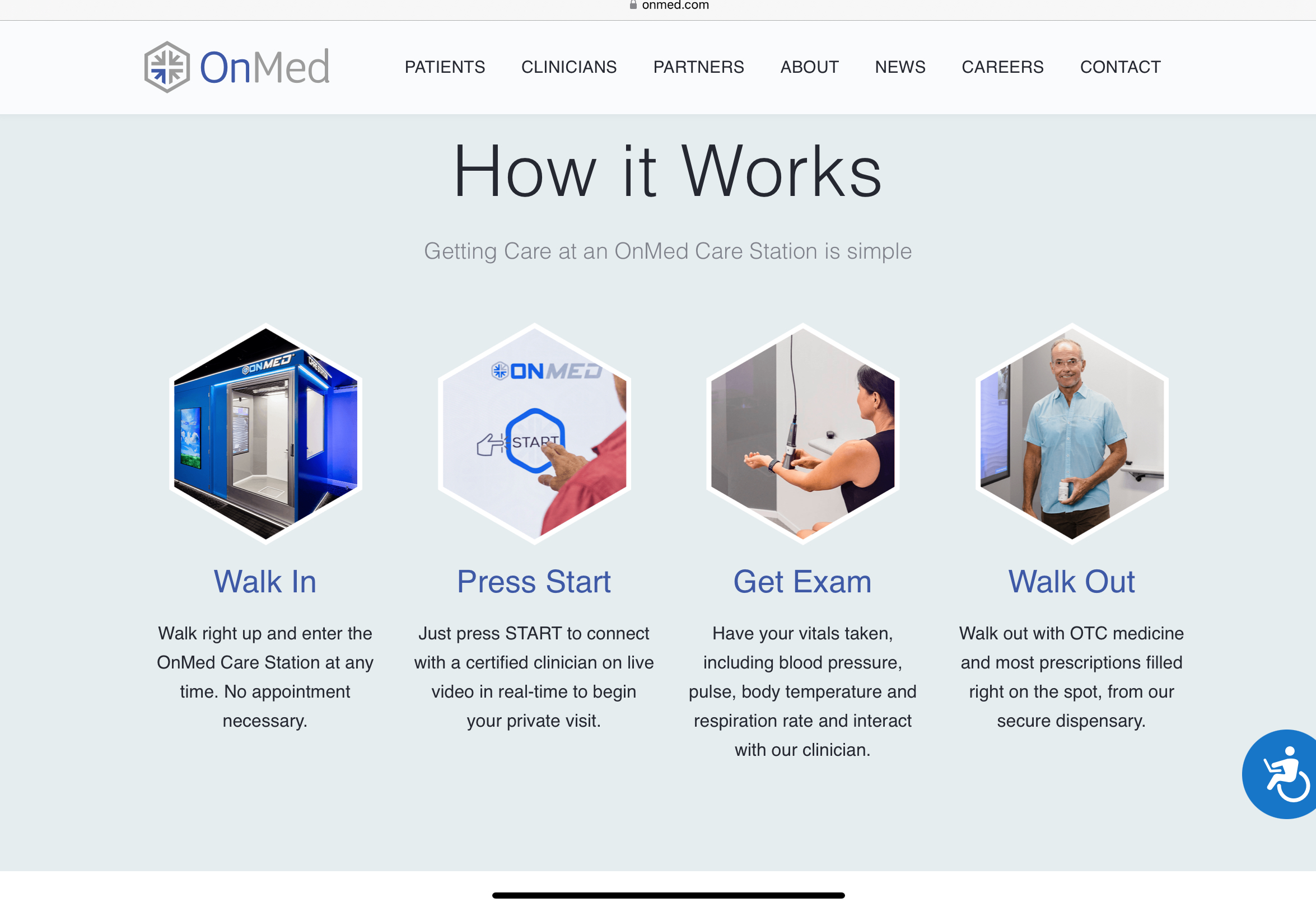
A couple of days ago I saw an advertisement for a local healthcare conglomerate. They have been quite active buying up small hospitals and physician’s practices lately and have in fact been sued by some. But this new enterprise amazed me. This “service” which you can explore further at their web site https://onmed.com/ promises an exciting new way to “see” the doctor.
After commiserating with the difficulty of seeing your own doctor, this option assures you that this will be just as good. I find that ironic since the same company urges you to always have a primary care doctor. And most insurance plans here insist on the same. But apparently even your doctor can be outsourced to this video/camera encounter.
As you can see from the promotion material, they omit the touch and smell that a real doctor uses when making a diagnosis. But perhaps they will find a way to add this to the robot camera that descends from the ceiling for a visit.
Now that it is summer here the street frequently fills with the tune “Turkey In the Straw” coming from an ice cream truck trolling the neighborhood looking for kids with money in their pockets and time on their hands. Although I get tired of the jingle which keeps playing in my head long after the truck has turned the corner, it does take me back to 1958.
That summer my mother, siblings and I went to New York State to visit all the “East Coast” relatives. At my cousins’ house I was introduced to the marvel of the Good Humor man. In Oregon we lived in a neighborhood without any commercial development, and the only food on a truck was from Jasper the greengrocer. I was astonished at the chance to buy ice cream outside my cousins’ house. I settled on a Toasted Almond Bar. Nothing had ever tasted so wonderful.
I never had the chance to buy from the Good Humor truck again. As an adult I discovered Good Humor bars in the ice cream section of the grocery store. I tried a Toasted Almond. Apparently most of the thrill came from buying one aged at 11 in New York. The packaged one left me cold. (pun intended.)
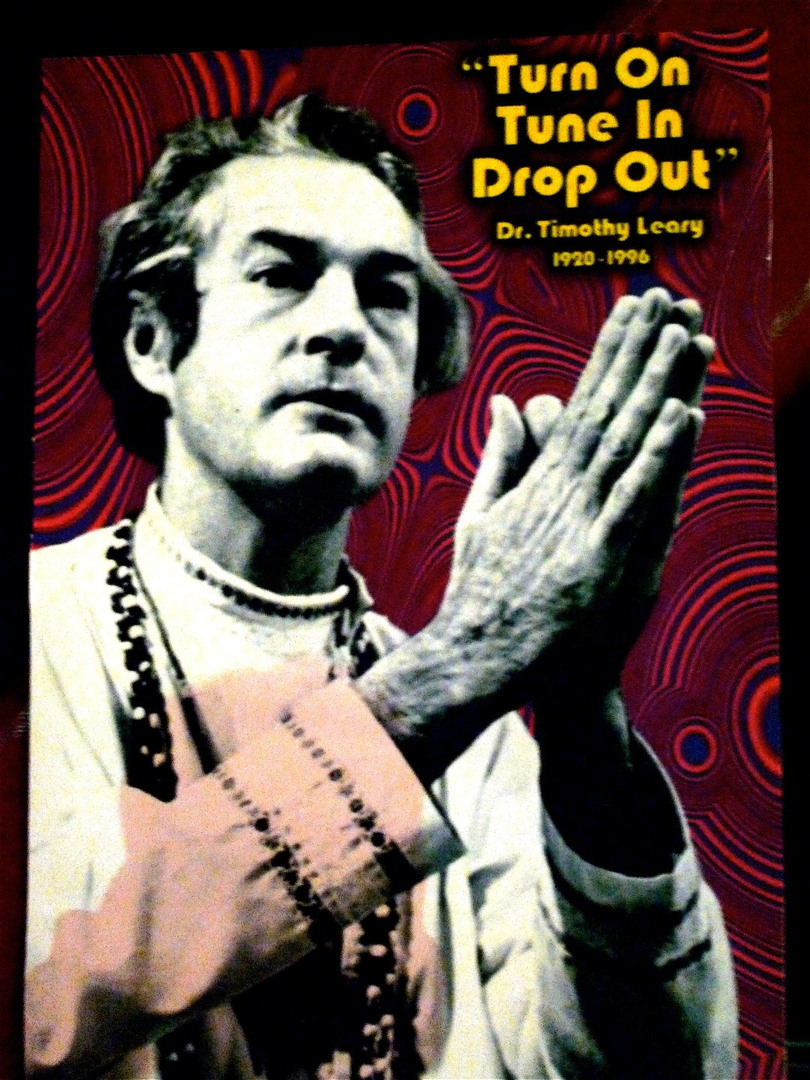
Two years before I arrived in Cambridge, Massachusetts in 1965 Timothy Leary on Harvard’s faculty had been fired after his experimental research on LSD(psilocybin) may have involved students without their awareness. For years after, debate raged about the use of “acid,” with many young people “dropping it” and many lawmakers concerned about its use. Eventually it became illegal.
Recently LSD is back in the news, touted as a tool for the treatment of many kinds of mental illness. Rather than being seen, as it was in the 1960’s, as a cause of mental breakdown, some say it may help. At any rate, laws have kept pace resulting in the legalization or decriminalization in many parts of the United States.
I notice with amusement that Cambridge has allowed it once again! Full disclosure: I have never used the stuff despite much encouragement from college friends. It has no more appeal to me now.
I first encountered the author Johann Hari when I read Stolen Focus about the effects of electronic devices on our attention span. His honest discussion of his own struggles along with research he did about the phenomenon allowed me to think through the issue. Here in Magic Pill Hari thoroughly explores the introduction of the drug Ozempic(and its near kin) now being used to lose weight. Injectable, the drug has a dramatic effect, not only reducing weight but helping with obesity related problems such as diabetes.
Having lived through a myriad of “instant cures” for weight loss beginning with Metracal in 1966, I was intrigued by this new approach. In addition I was curious about the surge in obesity in the last 40 years. What has been going on and why was a new and very expensive drug needed to “cure” it?
I have no interest in using the drug, but I am fascinated by its current popularity. Hari does an excellent job of addressing many of my concerns. Why is there more obesity? How does Ozempic work? What are its long term consequences?
The book captivated me and I think it will engage many others, whether users, prospective users or “not in this life” readers. And my personal bias after reading the book? I think big business has come up with an expensive solution to a problem that big business–the processed food industry–created. Hari remains fairly neutral. Let me know if you have thoughts on the matter.
Reading my genealogical magazine, I learned of a search site called “Perplexity.” Unlike search engines such as Google, it uses AI in a creative way. You type a question and it searches a variety of sources to produce an answer. You can then ask additional questions to elaborate on what you have found in the first response. Each answer shows the sources used, all reliable ones.
I tried it out with my research for the book on Great Aunt Lucy. Knowing that she was a landscape painter in Chicago in the 1870’s I began to search for more detail. After asking a general question “who was Lucy Durham a landscape painter in Chicago in the 1870’s” I was given citations in two catalogs listing her water colors. Knowing nothing about water colors, I began asking a series of questions such as “when did watercolor painting become recognized as fine art in the United States?” After learning that she was part of a new wave in painting, I naturally wanted to know all about the paints themselves in the 1870’s. Perplexity let me know the colors available to her at that time which gave me an idea of what her works might have looked like. No illustrations exist on line or off that show her actual work.
At a family dinner we used Perplexity to entertain ourselves last week with a series of macabre queries, courtesy of my teen grandson, about still at large serial killers. (Beetley Pete would be impressed.) I curtailed the research when I was worn out from all the banter.
Free to use, Perplexity also offers a “pro” version allowing many more “pro” searches than the free one. I tried out the free one first, and then spent for one month of the enhanced one to see if it was worth it. So far it has been.
I hope that it is available world wide. It is the first use of AI that I can fully embrace. No more scrolling through hundreds of useless search engine results to find very specific answers. I hope it gives Google a run for its money. We’ll see.
(I am no influencer! I receive no kickbacks for recommending things or books.)
We live amidst a variety of neighboring trees which house four different varieties of woodpeckers. Three feed regularly at our stations and Charlie sees the reclusive pileated on his walks. One of my morning delights is hearing one of them thrumming on the neighbor’s beech early in the day. I have never been able to spot the “carpenter,” though. That dull pounding in the video comes from his incessant efforts to create a nest (or eat more bugs!)
My own activity on line has been neither seen nor heard! I have been committing myself full force to writing about my great-great Aunt Lucy, last mentioned briefly nearly two years ago. I took a writing seminar at that time and it discouraged me enough to set the project down. I regret that pause and recognize now that the teacher was eager to show she knew more about writing than I did. I was in a competition I had no interest in, but it did set me back.
Now I am back researching all about her life from her artist days in Chicago to her rescuing slave girls in San Francisco to her riding junks up rivers out of Canton sharing the love of God with women and children. She never married, so her story will go untold unless I share it. I am having a blast. I still am looking for a way to work on it and keep up semi-regular posts. I love both, and I need to find a spot between “all or nothing!” I must say I so often find myself in “all or nothing” in general that I look forward to a new path.
Hope you are all well and hoping to begin to catch up a little.




 Saved By Words