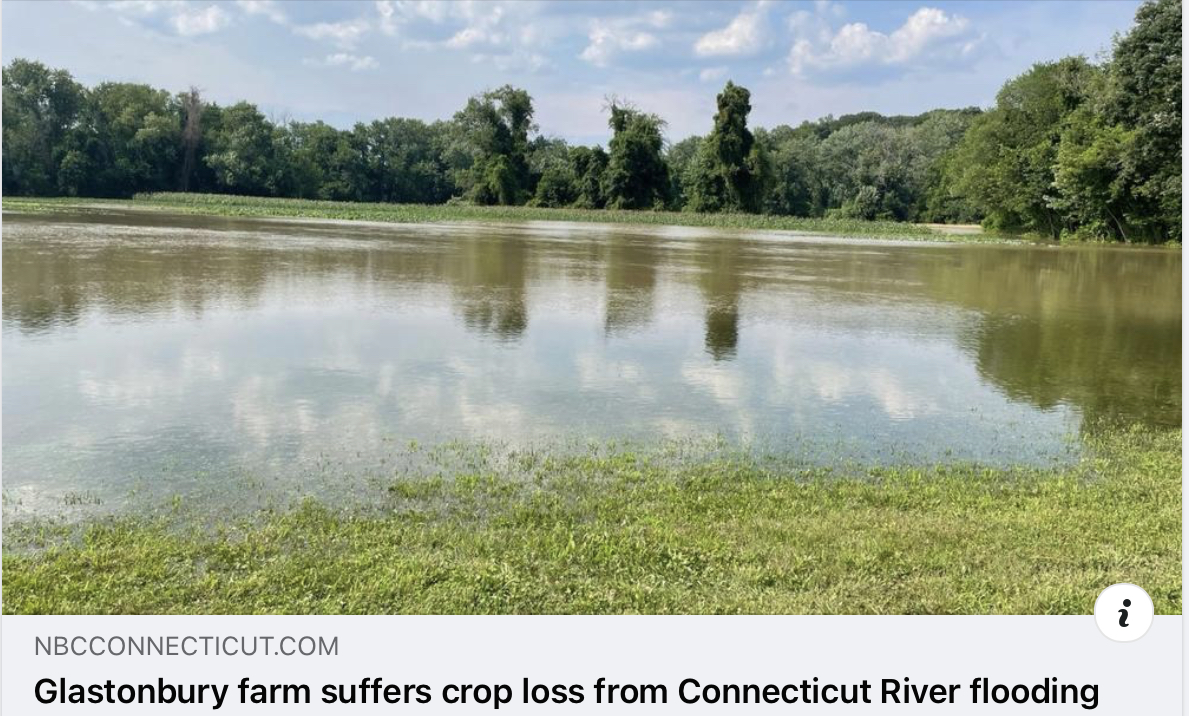
The Connecticut River, a few blocks from our home, drains a large section of New England on its way to the Long Island Sound. While our towns didn’t get the flooding of Vermont, our river is overflowing it banks. Here it fills our local park.

The Connecticut River, a few blocks from our home, drains a large section of New England on its way to the Long Island Sound. While our towns didn’t get the flooding of Vermont, our river is overflowing it banks. Here it fills our local park.

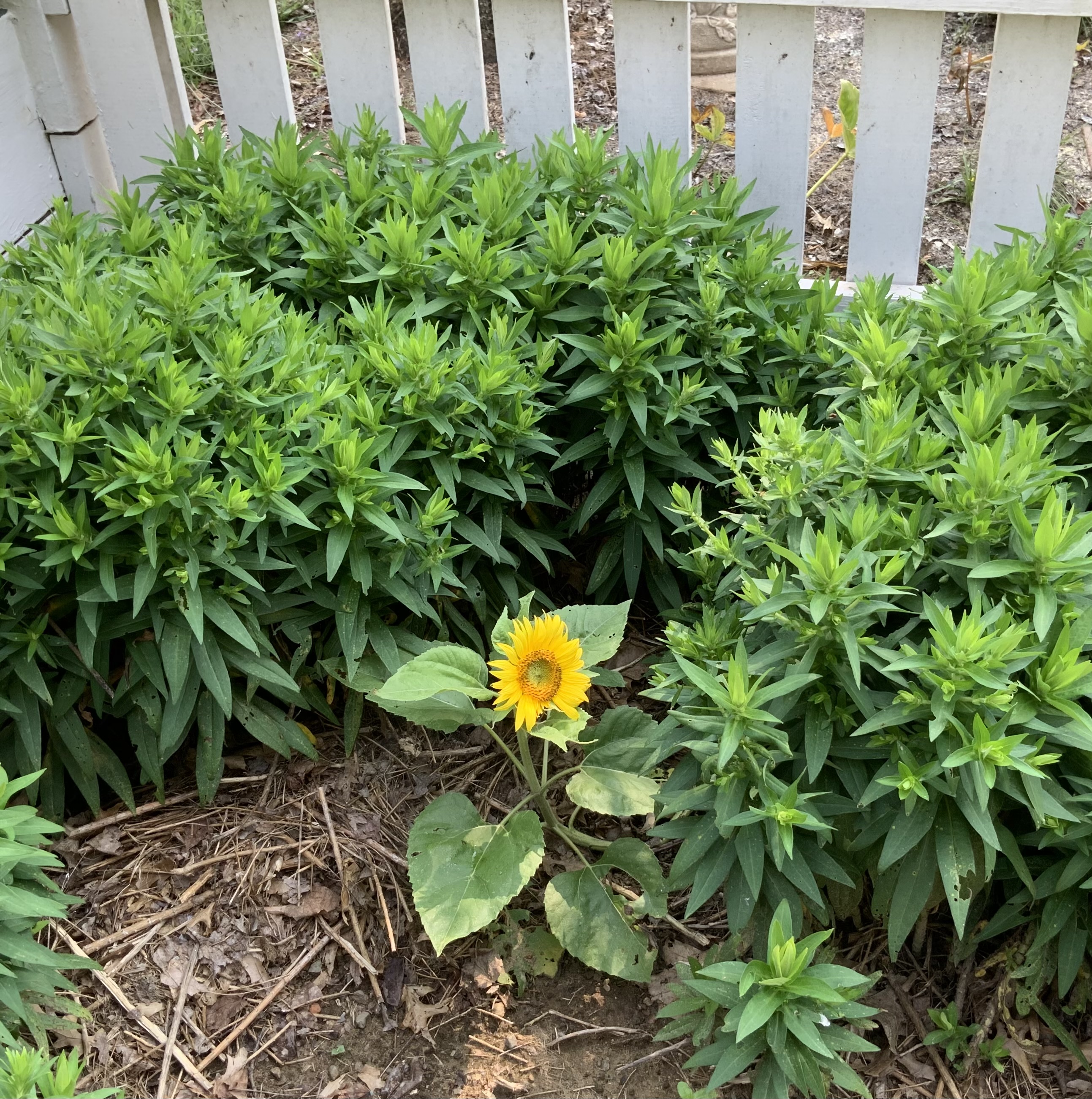
Nestled among the fall blooming asters I spied a 6 inch tall volunteer sunflower. Eventually I discovered that it was actually blooming at the end of a sturdy stalk lying woven between the asters. But first I was delighted at the idea that somehow a very short sunflower decided to show up before the later mammoth ones now sprouting.
Height challenged appears to be the new way to say “short.” While I reached the average American female height of 5’4″, it took me a long time–until I was seventeen–to get there. For many years I was distinctly short. It proved to my benefit in elementary school since we were assigned seats according to height and I always ended up in the front rows. This obscured my need for glasses which wasn’t discovered until eighth grade. I was astonished to learn at that point that the stars hadn’t disappeared from the night sky, I just hadn’t been able to spot them!
I was particularly challenged by needing clothing for teenagers but still fitting girls’ outfits. Fortunately I was not alone among the baby boomers, and manufacturers came out with “junior petite” sizing. Petite seemed to be a polite way to say “short.”
Before I end up going on a rant about the ways I am now supposed to describe heretofore normal observations such as fat, short, pudgy, scrawny, and skinny I best quit while I am somewhat ahead. Still I wonder what was gained by dictating a change in our vocabularies. I was still short (and a little skinny!)

Our store of frozen blueberries finally gone, Charlie strung even tougher mesh around his large blueberry patch hoping to keep the hungry birds out. Somehow we have never managed to steer them away from the garden to the luscious bird feeders hung just for them. The outer barrier has held so far, and only one robin and one starling have found their way into the crop.
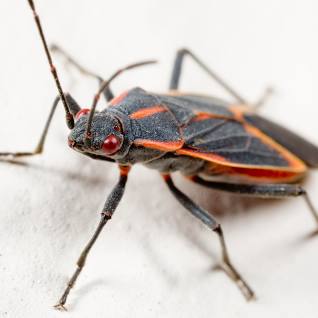
However when he went out to pick berries he found several bushes looking poorly, including one that looked as if it had been sucked dry. Looking more closely, he found hundreds of the above pictured critters. Thanks to his camera phone and Google, he quickly identified the culprit as a box elder bug.
We avoid all pesticides in our yard to keep our dogs and birds safe, so we were quite concerned to be confronted with our first infestation by a new predator.(I have been wanting to use “infestation” for a long time in a post. Not sure what that says about me!) To Charlie’s delight, a simple mixture of water and dish soap sprayed on the bugs kills them quickly. Off he went, a warrior on the advance. He returned triumphant having begun to decimate the hoard. (Another great heretofore unused verb!)
Now we just need to remember to rinse the soap off before we freeze the new bounty.

I somehow missed the memo that grandchildren grow up even faster than children! Life is teaching me anyway. My grandchildren are now teenagers, and only my stored photos and clear memories remind me of their births and early childhood. Fortunate to live very near these kids, I nonetheless am startled by how tall they have become. How did that happen? I can understand the response of my own grandparents to our changes since we only saw them every few years. (And of course there was no Facetime!) Somehow, though, I thought proximity would allow fewer jolts.
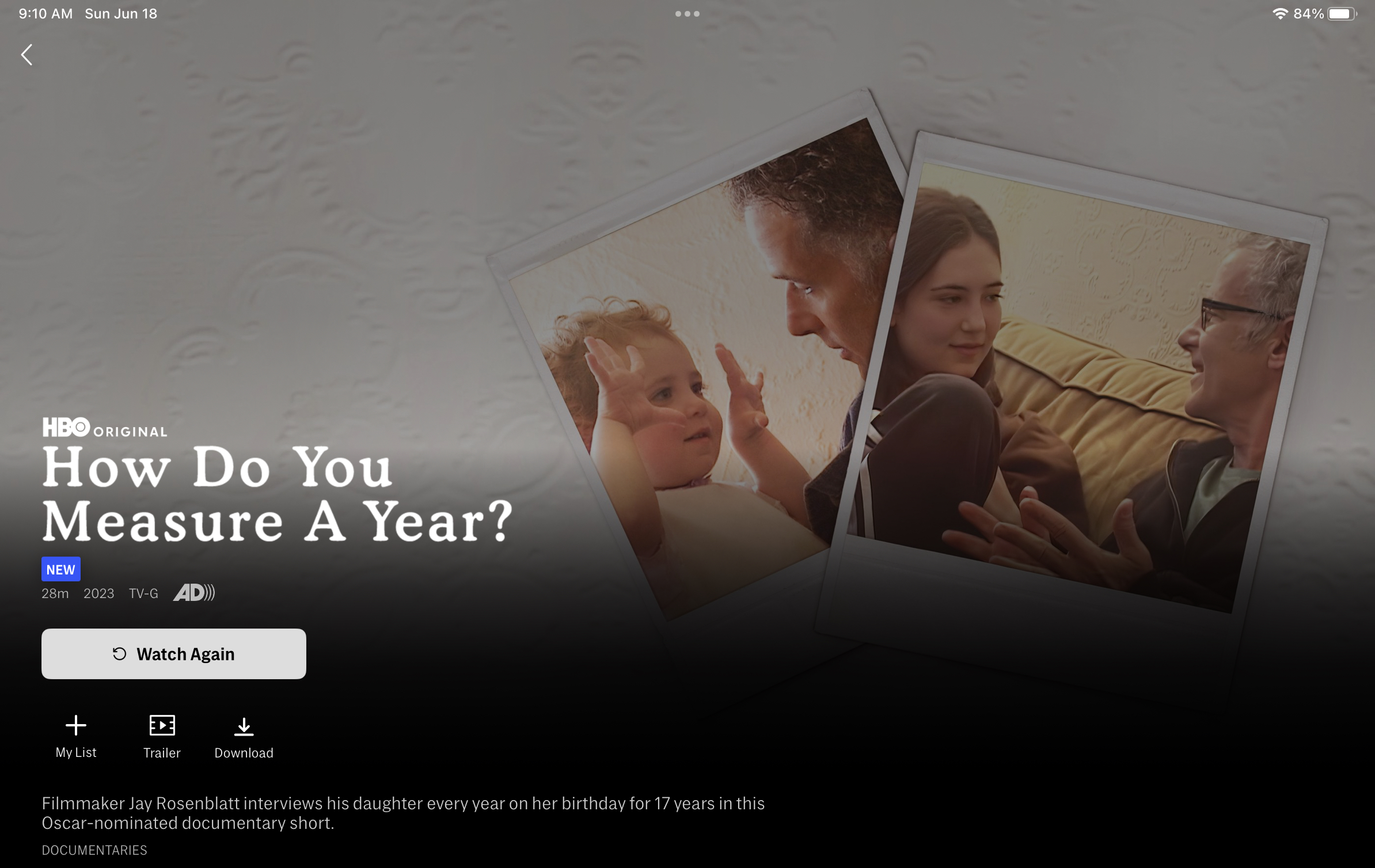
A New York filmmaker, Jay Rosenblatt, assigned himself a task of video interviewing his daughter each birthday from two to eighteen. He chose to wait until the series was done to view and edit the material. He has released it in a 28 minute film How Do You Measure A Year? I don’t know if it is distributed worldwide. I viewed it on HBO a paid platform. Trailers are available on line for free if you want a glimpse of the project.
Watching his lovely daughter grow, abandon her curls and her ebullience for long hair and a contemplative mien illustrated my own experiences in parenting and grandparenting. I don’t have nostalgia for the early years; the challenges are too clear in my mind. But there is a bittersweet sense watching the film and reflecting on my own life. For a brief time being a grandparent allows us to enjoy infancy and early childhood without being parents. But it too speeds by, just as the first time seemed to.
This poignant film captures the progression with care and love mirroring my own experiences.

I just finished listening to Covenant of Water by Abraham Verghese. His previous novel, Cutting for Stone is one of my favorites, and I had looked forward to this new one. Set in southwest India, it, like The Great Reclamation, spans many years as it traces one extended family. At 31 hours, the book took many evenings to complete. This audiobook was read by the author, which made me cherish the language and the sounds of the places. I just bought the book itself to reread, now knowing how to pronounce all the words.
My blog title quote from e.e. cummings reads “somewhere I have never traveled, gladly beyond any experience.” I chose the phrase since it accurately describes the broadening of my reading since I began blogging. Knowing people around the world has made me curious about those places. Even though I have never been to Singapore or India, my readers either have been or live there. That makes the locations feel more personal to me, and I want to immerse myself in them through fiction.
The experience parallels my relationship with U.S. history. Throughout school I struggled to remember dates. Once I began doing family genealogy the dates became easy to connect to actual relatives. I even began to understand the meaning of other historic events as when I learned of my forebear fighting for Cromwell and being “awarded” an Irish estate. “Anglo-Irish,” a phrase I had learned when studying Yeats, now had a specific meaning for me.
I would love to know of other novels that will take me “gladly beyond my experience.” Please share.

While I am unclear where I first heard of the novel The Great Reclamation, I am glad to have read it this past week. Set in a small fishing village outside Singapore, the novel moves from the early twentieth century when it was occupied by Britain, through the Japanese occupation, to the fights over its future, to its final iteration as a self-ruled republic. Focusing on two characters the novel deftly contrasts various responses to “progress.”
Sometimes I am grateful for learning about a part of the world about which I knew next to nothing. Sadly my only knowledge of Singapore was that it outlawed chewing gum. Others may have a more solid underpinning when they approach the novel. While the writing itself is adequate, I didn’t find it as lyrical or well phrased as much fiction I read. But the book made up for that by introducing me to the “great reclamation.”
At a time when land all along our coastlines is disappearing into the ocean, in stark contrast the project undertaken in Singapore during the last century was to create land. Immense amounts of sand was used to fill in wetlands and create “solid” land for factories, housing, airports and businesses. I was and remain intrigued by the determination to create what wasn’t there to fulfill dreams of how it “should” be.
Of course the same focus has dominated much of the history of the United States. From damming of rivers, filling in wetlands, strip mining mountains, and building houses on beach cliffs, humans seem determined to try to transform nature into man made ideals. The novel helpfully allows us to consider the cost on both the environment and the people. Here we seem to keep calling floods and landslides “acts of God.” I think God is getting scapegoated!

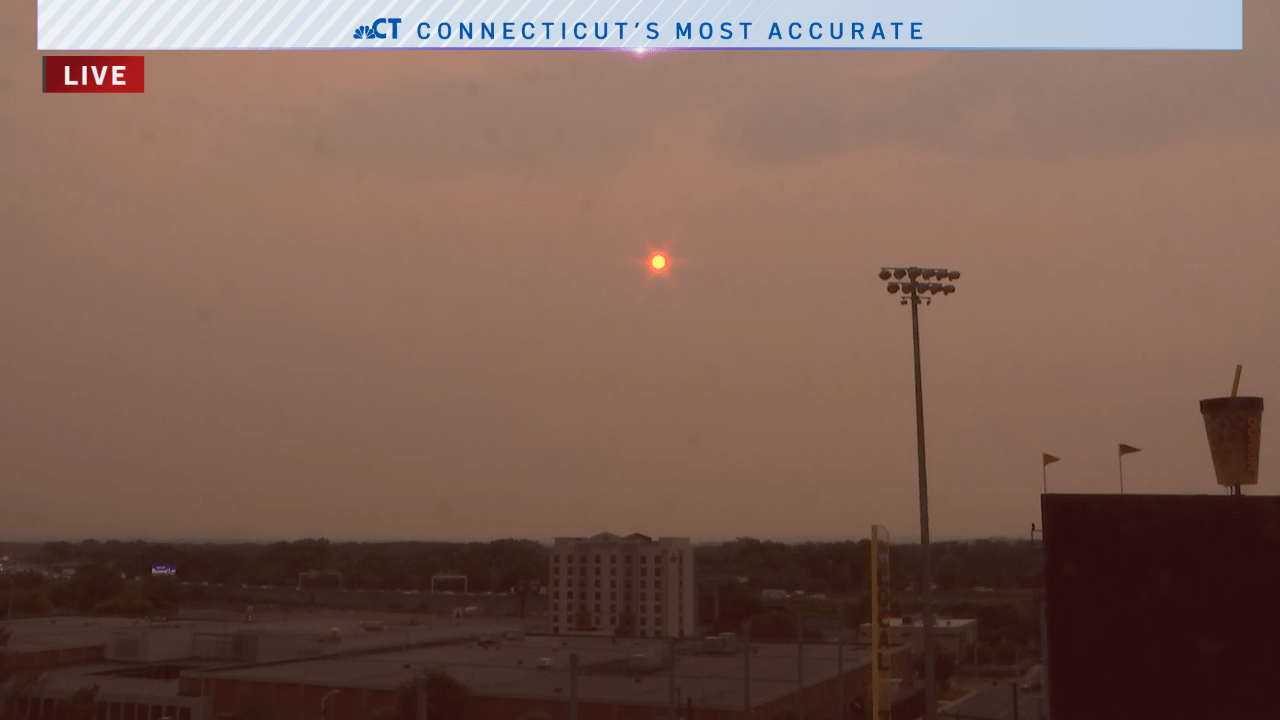
Forest fires broke out in Nova Scotia, Canada a week ago. The heavy smoke from them has covered the Northeast of the United States for the last few days. It is an atmosphere reminiscent of sitting too close to a camp fire. Unfortunately we don’t have the option of just moving back a few feet to find clean air.
While I don’t have preexisting lung issues, I am being affected in a less severe way. My eyes are watering, my nose is scratchy, my throat is raw and I have a mild headache. In fact before I realized that the smoke was doing it, I took a Covid test since the symptoms seemed the same. Thank goodness no Covid
Intense heat, drought, smoke, and fires all challenge any complacency we might long for. We are in the midst of change regardless of political pundits’ pontificating otherwise. The “new normal” challenges us all. May we stop arguing about it and find ways to work together to deal with reality.

In the United States today is Memorial Day. We set two days aside each year to remember the casualties, living and dead, of the wars Americans have fought. The other is November 11 originally Armistice Day but since 1954 Veteran’s Day. Both theoretically are somber occasions to be observed by the country as a whole, recognizing the sacrifices members of the military have made on our behalf. At our church service the Sunday closest to each observance ends with a prayer and a solemn playing of “Taps.” Yesterday I stood thinking about the effects of all those wars on the people around me in the pews.
But if not for that service I would be hard pressed to know why the day matters. Every headline announces “the start of summer,” “get out the barbecue,” “buy your pool for our special price,” and “be extra careful on the highways.” Apparently the day’s significance has been transformed into something else entirely.
I wonder if this has happened since we abolished the military draft. Growing up I knew many veterans of wars including the Spanish American, the first World War, the second World War and the Korean War. Boys my age assumed they would be drafted and sent into combat should there be another war. Then the conflict in Viet Nam pressed them into service.
There is no longer a national draft. Unless one chooses the military, it is possible to avoid any involvement in future conflicts. “Other” people can fight. Perhaps when those “other” people die a huge distance develops between us. In 2023 many fewer Americans risk their lives for our country. The idea seems foreign. Why think about war and its cost?
Most Americans seem ready to spend the day in leisure, not in remembrance. Maybe it’s time we retired the name “Memorial.”

The school bus stops at the corner near our house. Each morning and each afternoon cars line our street occupied by parents waiting to either drop their children off for the bus or pick them up from the bus. Only rarely does a child walk home from the bus stop. Even then he is often accompanied by an adult.
It is as if somehow parents have collectively decided that it isn’t safe for their children to walk the several blocks between the bus stop and their homes. This decision isn’t based in statistics but in some generalized fear of stranger abductions. I am not sure when this settled in among people. Most abuse of children takes place at home, not from some random stranger on the street. But the idea that children are easy prey outside seems to become a standard belief among both parents and, sadly, children.
I am saddened to think of this fear being added to all the others heaped on American school children. Perhaps, at least, parents might cooperate to let the kids walk home together. I could then again enjoy the banter and high jinks that such schoolchildren used to share as they walked by my house years ago.

I love this cartoon because it perfectly illustrates that we don’t know what we don’t know. All of us generalize from our own experiences and often don’t realize that we have assumed much without realizing it.
A couple of weeks ago I was waiting to see my doctor and I was asked if I minded that a male medical student was accompanying her. I had to laugh. Until I had a woman doctor in my late 50’s I had only ever seen a male doctor. When I read about a doctor I still generally imagine a man until proved otherwise. I grew up surrounded by only male doctors. I had never seen a woman doctor.
Today my generalization might be attacked as a moral failing on my part. Why didn’t I think a woman could be a doctor? But that question misses the point. It wasn’t that I didn’t think a woman could be a doctor. I just had never seen one and therefore didn’t imagine one. Like the fish in the cartoon I had nothing with which to compare my experience.
I wish that we could all acknowledge that our experiences limit our understanding of the world. Instead of attacking each other for failing to respect another point of view, I hope that we could take a deep breath. We might then be able to learn why someone’s experience produced a different understanding than ours. Then we might take the opportunity, as I did, to explain why I was surprised at the question about a male in the exam room. And the 25 year old nurse learned that for a 75 year old woman having a woman doctor was the novel experience.