Lake to Table

1948-50s 399

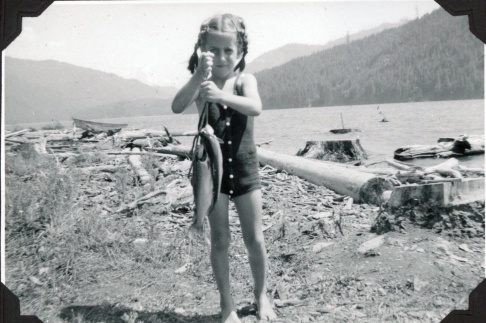
While I no longer fish, I still eat fish a couple of times a week. Here in my very itchy wool bathing suit, I show off the trout my father and I caught that day. I was very aware that there were rules about fishing. You never caught fish you didn’t intend to eat. You took the hook out carefully if the fish was too little and eased it back into the water, touching it as little as possible. You killed the fish quickly. You didn’t put the “guts” back into the lake. You ate it right away.

I try to buy fish that has been caught with the same care that I learned as a little girl. And I try to remember to always say my grandfather’s favorite grace, “For what we are about to receive may the Lord make us truly grateful.”

Farm to Table?

1948-50s 085

It has taken me a while to figure out what the big deal was about “farm to table.” Here I am surrounded by the vegetables in our back yard in 1949. I only knew two kinds of food: fresh and canned. I assumed that food came from the farm and landed on the table. The excess from the summer was home canned, stored in the basement and eaten during the rest of the year. I had heard of “hothouse” tomatoes, but we never ate them, since my mother thought they tasted like cardboard. So it was fresh tomatoes or canned ones.

Everything had its season, and the things we ate reflected that. I take some ironic delight in the “rediscovery” of food in season. It took me a long time to realize that there might be any other way to eat.


Dog Sitting

IMG_0353

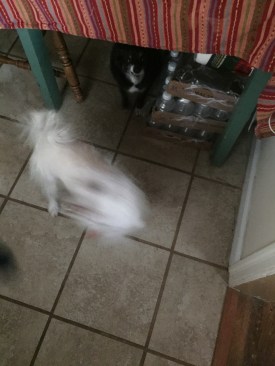
I often take care of the dogs for a neighbor when the neighbor is away for a couple of days. Ideally, I put a leash on the white dog and walk her while I let the black dog out to run around the back yard. Yes, that blur is the white dog. The black dog waits patiently under the table for me to let him out.

There are many ways to get daily exercise. This time it was from trying to catch up with the white dog!

Safe Classrooms

Classroom_1

I was struck today by two very different discussions of safe college classrooms. At the University of Chicago, the dean addressed a letter to incoming students letting them know that the university would neither be issuing trigger warnings nor barring controversial speakers from campus. The dean was reclaiming the university as a place for free exchange of ideas and viewpoints. He laid the responsibility of dealing with the effect of those exchanges onto students, not the college administration.

I taught college literature for 30 years, and we read many distressing and difficult works. I assumed that my students were adults and were responsible for handling the emotions that such works aroused. I never denied the impact of things we studied, but I also never shaped my syllabus to avoid challenging texts. Occasionally a student would be overcome with emotions, as was one veteran reading poems from World War I. In such cases, I always let my students know they could take a break and quietly leave class for a while. Much literature is meant to unsettle the settled, stir the complacent and challenge the contented.

Meanwhile, students in the University of Texas are asked to accept the presence of armed fellow students in class. The same young people who need to be protected from the “triggers” of the violence in Macbeth are supposed to be calm in the face of actual potential violence from the student across the aisle.

My sympathy goes out to colleagues having to navigate the insanity of these contradictory ideas of safe classrooms.

Shifting Earth

earthquake
San Francisco Earthquake 1906

The earth beneath our feet is often shifting, sometimes, as today in Italy, with terrible results. Buildings that have stood for hundreds of years can crumble in a minute. When I lived in Oregon, I experienced three quakes that I remember, none catastrophic. Still, I can believe the forecast that the Cascadia fault may produce one that would be.

Earthquakes challenge our basic premise that we can count on the ground beneath our feet. They can force us to wonder what can we truly rely on. At least, that has been the effect they have had on me.

Humble and Kind

F3LWYJ7GM7.com.apple.mobilegarageband_80x80_iOS

I am not usually a country music fan, but I heard a Tim McGraw song on the car radio this afternoon that gave me pause. It seemed to be an advice song to a young person setting out from home, and the often repeated line was to be “humble and kind.” It isĀ  an echo of the line from the Old Testament prophet Micah: “and what does the LORD require of you but to do justice, to love kindness, and to walk humbly with your God?

Sometimes discussions of values, ethics and character development make the subjects seem unnecessarily complicated. There are lists of desirable personal traits all over the elementary school where I go to vote. How much clearer we could be if we just emphasized the simplicity of “be humble and kind.”

In The Good Old Summertime

image

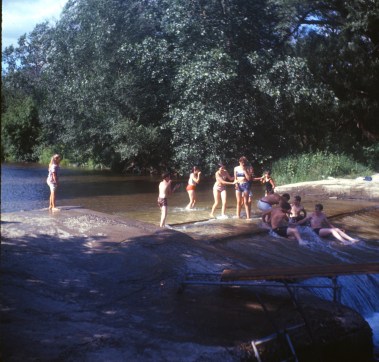
My grandparents had a farm house in western New York State where we visited several different summers. The highlight when I was 11 was swimming in Wiscoy Creek which ran over a little old dam. We had no adult supervision and the town kids swam, splashed, pushed each other over the dam and held each other under water. Some older kids convinced me that a snapping turtle lurked in the deepest water.

Many years later, I took my husband to see this stellar swimming spot. The water fell peacefully over a several inch high dam and my husband said I must have been idealizing the past. Fortunately, this photo arrived a few months ago in a collection sent by my brother. Clearly in the intervening 50 years, silt had filled in the swimming hole, but my recollection was accurate.

As for the snapping turtle..Men fishing in the creek told me that there had never been such a turtle there. The men looked to be my age. Perhaps they were once the boys who had told me about the dangerous turtle!


Pete’s Dragon

index

One of the many delights of having grandchildren is the excuse to go see “kid’s” movies. This afternoon we bought the family four pack of tickets, two huge waters and a tub of popcorn and watched Pete’s Dragon. Not in 3-D. Some things are too challenging with trifocals!

Robert Redford, who seems to have aged more than I have since Butch Cassidy and the Sundance Kid, plays a curmudgeonly grandfather. Maybe that is redundant. Most grandfathers I know are curmudgeons. I think it comes with the territory of trying to keep up with little boys.

The movie was satisfying on many levels, entertaining two kids and two adults for an hour and a half. I even cried a little, to the surprise of the kids. They seemed very assured–correctly–that the movie would have a happy ending. I think I may stick with their choices from now on. I have had enough of “adult” movies of despair such as the much touted 45 Years. Give me a happy ending from here on!

One is the Loneliest Number

IMG_0234

In the last few days I have pumped my own gas, self rung my own store purchase, used an automated system to refill my prescription, and entered numbers to tell the New York Times that the paper was incomplete. I have listened to a phone call from a woman in India who told me that my Windows software was in danger, but she didn’t want to listen to me tell her I used IOS only. So that wasn’t an interaction either.

For some reason, it is now assumed that we value speed over interaction, solitude over engagement. This can make for a pretty lonely daily routine. I have tried to counter this trend by consciously deciding to go against it. I use a human teller when my bank is open. I go through the staffed checkout lane at the store when I can. But it has led me to wonder what we are gaining in this new self-help world and what we are losing.

Accompanied by Song

music_lesson

I have loved listening to singers as long as I can remember. As a young child I loved Burl Ives, and I played Little Golden Records over and over on my little phonograph. I got my first hi-fi in high school and listened to Joan Baez for hours at a time. In college I got my first stereo, a portable with two detachable speakers, and immersed myself in the folk artists then playing regularly in Cambridge.

Today I am nourished by the lyrics of what are now called singer-songwriters. Of particular solace lately is Carrie Newcomer whose music I bumped into a few years back. A Quaker, Carrie explores daily life and its deep questions. She is an antidote to cynicism and despair. You can find her at www.carrienewcomer.com.