Car Talk

1948 PACKARD Brochure posted tocmp 06

I have had a life long love of cars, though you might not guess it from the minivan I now drive, but that’s a later story. I thought I would be begin to give you an autobiography through cars. I hope it gets my readers to think about all the cars in their lives. Please feel free to share your car thoughts in the comment section.

My mother didn’t know how to drive for many years. In the late 40’s they lived in New York City where a car was unnecessary. Later, they bought a car, but my father drove it to and from work. Fortunately, in the early 50’s everything could be delivered. The milk came to the door. The druggist drove prescriptions to the house. The neighbor would give a ride to my mother to the grocery store. We could take the bus downtown to shop, and the stores would all deliver our purchases.

But in 1956, now that there were four children and we lived in a more isolated neighborhood, my mother learned to drive and they purchased the amazing 1948 Packard. We called it the Brown Bomb. The best feature was the back seat, accurately pictured in the sales brochure from 1948. It was as large and comfortable as a sofa, and the front seat was equally plush.(The gear shift was by the steering wheel, so it took up no room.) After one of us won the “front seat, front seat” contest, the rest of us settled into the back with “I call a window, I call a window.” Supposedly the worst seat was in the middle, but it did provide a great opportunity to pinch or poke the sibling on either side.

The car was a perfect place to hide out, and when there was a heavy rainstorm, my brother and I liked to lie out on the two seats and listen to the thump of the rain, luxuriously ensconced on the “sofas.”   We could escape chores and demands from our younger sisters and tell each other knock-knock jokes until it was time for dinner.

When they say, “they don’t build cars like they used to,” I remember the Packard.
A Star in the Making

marc-singer

Our junior English class was so enamored with the way Mr. Sanders taught that we petitioned the principal  (“remember the principal is your pal” spelling hint) if he could teach us Shakespeare as seniors. There had never been a Shakespeare class, and there was no text at the high school. Still, Mr. Schneider said, if we could fill a class, he would order texts and run the class for us. I remain thankful that he was flexible enough to help out a class of talented and eager students.

We read our way through almost of all his plays that year. Often Mr. Sanders would have us read dialogue aloud, taking turns with various characters. It became clear, early on, that only one student–Marc–was really born to the task. He would read with enthusiasm and gusto, waving his arms around and convincing us of each character he chose. The rest of us were either in awe or convulsed with laughter over his renditions of such characters as Falstaff. A lot of Shakespeare’s comedy is bawdy, but allowable since it was classical literature. Our other classes’ coursework would have pleased Queen Victoria, but here we could enjoy “dirty” jokes.

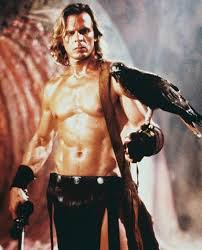
To no one surprise, Marc Singer went on to a very successful life as an actor. We had never seen him shirtless in high school, of course. But I was constantly treated to such images as the one above from Beastmaster in the years that followed. When ever I saw a picture or reference to him throughout the years, I smiled, remembering his “auditions” in front of a group of admiring high school seniors.

On a subliminal level, I must have tucked away this image as an inspiration for my own. Take another look at the image on my “about” page!

Done In By Wallace Stevens

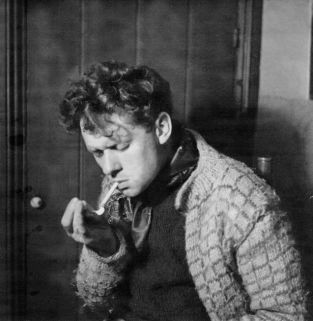
wallace-stevens

I guess I was feeling pretty confident, more or less, after my however tentative understanding of Dylan Thomas. I actually fell in quasi-love with him for a while and listened to the Caedmon recording of him reading A Child’s Christmas in Wales. The first ever paperback book store–Brian Thomas books-had opened across the street from the Central Library, and I found a copy of the Christmas tale and took it home

(As a side note, paperback books were a true rarity in my high school days. Hard cover books were relatively expensive, so the library was my main source for reading. The sudden availability of paperback books, selling for between .95 and 1.95 was intoxicating.)

However, the next poem Mr. Sanders handed us was Peter Quince at the Clavier.
Too lengthy to post here, the link will send you to the full text. Here, I was an unfortunate victim of formalist criticism. The poem centers around a text from the Bible about Susanna being spied on in her private garden by elders of the synagogue. I had no knowledge of the Bible, so the allusion was lost on me. There were numerous other references too. Context, history, allusions, and author biography were superfluous to a true formalist reading, as I understood Mr Sanders’ assignment. But the poem totally flummoxed me.

When I later became an English professor, I tried to walk a line between telling my students what something meant and leaving them completely adrift if I thought some background might help their reading. Sometimes sitting with a hard poem and no clues is just frustrating.

Let It Snow?

e_00009a

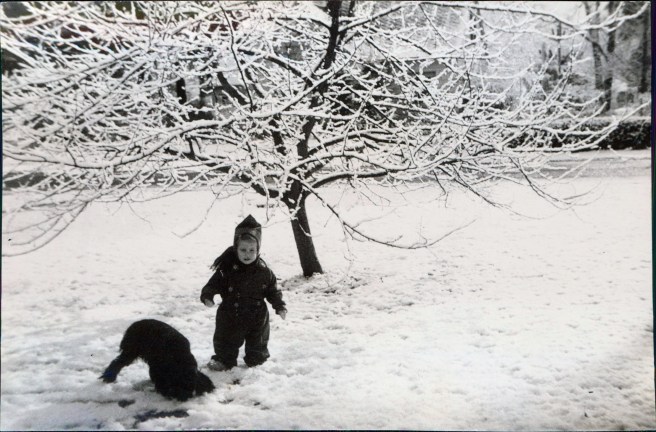
Photo of  snow storm in  New York 1948.

Well we have been bemoaning the lack of snow in New England this winter. We have had a couple of minor storms, with a few inches of snow, but nothing to remind us we live in New England. Today, we got our comeuppance with 16 inches falling at our house, and similar amounts around the state.

My husband, a “non-essential employee,” had the day off and was chomping at the bit for the snow to stop so he could go outside with his top of the line Sears snow blower. This is our third snow blower in 16 years, and we finally went for the one with bells and whistles, including a head light. Not that I have ever used any one of them! I am a firm believer in a division of responsibility at home. He gets the outside and I get the inside. So I baked bread and made his favorite Almond Granola to fortify him in the seriously cold task of moving snow.

I am in my warm house comforted by two distinct sounds. The town plow goes by about every hour with a satisfying rumble. And I hear the drone of the snow blower as my husband takes care of our home and the ones on either side of us. Thanks guys!

Beyond Rhyming Part 2

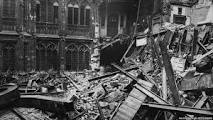
blitz

We left me sitting in the Portland Central Library, book opened to the Dylan Thomas poem, totally stumped. Where was the teacher to explain what it meant? Where were the rhymes? What were all these strange references to Zion and sackcloth? I didn’t know how to begin.

I grabbed a dictionary, hoping that it would help. It didn’t. Mr. Sanders had said we had the capability of understanding what we would read among the poems available. I wasn’t so sure, but I was, if nothing else, diligent. I would sit there until I made some sense of this strange writing. I read it over and over. Finally I was able to figure out the sentence structure of the writing. Before I had been guided by line length and rhyme, but those weren’t helping here. I determined that the title was a clue: he wasn’t going to mourn the death of the child. But why not? And as I read on, I gathered that he wasn’t going to mourn for a very, very long time. I.E. probably never. Whew!

Still, why wasn’t he? Didn’t he care? Didn’t he believe John Donne’s famous thought that any death diminishes us all? Apparently not, as far as I could tell. The poem now actually had me upset. That was something new, since in my experience poems were to be memorized, not felt! And my distress actually answered my question. Basically, as far as I could tell that afternoon, he was telling me that after the first human died, death was a fact of life. And that got to me, more than a romantic elegiac ode to the one particular child would have done. I thought of the human predicament, and of my own mortality, and I was silent.

Beyond Rhyming Part 1

img_0052

Mr. Sanders, our junior high school English teacher, had a very unconventional method of teaching poetry. Years later, in my graduate school course on literary criticism, I learned it was formalist criticism. At the time, it was the most radical approach to reading poetry we had encountered. Up to that point, we were taught about the poet, the date of the poem, its rhyme scheme, and what it meant.

Mr. Sanders, to our utter dismay, asked us to pick a poem out of our text book and explicate it, without giving us any further information or any hint as to its meaning. I can perfectly remember, 54 year laters, sitting in the library staring at Dylan Thomas’ poem A Refusal to Mourn the Death by Fire of a Child in London.

                                       Never until the mankind making

Bird beast and flower
Fathering and all humbling darkness
Tells with silence the last light breaking
And the still hour
Is come of the sea tumbling in harness

And I must enter again the round
Zion of the water bead
And the synagogue of the ear of corn
Shall I let pray the shadow of a sound
Or sow my salt seed
In the least valley of sackcloth to mourn

The majesty and burning of the child’s death.
I shall not murder
The mankind of her going with a grave truth
Nor blaspheme down the stations of the breath
With any further
Elegy of innocence and youth.

Deep with the first dead lies London’s daughter,
Robed in the long friends,
The grains beyond age, the dark veins of her mother,
Secret by the unmourning water
Of the riding Thames.
After the first death, there is no other.

A Reading Reprieve

img_0507

I entered my junior year high school English class with no expectations. I had survived two mind numbing years of English, and thought I knew what to expect. Instead, after we were all seated, our new teacher, Mr. Sanders, began pacing the room reading aloud from a novel. He gave us no introduction, not even the title of what he was reading. Were we supposed to take notes? Would there be a test? What was going on? We were polite and respectful, since it was 1963 and that was the norm, but we were puzzled.

We gradually realized that we knew nothing about reading literature, or else we were being reminded of what we used to know before high school had ruined it for us. He had joy in reading, delight in talking about reading, and encouragement for writing about what we were reading. Our first assignment on the novel was to pick one American book of social protest and analyze it in any way we saw fit. How to explain how shockingly radical this task was to those of us used to parroting the teacher’s point of view back?

I chose Richard Wright’s Notes of a Native Son. The book staggered me, introducing me to parts of life I had never seen. It was, for the times, a completely subversive text and also a perfectly timed reading for me, igniting a deep sense of the need for racial justice which has never left me.

On November 22, 1963, we were in Mr. Sanders’ English class when the P.A. system crackled and our principal announced that President Kennedy had been shot. Mr. Sanders began to cry and left the room. I had never seen a man cry, nor had a teacher ever left the room.  He came back in, turned off the overhead lights, and stood looking out the window. We were able to sit and feel the impact of the shooting and the comfort of a teacher who didn’t insist on “business as usual.”

Several hours later, the P.A. crackled again and we knew the President was dead. My teacher at that class went right on talking about the American history lesson. But I wasn’t fooled, I knew we were experiencing real history and that Mr. Sanders had modeled the appropriate response.

Alas: Required Reading

c4g-062

All through elementary school, after those disastrous first Dick and Jane episodes, I was able to choose what I read. Sometimes we had to try different categories, such as biography, history, folk tales and fiction, but we were able to choose titles within those categories. We then had to write book reports about each one we read. These were generally delivered in front of the class in such a way as to intrigue the other students without revealing too much of the plot. Most of the reports ended, “if you want to know what happens, you will have to read the book.” It got so we could chant it in unison.

But alas, in high school, I once again was forced to read the same book as everyone else in the class. Fortunately, I still spent my time in the library stacks, slowly reading my way around the alphabet. But the English classes had set curricula for each year: a novel, a Shakespeare play, some poetry, occasional short stories and not much else. As you can imagine, this meant we spent weeks on one book. We were assigned a chapter at a time. A dreadful way to read anything.

Of course, I was incapable of stopping after one chapter and always immediately read the whole book. The classic collision of me and the English teacher came in my senior year when the novel was Thomas Hardy’s The Mayor of Casterbridge. The teacher was agonizingly slowly leading the class in a discussion of the minutia of each chapter. Then she asked me some question. When I answered it, she said “You can’t know that yet!” I tried to stay silent after that, and she stopped asking me questions.