“Jumping for Joy”

pogostick

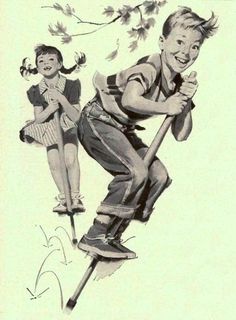
We didn’t own a pogo stick since we had a gravel driveway which didn’t have a good surface for using one. My good friend Penny, however, owned one and I used it at her house. This picture accurately portrays the outfit I would have been wearing to jump. However, there the similarity ends. This little girl and boy seem to defy gravity, making a deft series of hops, all the while staying upright and smiling. Me–not so much!

Even getting on a pogo stick required a certain grace. Somehow while keeping the pole upright, you had to put both feet on the little step which was about 12 inches off the ground. As soon as you were on the thing, you needed to begin hopping in order to stay on it. I spent most of my time trying to get on the stick and picking myself off the ground after I fell off the stick. Penny and I quickly found something else to do.
stilts

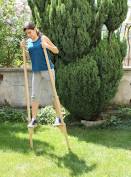
Fortunately, her father had built her a set of wooden stilts. While these required some of the same agility as the pogo stick, at least once you were on them you could step, not hop, across the yard. I enjoyed the stilts more than Penny. I was always one of the shortest girls in my class. For a short while, I could tower over my playmates!
“Flying High”

1948-50s 057

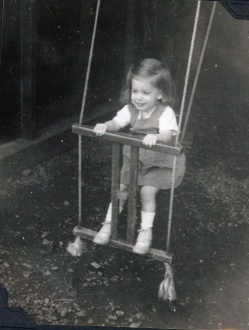
What kid doesn’t like a swing? Here I am at two on a wonderful contraption hung from a tree. By the time I was three I had an actual swing set with two metal swings. Later we acquired a set with two swings and a glider. The school had swings, parks had swings, friends had swings. When I was a kid the seats on swings were either wood or metal, but the seat was always flat. This allowed two wonderful and often parental discouraged activities. One was standing up on the swing seat. The other was getting high in the air and jumping off the seat.

Getting a swing going by oneself requires the skill of “pumping” one’s legs. It takes kids quite a while to master that. Until then every child continually yells “Push me. Push me.” As the oldest child, I often obliged by pushing my younger siblings until I was tired. The seats were hard edged and it was imperative for me to get out of the way before I was hit in the face by the swing. I remember many adults yelling at kids in the park to “Get away from the swings. You’re going to get hit.”

Sadly some safety conscious people decided to redesign swing seats. They replaced those platform seats with curved rubber.  The first time I encountered one I was angry. It was impossible to stand up on that rubber seat. Besides, they pinched the sides of my legs making it impossible to make the death defying leaps out of the swing.

My husband hung a tire swing from my grandchildren’s tree. The kids swing high and dangerously I suppose, standing and leaping to their hearts’ content. Thankfully no one has discovered how to take the fun out of a tire!

“Send Betsy Right Over”

redrover

A favorite game for us girls was “Red Rover.” In this game two lines of girls face off against each other forming chains by holding hands. One team chants “red rover, red rover, send _____right over.” The girl who is named then runs at full speed into the opposing line, trying to break through between two girls. If she is successful at breaking the chain, she can take one girl back with her to join her team. If she can’t get through, she has to join the opposing team. Theoretically it is played until only one player is left on one team. We never made it that far. In our case, it ended when  everyone was thoroughly sore from being run into.

I was one of the two smallest girls in my group. I was a poor candidate to be called to come “right over,” since I would rarely get through the line. I was also not an ideal member of the chain and probably suffered more arm collisions than most as stronger girls broke past me.

Teams were chosen by two team captains, usually the same two biggest girls. They would take turns choosing members. No matter the game, I was usually one of the last girls chosen. While contemporary theory suggests this is a dreadful thing to do to children, I accepted the logic of it. I was, after all, short and not very strong. I am grateful that no adult intervened in the hope of making things more “fair.” Kids gain resiliency in many ways, including recognizing reality about their abilities. I excelled in the classroom, so I figured it all balanced out.

“RECESS!!!”

The best word in grade school was “recess.”  We had two of them every day, morning and afternoon. Rain or shine(and in Portland, Oregon it was often rain)we poured out of the classroom to play. We had most of the equipment pictured above, including the line of hanging rings, the jungle gym and the merry-go-round. I had to laugh when I was collecting these pictures off the internet since they were all found under the title “dangerous playgrounds.”

I suppose the playgrounds were dangerous compared to those of today. One could easily fall off the jungle gym, though I never knew anyone who did. We all seemed to pace ourselves according to how secure we felt climbing high. The rings were cushioned underneath with sawdust which helped when I inevitably fell before making it all the way across. The merry-go-round was probably the most potentially lethal since as it went faster and faster it could possibly fling you off. However the girls I knew who went flying off did it on purpose. The most damage I suffered was severe nausea from the spinning.

No teacher came outside during recess to supervise us as they do today. We were expected to work out all our squabbles over whose turn it was to use which equipment. I think the girls tended to use the equipment more than the boys. I remember the boys doing more general running and falling to the ground in mock battles on the grassy field.

I imagine that the boys in my school days would all be labeled ADHD today. They all fidgeted, spat paper wads, poked girls and ran amok outside. Fortunately we just thought that was what boys were like. Thank goodness they had not only two recesses each day but also daily gym class. Educators when I was a kid knew no child could go more than two hours without jumping or running. So they let us do both.

“Olly Olly Oxen Free”

I have written in previous posts about growing up in the large house with a two acre yard pictured above. Both places were excellent for hide and go seek, a perennial game in my childhood. There were two versions of the game. The one we played at home had one child hide and everyone else look for that child. The one who found the hider won. If no one could find the missing sibling, we would yell out “olly olly oxen free” and the hiding one would win the game.

With my friends we tended to play the other version. In this case one of us would hide and we all had to seek. When anyone found the one hiding, she(this was always an all girl game)joined her in the hiding place. The game continued until only one seeker was left. That seeker, noticing she was alone, would realize she had lost and she would yell out “olly olly oxen free.”

I am mystified about how we learned this phrase. It, like jump rope rhymes, ghost stories and the sites of witch houses in the neighborhood seemed to float from kid to kid, apart from adults, in its own child world. Since I have readers from around the world, I am curious if any of you heard this phrase and have any idea of its origin.

“All By Myself”

9B06B19B-CCF4-427C-93E1-14C9AB8F8A3C.jpeg

One sentence never uttered by any of us children to our mother was “I’m bored.”I’m not sure if it was the 1950’s or my particular family, but we never thought our parents had any duty to amuse us. When we were bored, as we often were, we first turned to each other for playing outdoors or games indoors. Then we would figure out how to walk over to a friend’s house. (No parents drove any kid anywhere to play.) But if that failed and we were out of books to read and homework to complete, we had to resort to solitaire.

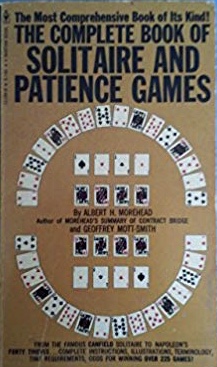
I actually was given a great book of solitaire games and worked my way through most of the book. Later I bought the volume shown above, adding more possibilities for rainy(most of the year in Portland)boring afternoons. I was intrigued by the alternate name for solitaire games–patience. While I guess this is the British name for this kind of card game, it also appropriately fit what I needed for some of the games. With the books and a deck of cards, I could always fill spare time.

Today many solitaire games are available as apps for computers. In fact my computer came equipped with one. They do speed things up by distributing the cards, reshuffling them and keeping score. Still when I play them I miss the feel of the cards and the immense satisfaction of winning a round at last.

What never occurred to me in my childhood was turning to television at boring times. We did own one which stayed in my parents’ bedroom. We gathered to watch it together for the Ed Sullivan Show and the Wonderful World of Disney. But I had spent the first part of my life without one and it was never part of my routine. And even today I rarely think of tv when I need to fill spare time.

“Haven’t a Clue”

ca493403-474f-4c63-9ed2-b107637df009

The game of Clue, unlike some of the other luck based games, required a certain amount of logical reasoning. The premise of the game centers on a murder committed by a murderer, using a weapon, in one room of the “mansion.” The possible murderers include Professor Plum, Colonel Mustard and Miss Scarlet. The weapon array includes a lead pipe, a wrench and a candlestick. The possible rooms where the murder took place include the library, the dining room, and my favorite, the conservatory(mostly because I never knew a house that had one.)

After a roll of the die, a player can enter a room and make a calculated guess to solve the murder. Each player has been given cards representing several rooms, several weapons and several characters. They can prove the guess wrong by revealing one of these cards. The game proved particularly challenging in my childhood because it required three players. I could always count on my brother, but we had to convince my sister Patsy to join us. She hesitated because being much younger she really didn’t understand how to play and would make random guesses regardless of them having been proven wrong earlier in the game. Hence she usually lost, reducing her interest in playing.

Since it was Jimmy and my favorite board game we tried various strategies to get Patsy to join us. We would insist that it was a REALLY FUN GAME. We encouraged her by saying “I bet this time you will win.” Heartless I know because we were 11 and 8 and she was only 5. But she always wanted to be included in our games, so she usually capitulated.

As I wrote this, I remember how much I miss her in my life.

C96402CD-6D09-4FEE-80CD-62F686E0DD23

Here’s to you again, kid.

“Not Sorry!”

CE382839-D8B1-4779-9BB2-D0C7C7B19094.jpeg

“Tell your brother you’re sorry.” “Tell your sister you’re sorry.” “Tell your friend you’re sorry.” “Apologize to your mother.” “Apologize to your father.” “Go to your room until you can apologize.” These sentences echoed throughout my childhood. Remorse for actual infractions was pretty slim in most cases. The four of us learned to say, as so many children do, “I’m sorry” whenever we were told to. It rarely correlated to our true feelings. So we would mumble “sorry” only to be told “say it like you mean it.” So we would try to approximate what it would sound like if we meant it.

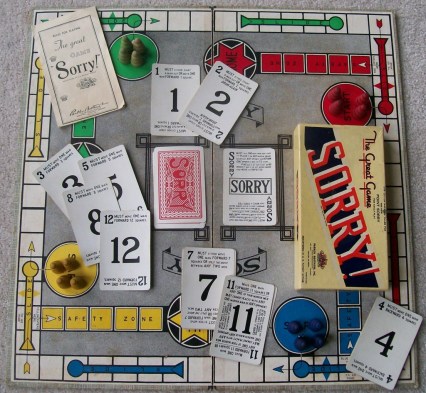
But thank goodness we had the board game “Sorry” to vent our true feelings on the matter. Because the game was pretty simple, only requiring the ability to count to 12 and to read or have a sibling read the print on the cards, any number from 2 to 4 of us played it. The goal was to move one’s four pieces around the board and into the “safety zone” on the way to “home.” Not too exciting except for the “sorry” card. Here was our chance for revenge. A “sorry” card allowed the holder to swap places with a piece of another player’s and send that player back to “start.” And of course to yell “SORRY.”

Finally we were able to utilize the depth of our sarcasm as we gleefully moved an opponent back to start. We were no more sorry than all those times we had said we were on demand. But this time we were merely following the rules of the game!

“Catching Cooties”

087B9AB2-DEF5-4E53-9B46-D53B224BF670.jpeg

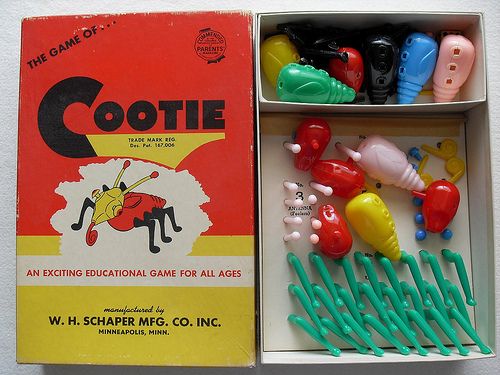
My siblings and I had much fun playing Cootie. This game was ideal for our age range, since it only involved rolling one die and assembling the cootie. Each body part corresponded to a number, such as 6 for the legs. The game could go on quite a while since each bug needed six legs. But there was no need to argue over rules, a common disturbance for the four of us!

Amusingly enough, we had no idea that cootie was a real word until a lice outbreak took over our elementary school. This outraged my suburban school community which identified lice with the unwashed poor. Grievously the cure at the time was to dust each of our heads with DDT. Yes, really. DDT on our little heads. Sure it killed the lice but who knows what other damage it wreaked.

That summer we spent with my very proper grandmother. Playing Scrabble I put down the word “nit.” Horrified, she asked me how I even knew that word. I told her about our lice outbreak. She stared in disbelief, then told me I should rearrange the letters to spell “tin” and let it go at that.

Now that bedbugs, lice and scabies proliferate everywhere perhaps the stigma has been reduced. But I still shudder remembering that head dusting.

“Little Ups and Downs”

IMG_0220

Long before pinball machines or video games, my first introduction to games was Chutes and Ladders, the game board picture above. It was a version of the game of Snakes and Ladders, toned down, I guess, for American children’s sensibilities. The game was simple; a roll of the dice advanced each player from square 1 on. If you landed on the base of a ladder you climbed it. If you landed on the top of a chute you went down it. The little illustrations showed meritorious behavior granting you a ladder and bad behavior punishing you with a chute. The goal was to reach the 100 square before your opponent.

I was the only child able to count, so at 3 my only opponent was my father. I had no idea that no skill was involved in this game. I remember feeling elated when I landed on a ladder and crushed when I landed on a chute. The game, supposedly fun, reinforced some suspicion of mine that life was somewhat random. I wouldn’t have phrased it that way, of course, but I still remember the mixture of excitement and dread whenever we sat down to play.

I was very relieved when my father brought home the next game, Uncle Wiggly. While this game was purely luck based also, it seemed less moralistic. I happily moved my piece forward and backward across the board, hoping to reach home before my father. Luck being luck we each won fairly regularly. I always chose Uncle Wiggly from then on.