
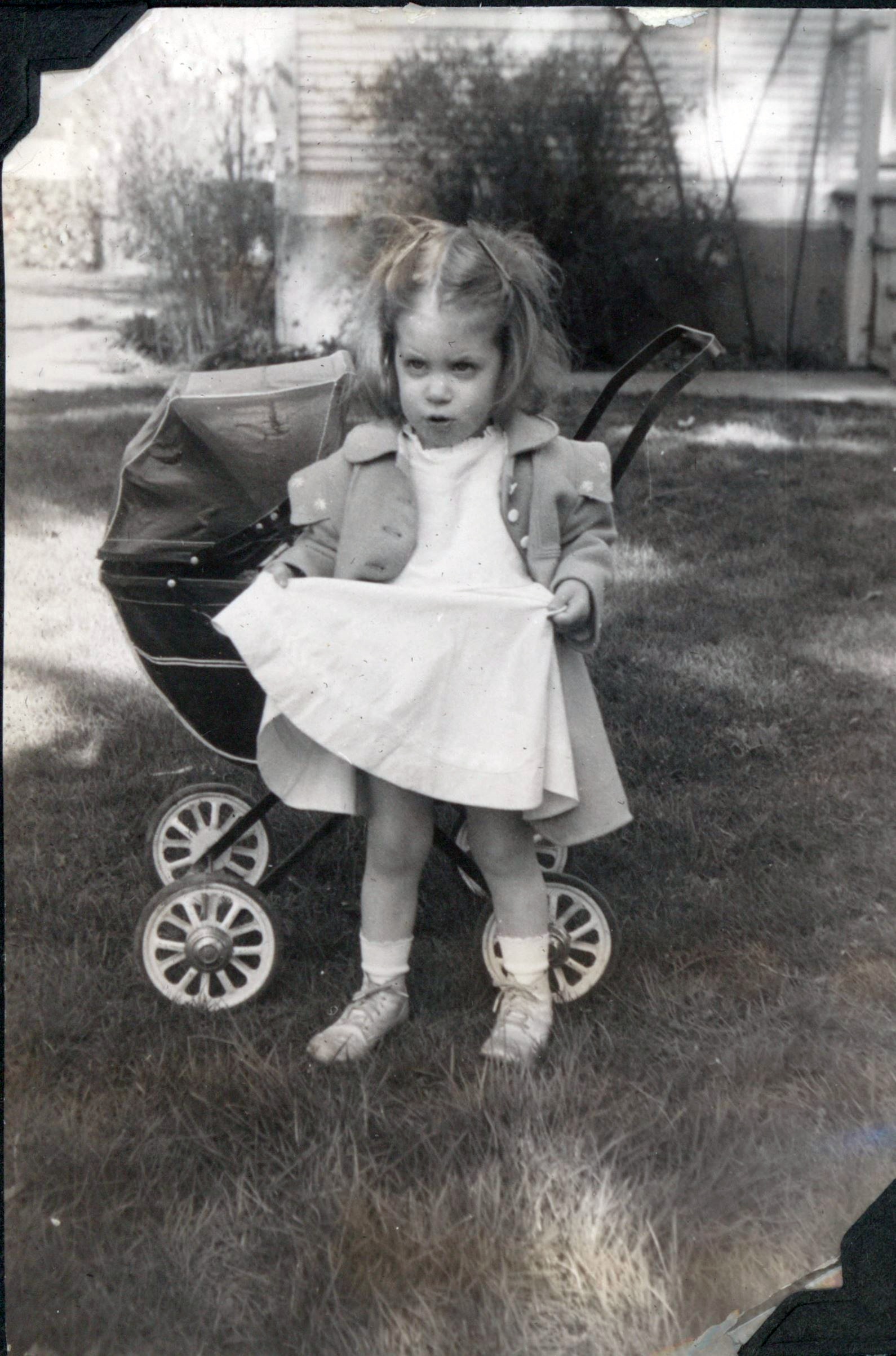
My mother always had a basket of clothes next to her chair waiting to be mended, hems let down, hems taken up, and buttons added. Each of us had hand-me-downs, either from our cousins or from each other. Most needed to adjusted a little for the second or third wearer. Clothes were expensive, but they lasted a long time through sequences of kids. I don’t remember anything unusual about the practice.
What struck me in the photo above was the depth of the hem at the dress bottom. Here was a hem ready to be “let out” to allow a child to grow. If the hem had been in place a long time, sometimes a white line showed that it had been lengthened. I am convinced that rick rack was invented just to camouflage that line!
Sometimes clothing had room to grow features. Snowsuits had sleeves that could be lengthened by snipping some threads, for instance. Sometimes my mother bought my brother jeans he could grow into. Many photos of him show the pants legs rolled up in anticipation.
I thought about this when reading about the mountains of used clothing piling in a Chilean desert. Somehow clothing has became disposable instead of reusable.

 Saved By Words
Much of that pile of clothes will, sadly, be plastic-based!
LikeLike
Wow. I never even thought of that. I wear cotton and wool as I always have and had no idea.
LikeLiked by 1 person
Yes, here in Australia we grew up with the same practice asyou did Elizabeth. And many of us have continued to buy our clothes from the preloved Fashion Boutiques (aka charity or recyling shops). In fact many of my friends, as well as my daughters & grandchildren love these & we always look ‘fashionable’, neat & tidy. In fact my youngest daughter actually works for one such Boutique.
I’ve always been all in for up cycling & recycling just about everything. The mountains of clothes above are just so wasteful.
Blessings, Jennifer
LikeLike
I find that my grandchildren don’t need the latest fashions and embrace “vintage” ( a posh term for used I think.)
LikeLiked by 1 person
I’m all for vintage Elizabeth 😊
LikeLike
Such a different era for us all
LikeLike
I was just thinking of that when I saw that pile of clothes.
LikeLiked by 1 person
My mum bought me school trousers that were too long, sewed in a huge inside hem, then let it down in stages as I got taller. I ended up with a series of visible lines on my trousers, but nobody cared, least of all me as a child. Now I am old, I make things last, and resist throwing any of my clothes away. I still have some shirts that I bought in 1991, and at 34 years old, they look as good as new. ‘Pay for quality, and it lasts’. Something my dad instilled in me.
Best wishes, Pete.
LikeLike
I think what is so sad is that quality seemed to be ordinary when we were kids. I too wear things I bought many years ago and follow your advice now about new ones.
LikeLiked by 1 person
Mum was a dressmaker before giving up work, so made most of our clothes. I was a bit of a tomboy, so hated it when she’d sew some kind of fringe or flounce on the bottom of a skirt to make it longer. I hated flounces of any kind (and ribbons in my hair).
My own four not only had their clothes handed down between them, but the girls’ clothes went to my three in-between-age nieces on the way. Dungarees zig-zagged to everyone.
LikeLike
My little sister hated all feminine touches too. She was happy to wear my brother’s hand me downs except for the requisite dress for school.
LikeLiked by 1 person
We all grew up with clothes a bit too big so we could grow into them, and I certainly remember the white line on my dresses after they were taken down. Mom always had a jar of buttons and could find the perfect one for any need.
It’s so sad that we’ve made clothes so flimsy they often can’t be handed down, they are worn out after a few uses. And the pile of clothing you show is only one of many dumps like this. A sad state of affairs.
LikeLike
I was unaware of the clothing heaps. My mom had a button collection in an old candy tin. We got to play with it when we were sick in bed.
LikeLiked by 1 person
There’s a movie on Netflix: Buy Now: The Shopping Conspiracy. https://m.imdb.com/title/tt34350086/
Every single one of us should watch this.
LikeLike
I grew up with hand me downs. My friends laugh about ‘hand me ups’, clothing passed from daughter to mom. Consignment stores are wonderful. Why people throw away clothing makes me shake my head.
LikeLike
Yes, I am also aware of so called disposable clothing. A new way to ruin the youngsters and destroy the planet😞
LikeLike
The mountain of used clothes looks wierd. If they had been folded and stacked it would not have been so. We too wore dresses from our cousins. In fact my daughter says that she and her friends hand down frocks and shirts used by their children to each other. They are in good condition and clothes are expensive there.
LikeLike
The dresses I used in childhood were of cotton, very occasionally silk. They were made by ladies at home. The depth of the hem was in common practice as growing was related to height.
LikeLike
The hems today hardly deserve the name! No room to grow for sure.
LikeLike