“Out of Sync”

For most of my life I followed an academic schedule. The year began at Labor Day and ended mid-June. I had an ingrained sense of time from that routine. After I retired and began attending the Catholic church pictured above I learned to move to a different schedule. There the year begins in Advent, the time leading up to Christmas, usually late November and runs until the next November. This new calendar has now been imprinted in me and I am comforted by the predictability.

Which brings me to the sense of being completely out of sync during this year. We went into isolation in mid March and missed the great feasts of Easter and Pentecost. We are nearly through Advent and are still unable to gather for worship. After Christmas season we will enter what the Church calls Ordinary Time, but there will still be nothing ordinary about it for us.

Catholic worship is very physical. While we joke about standing, sitting, kneeling, repeat, our bodies are quite accustomed to the practice. And the pinnacle of worship is a walk to the front of the church to receive Communion, a physical wafer in our physical hand. And much physical action happens before and after the service as we greet one another, often with a hug. We are an embodied religion and we experience much of our faith through our body.

While I watch Mass streamed on television, it becomes a listening experience rather than a fully embodied one. I am not surrounded by music: I can’t smell the incense or oil used at special times; I can’t take the bread and wine into my body. While seeing and hearing the Friars is much better than no contact, much is missing. That makes my worship feel as out of sync as the calendar.

Here’s hoping that enough Americans get vaccinated that it is safe to return to church or any other activities that people need to feel grounded once again. It turns out that routine is underrated. I miss it terribly.

“He Comes With the House!”

Reading about the possibility that Donald Trump would refuse to leave the White House(on the right) to allow President-Elect Joe Biden to move in, I thought back to 1955 and the house on the left. Our next door neighbor’s aunt had died and left him her house. It was an enormous place, filled to the brim with her hoards including ceiling high piles of old newspapers, and the neighbor wanted nothing to do with the place. Meanwhile with my mother expecting her fourth child and us living in a small two bedroom house, my parents were willing to buy the place, hoards and all. He only had two stipulations. He didn’t want to have to go in the house himself. And we had to continue to let Norman live there.

Norman, an odd man in his late 30’s, occupied a bedroom on the third floor. Perhaps he was the last resident of the boarding house that our neighbor’s aunt ran. He was a small man perpetually smelling of cigarette smoke. My desperate parents took up the offer and we acquired a new house and a new boarder. He paid no rent and made his own meals.

Norman gave me the creeps, though I couldn’t have told you why. He regularly baby sat us, apparently having earned my parents’ undeserved trust. One evening as we sat on the sofa watching television he bent over me and started kissing me. No fool I, even at seven, I pushed him away in disgust. Then I told my mother. Norman left. The house was ours for the first time.

Let’s hope it takes much less than that appalling scene for Trump to move out!

“Room With A View”

Two winters had passed with little or no snowfall. People began to talk as if New England was the new mid-Atlantic with a milder climate. Fortunately, for those of us who like New England, the snow delivered overnight, dumping 12 inches in our neighborhood. The little window thermometer reads just over 20 F degrees, but it is next to the kitchen window so is a little warmer than the real outside reading. Thanks to their overhangs, the three feeders in the picture continue to feed the visiting birds.

We have one neighbor who always likes to be the first on the street to clear a path. This morning I looked out and saw that there was a path clearing half of the sidewalk next door. He and my husband take care of that widow’s walks and driveways, so I knew he had been out. My husband commented that the man has a “little snowblower,” hence the half done job. At my encouragement, my spouse had purchased the Cadillac of snow equipment–a much larger machine. In the middle of a pandemic you take your bragging rights where you can!

If we can’t celebrate in any normal way this Christmas, at least we have snow. We can truly say “it’s beginning to look a lot like Christmas” around here.

“Neither Here Nor There”

Most of my reading of late has been nonfiction. I seem to be sitting either with long biographies or serious histories. The biographies center on authors, the histories on immigration. But occasionally I find a novel that is worth the time it takes to read it. (For me, a lot of them aren’t) The Midnight Library by Matt Haig, written this past August, passed my test.

The premise of the novel is intriguing, and it is no spoiler to reveal it here. From the start of the book we learn that Nora is about to die. (If you really need to be completely surprised, stop reading now.) When she does, she finds herself in the midnight library, a place between life and death. There she finds the very helpful librarian who allows her to relive any part of her life about which she has regrets. Suddenly she finds herself back at those junctures.

While I often wonder “what if” about various times in my life, as do most I imagine, I have never encountered such a witty treatment of the questions. The book comes closest to the classic movie It’s A Wonderful Life, but departs from it in an intriguing way. Here Nora ends up time traveling and remaining both her old self(her root self) and the new one. My mind enjoyed the conundrums that arose thinking about that dual consciousness.

Great literature? No. But neither is it completely formulaic. If you need to depart from the crazy pandemic and political chaos surrounding us, you could do worse than to spend it in the midnight library.

“You Have To Be There”

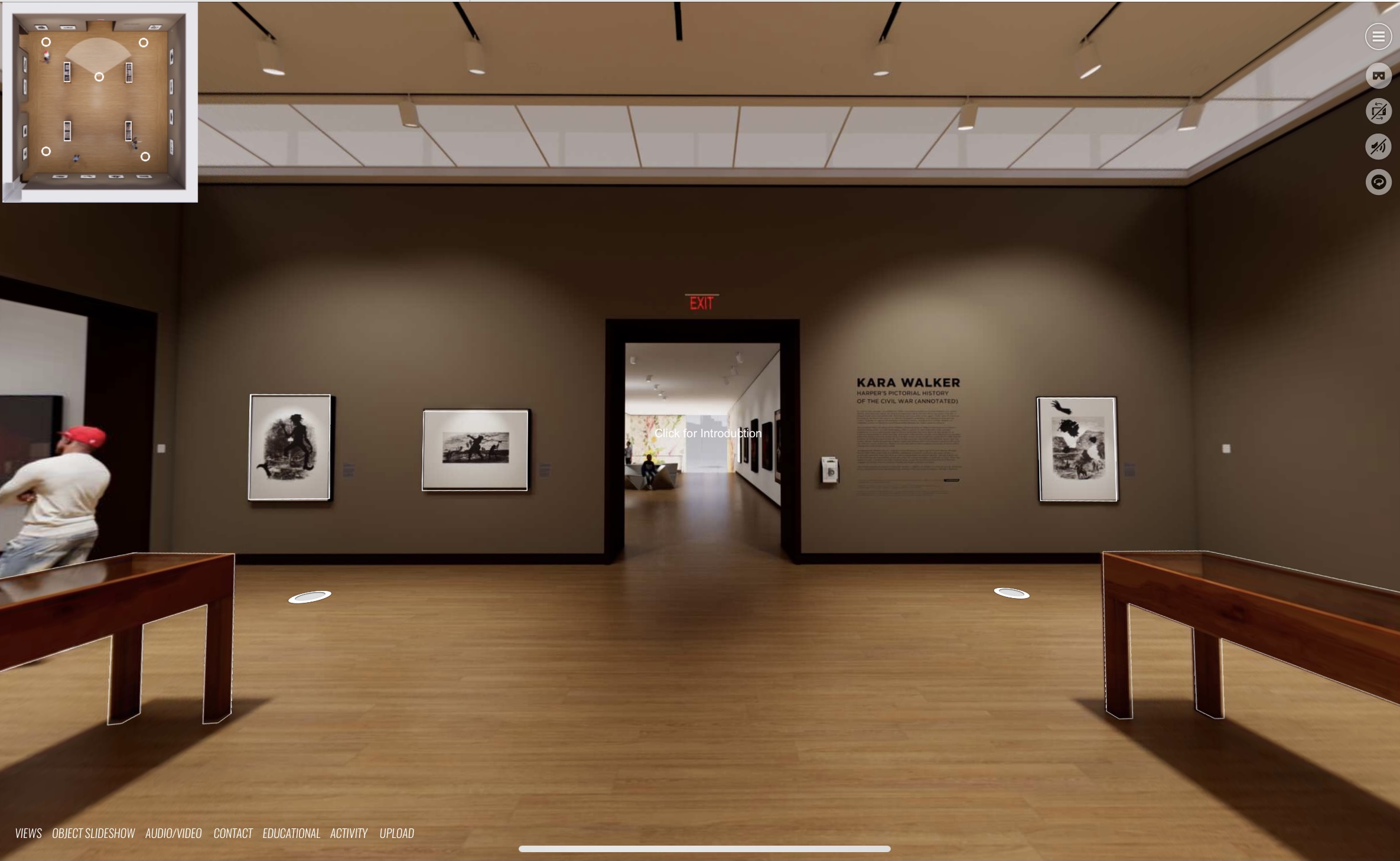
Above is a screen shot of the Kara Walker exhibit at the New Britain Museum of American Art near our home. The site allows a “walk through” of the exhibit. At least it maintains that it does. The upper left corner shows the full room and the larger picture one view of it. The large white spots on the floor are places to stand or place your cursor or something. I never could figure out what I was doing as I scrolled around on the page. I looked too long at the ceiling and managed to get motion sickness trying to move from one print to the next.

I am grateful that museums are trying very hard to create “museum tours” at home. Sadly most of the technology reminds me of the very early days of video games. Do you remember the game Pong installed in some movie theater lobbies years ago? In essence for 25 cents you could hit a white spot back and forth on a screen. Pretty exciting at the time, but no match for the elaborate games now available. I imagine that the museums may improve their “virtual” experiences too some day.

But just as ping pong is much more fun than Pong, so going to an actual museum is a deeper experience than any “virtual” imitation could ever be. The space itself, the smell, the feel of the floor under your feet, the ability to peek into the next room, the chance to move in a pattern you choose, the bench to rest on and stare for minutes at one painting. Most importantly you can see the actual scale of the work of art in comparison to your own body.

I will be back in the actual New Britain museum as soon as I can. And I can guarantee I won’t spend any time staring at the ceiling or getting motion sick.

“Canned Fish 4”

For a long time in the 1970’s I had either no money or very little money. In the early part of that decade we received “commodity foods,” basically surplus goods packaged by the government in generic black and white cans and boxes. It included dried eggs, canned tomatoes and a block of what Keb Mo the singer refers to as “government cheese.” His song is the only good thing about that block of plastic-like cheese.

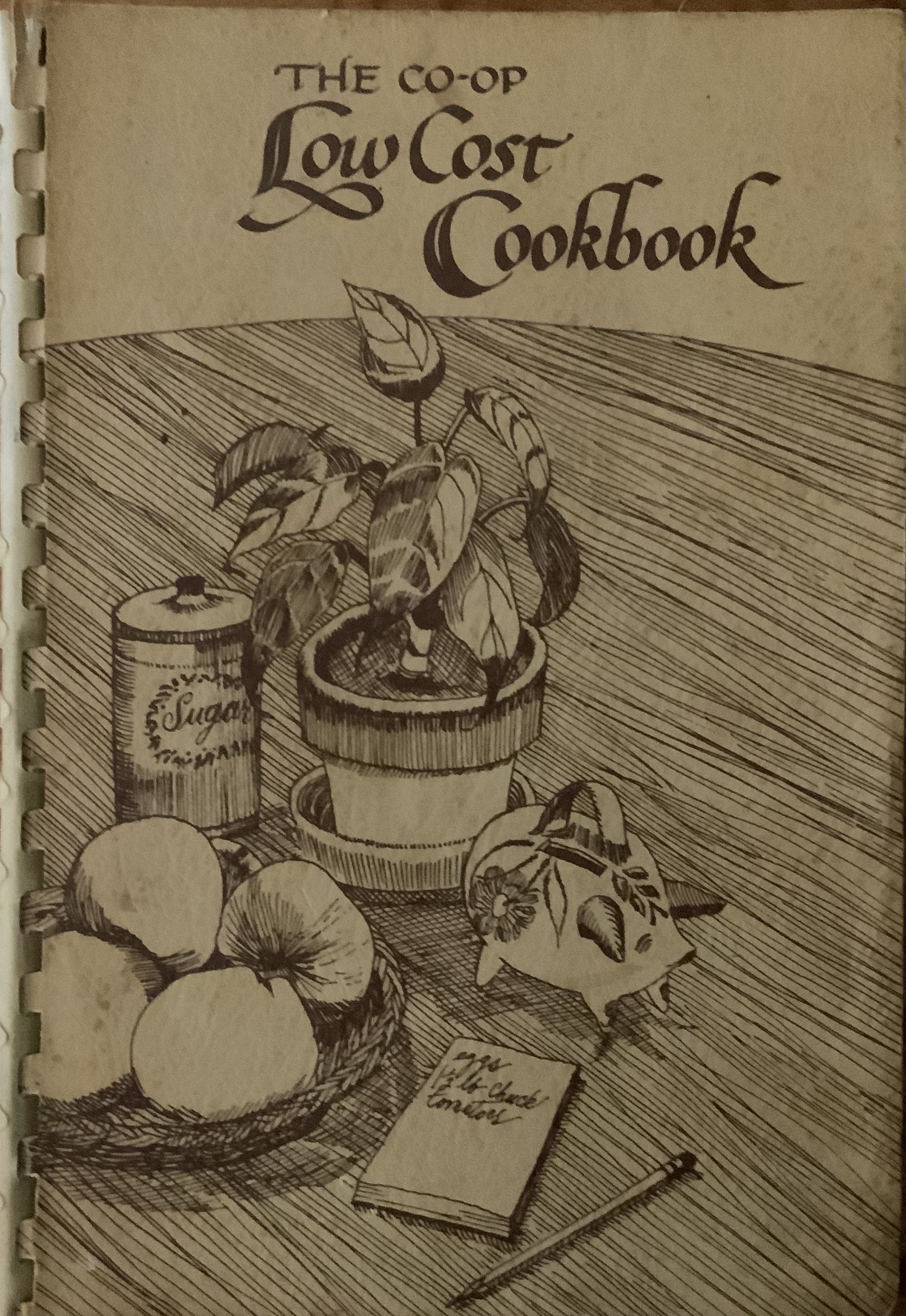
But in the mid-1970’s the government found another way to support agriculture by issuing food stamps (they came through the Department of Agriculture.)These little coupons could be exchanged for food while gaining one the critical stares of customers using cash. Fortunately we ate very low on the hog already, so those noisy people could find nothing to complain about. (Steak? Cola? Potato Chips? How dare they?”) No, my basket was filled with ingredients for the extremely helpful recipe book pictured above. And central among them was canned mackerel.

I could buy a pound of the canned fish for 59 cents and make a variety of filling dishes thanks to the booklet. Looking through the pages this afternoon I see a check mark next to every dish I prepared. Baked Fish Loaf, Creamed Mackerel, Baked Mackerel with Lemon, Fish Cakes, Mackerel Puff, Mackerel Fritters, Mackerel Turnovers and Mackerel Roll. Our favorite, as I recall, was the roll, a mackerel mix wrapped up in biscuit dough. Hearty and cheap.

Eventually the government went to issuing plastic cards which look similar to credit cards. It is harder to judge other shoppers I hope. But by that time I was again employed and I was able to buy a wider variety of food. I haven’t eaten canned mackerel since, but I am forever grateful for its place in my life. It was nutritious, filling and nearly tasty!

“Canned (Shell)Fish 3

By now you probably have realized that all the canned seafood I ate as a child came to us from Bumble Bee. I actually hadn’t noticed that myself until I added this third image to write about canned shrimp. Sure enough, there is that little cheerful bee on the label.

I wrote last year about my mother’s insistence that I learn how to make white sauce, one of the three skills she thought every girl should master before marriage. The other two, by the way, were how to iron a man’s shirt and how to make turkey gravy. I taught my own daughters none of these things. Anyway, white sauce was the key addition to the drained canned shrimp. Mixed with cooked spaghetti noodles they became “shrimp wiggle.” I liked this dish more than creamed tuna, but shrimp were more expensive than tuna so were served less often.

Needless to say I had no idea what a real shrimp looked like for many years. The only other time I had the shellfish was at a Chinese restaurant we used to go to a couple of times a year. Here we were treated to fried shrimp dipped in hot mustard. We each got one and learned to discard the end sticking out from the batter. I never even realized they were related to those tiny things swimming around in shrimp wiggle.

Many members of my family have deadly allergic reactions to shellfish, so they haven’t featured in my adult life. I am afraid the recipe for shrimp wiggle may lie dormant for years to come along with instructions for white sauce.

“Canned (Shell)Fish 2

My parents threw dinner parties now and then for clients and associates from my father’s law firm. Each time the appetizers were the same. One standard was a smoked oyster atop a Triscuit cracker. The other was sour cream mixed with dried Lipton Onion Soup Mix, again with a Triscuit. I had the job of spearing each oyster with a toothpick, and leaving the open can next to the crackers. I also was responsible for mixing the sour cream with the onion soup mix. I enjoyed sneaking an oyster for myself and rearranging them so that its absence wasn’t noticeable before the tray went out.

I never tasted a fresh oyster until many years later when I was handed one on the shell and told to swallow it whole. I found the experience disgusting and still have trouble understanding the idea of trying different varieties as a gourmet treat. Perhaps if they were as tiny as the smoked ones I might have had a different opinion.

In college I encountered oyster stew, a favorite in New England. I liked it only slightly more than the raw one. For me the best part of oyster stew was the accompanying oyster crackers. Now that I know it is possible to buy the crackers and forgo the stew, that is what I have continued to do.

I still occasionally get an urge to eat the canned smoked oysters of my childhood. I get out a handful of toothpicks, a box of Triscuits, and open the can. I have never found anyone interested in joining me, so I get the whole tin to myself. A vast improvement over the one sneakily eaten many years ago.

“Canned Fish 1”

Despite the fact that my father liked to fish, the only time I ever ate fresh fish was on camping trips. All of the other fish I ate growing up was either canned or frozen. I ate tuna fish. A lot of tuna fish. Tuna fish sandwiches with tuna mixed with mayonnaise(never Miracle Whip.) Tuna noodle casserole with tuna mixed with white sauce. Creamed tuna on toast, the same mixture poured on toast. Scalloped tuna, the same mixture baked in artificial scallop shells giving it the fancy name.

Fortunately we lived only 90 miles from a gigantic tuna packing facility, the Bumble Bee cannery in Astoria, Oregon. In fact until the “sorry Charlie” tuna ads ran for Chicken of the Sea tuna I never knew any other tuna existed. Bumble Bee frequently went on sale at five cans for a dollar instead of the usual four cans for a dollar. Needless to say, my mother had us pile cans in the cart at such times. We NEVER ran out of tuna fish at our house.

Of course times have changed dramatically in the intervening years. The abandoned cannery has been transformed into the Cannery Pier Hotel and Spa. Tuna fish now costs nearly $2 for a can now 1 1/2 ounces smaller than the one of my childhood. Tuna sandwiches with confetti topped toothpicks and a side of pickle and chips now seem unusual, save in a “retro” lunch spot.

But for many years if you had asked anyone in Oregon to name a brand of tuna fish, she would have answered “Bumble Bee.” And it would have been in her sack lunch at least a couple of times a week.

“Fish Tales 6”

While I had always gone fishing with men, one of my college students Jackie(on the right above) lived on a houseboat and invited me to go salmon fishing with her. Salmon run up the Willamette River in late spring, and it is legal to fish for them. Jackie and I went out in her little motor boat, dressed to get wet, but with little hope of actually catching a salmon. We joined a flotilla of similarly hopeful anglers around the base of the Sellwood Bridge near her home.

To our astonishment I got a bite on my line and the adventure began to haul it in. Between the two us we managed both to get the salmon into the boat and to keep ourselves in the boat. We nearly lost the fish and almost sent one of us into the river. Eventually we did reel in the fish and motored back so Jackie’s neighbor could give us the photo proof of our success. Jackie cut the fish into freezer size pieces and we split the bounty.

Having finally caught a huge fighting fish, I concluded my life as an angler. Future posts will discuss how I came to enjoy the fruit of others’ labors.