
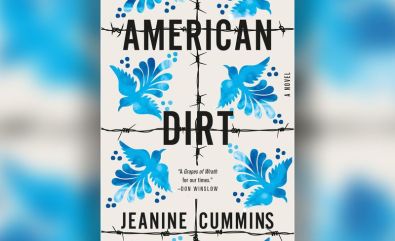
When I was a child, the library wouldn’t carry Nancy Drew mystery books because the librarians had determined that they weren’t “literature.” At the same time Joyce and D.H. Lawrence writings were banned in the United States. School boards continue to decide what books are and aren’t appropriate for children, though what is appropriate seems to differ vastly across the country. But I thought that once I was an adult I could choose to read what I wished and would be free of the “reader police.”
Sadly a whole new group has sprung up to caution me about what I might read. At the moment the furor is over the book pictured above, American Dirt by Jeanine Cummins. This is a NOVEL. It is FICTION. It is a creation of the writer’s IMAGINATION. The story features a woman who escapes a Mexican gang that has killed all of her family except her son. She and her son make the arduous dangerous passage to the United States. The author is not a Mexican woman who escaped a gang and made her way to the United States with her son. This apparently should make me ignore the novel. In fact, according to the “reader police” it ought not to have published.
This new criteria seems to suggest that only one who has been through exactly a situation portrayed in a novel should be allowed to write one. The genre for writing about one’s personal experience, however, is not called a novel. It is called a MEMOIR. I have had fun thinking about how many novels should not have been written if this is the criteria for authors. I just finished a NOVEL narrated by an Italian nun. Sadly the author was an American man. I guess I shouldn’t have found it as compelling as I did.
Empathy comes from the ability to imagine what another is feeling and experiencing. Many novelists are gifted with the art of imagining their way into other people, other places and even other historic times. Some of them do a great job, some do a poor job. But they all have the right to imagine and write. And I have the right to continue to distinguish fiction from reporting.



 Saved By Words