“It’s Just What I Wanted!”

CA59EC0A-CDC2-4934-AF24-D7D3DC089D53

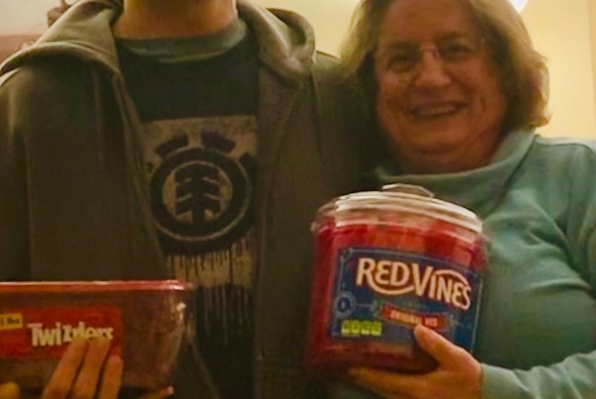
At Thanksgiving a friend of my daughter’s (he has a head, but I don’t post photos without permission of living people) and I had a discussion about red licorice. I said I loved Red Vines. He said that Twizzlers were unequaled.

We bought a five pound box of Twizzlers as a small gift for him for Christmas. On Christmas Eve he arrived at our house with a present for me. My daughter whipped out her camera since, unlike us, she knew what was about to happen. Sure enough, he had brought me a super size barrel of Red Vines. She quickly snapped the photo above(including his head!) and sent it to me.

The dentist probably is groaning, but two people got exactly what they wanted for Christmas.

“What a Tangled Web We Weave…”

EBA745C0-7567-4251-BF24-DBE63B4DEECE

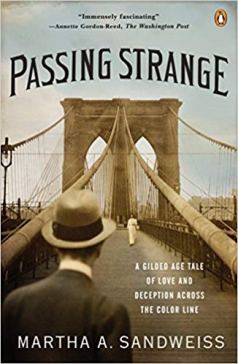
As Sir Walter Scott once put it “what a tangled web we weave when first we practice to deceive.” I thought of that when I finished the book pictured above, Passing Strange by Martha Sandweiss. I checked it out of the library after seeing an intriguing reference to it in the book about Rudyard Kipling If that I wrote about a while back.

The book explores the double life of Clarence King, the first head of the United States Geological Survey, a scientist, an historian and a writer. King was white, of Puritan descent, privileged member of Newport, Rhode Island and member of New York elite men’s clubs. But in King’s other life, he maintained that he was an African-American railroad porter named James Todd. Under that name he met, married and had five children with Ada Copeland, a former slave from rural Georgia, living in an African-American section of New York City. Sandweiss meticulously researches both King and Copeland’s backgrounds. In King’s case much primary source material exists. For Copeland, Sandweiss has had to speculate from primary sources about women such as Copeland, but without specific source material about Copeland herself.

But clearly the fascinating aspect of the book is how it was possible for King to “pass” as black when he was to all appearances white. Here Sandweiss explains how King was able to exploit the particularly racist times of the end of the 19th century. At that time if a person had even one grandparent, and in some cases one great grandparent who was African American, the person was declared to be so also. While many “white” looking citizens with such backgrounds “passed” as white, this also allowed King to “pass” as African American.

King moved back and forth between both worlds without disclosing to either his friends or his wife his double life. Eventually the strain broke him. But Sandweiss draws back the curtain on an unexplored part of a famous man’s past. And she meticulously shows us the tangled lies King lived with in order to be with a woman it is clear he dearly loved.

“But I Don’t Feel 50..60..70..80!”

77542AA1-1BCD-4A86-BD8C-BFEC26C5CB9B

Yesterday at the gym a woman shared that she was turning 65 but complained “I don’t feel 65.” I pondered that comment for a while and wanted to respond in this post. Above the picture shows on the left my Great-Aunt Margaret and on the right my Great-Aunt Elizabeth, both in their mid eighties. They were my grandmother’s younger sisters. I remembered how much I loved them and enjoyed their personalities, different but equally witty.

What does it mean to say we don’t feel our age? In one sense it is foolish. We feel exactly the age that we are. I am 72, so however I feel is how it feels to be 72. But that disconnection is possible for two reasons I can think of. The first is that we have absorbed some cultural bias against aging. To us to feel our actual age would be to confronted with our preconception of how we would feel at that age. Of course as a child I had no way of knowing how I would feel in my mid eighties. But fortunately I had these women around and wasn’t worried about it. Many others absorbed the idea that by their late eighties they would be dull, stuck in the past and resistant to new ideas. Of course they don’t feel their age as they imagined it since they feel so alive.

The other reality is that we seem to remain essentially ourselves as we age. I am still very like the child, adolescent, young adult and middle-aged adult I once was. So in that sense I don’t feel any age. But when I acknowledge that I am in fact now old, I can embrace some of the gifts that I didn’t have when younger. I am slower to judge, quicker to forgive, less likely to bear a grudge, more likely to cut someone some slack. My edges have been worn down a little. My soft body reflects my softened personality. Still lots of prickly quirks which have been there forever, but I am different.

I do in fact feel 72.

“Kipling Redux”

D3BFCF2A-6FCC-48AB-BDF0-53C86A786A48

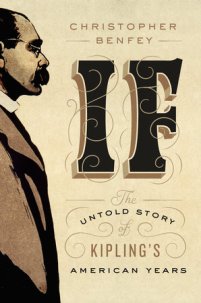
When I was in seventh grade, one of the poems I memorized was If  by Rudyard Kipling. Among the lines I still remember are :”If you can keep your head when all about you/Are losing theirs and blaming it on you,” and “And–which is more–you’ll be a Man , my son.” At the time it seemed perfectly natural that I, a girl, was memorizing a poem promising to make me into a Man.

Recently I finished the biography pictured above which narrates Kipling’s ten year residency in Vermont, in a town just under an hour north of us. It turns out that much of his most popular writing, including The Jungle Book and Just-So-Stories was penned there. I remember from my childhood a line from the Just-So-Stories: “the great grey-green greasy Limpopo River.” The stories of how animals came to be intrigued me.

In the intervening years I somehow absorbed the common notion that Kipling was a nasty imperialist who wrote shoddy books and was no longer of any literary interest. It turns out that I was not alone, and when Benfey, who wrote the book, told peers what he was exploring they warned him that a focus on Kipling would doom his academic career. My thoughts on that kind of dismissal of a writer will follow in another post. Needless to say, somehow I had absorbed the disdain without questioning its veracity.

Kipling, as are most of us, was infinitely more complex and intriguing than I could imagine. Even If seems not a call to manhood but rather a preview of the daunting requirements set out by society for men. The question for anyone is If it is possible to surmount all the challenges. And the use of Kipling to justify wars by the United States chilled me. The final chapter about the generals misusing his quotes in Viet Nam is worth the whole book.

In the end, Kipling has a sober last word:

If any question why we died,

Tell them, because our fathers lied.

So much for the irrelevant imperialist!

“I’m Gonna Mail Myself To You”

D3A7E2A8-DE49-426E-86D0-05D7B43691D9

One of my favorite silly songs, written by Woody Guthrie and sung by Pete Seeger is the song “Imma gonna mail myself to you.” Since I am unable to do that, I have to resort to mailing packages to my dear friends on the other side of the United States. I procrastinate around mailing things, knowing I will face long lines at the post office. Of course the longer I put off the task, the longer the lines will be at the post office. So I put it off even longer. Eventually I realize that the gifts will be arriving for Valentines Day instead of Christmas if I don’t act.

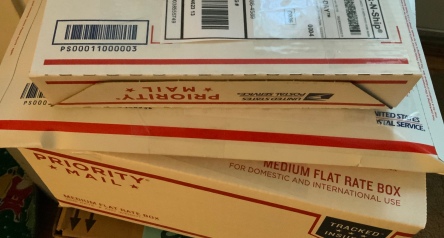
Amazingly I learned today(during yet another session of avoiding going to the actual post office) that I could buy postage, print my own labels, put them on regulation packaging and leave them on the front porch to be picked up by the local mail carrier. I had the packaging gathered in bulk the last time I was at the actual office. I had only to fill out forms, use my printer, and stick the labels to the boxes. Above is the fruit of my work, a group of items ready for tomorrow’s collection.

For all I know I could have been doing this for years instead of endlessly whining about waiting in line to mail gifts. Christmas seems to be the only time that the people in front of me in line are mailing 50 items, all various sizes, needing custom’s declarations and insurance. Their partners in crime seem to have only one package, but when they get to the front of the line they say “the rest are outside–I’ll be right back.” And in come 20 more boxes.

Can’t say that I will miss the experience!

“Dressed For The Occasion”

6DA85D9D-4273-4AE3-97BF-7A0E5104A2A8

I have been setting out our Christmas decorations and came across this trio of little figurines, each about two inches high. (It is hard to get a sense of the size in this photo.) I inherited them from my grandmother and they represent three phases of my beloved grandfather’s life. On the left is his uniform from World War I. He never went overseas, but he did serve in the Army. In the middle is his academic outfit. He graduated from Harvard with a PhD.  and was a college professor throughout his life. On the right Grandpa is dressed in his liturgical robe. He never could decide between the church and academe, so he did both. He attended Harvard Divinity School and was an ordained Episcopal priest all his life.

I enjoy the smiles on each figurine. Grandpa was, as my favorite aunt used to say, “a hoot.” He loved limericks, jokes in bad taste(not terribly bad taste, just enough to annoy my proper grandmother,) “hillbilly” music and an afternoon nap. He was deaf in one ear from a mastoid infection in his childhood before antibiotics were available. The left side of his face was covered with a port wine birthmark. Neither issue ever mattered “a hill of beans” to him and so it didn’t bother us either.

When we were able to visit him at his summer place in Western New York he was always up for an adventure. He was the one who took me outside to marvel at Sputnik going by overhead. And he piled us all into the car when the town fire siren blared so we could “see what’s burning.”

I would love to hear from any readers about Christmas decorations which bring similar memories.

“Christmas Music”

4374E140-FEFE-46FA-A16E-216F0EE15056

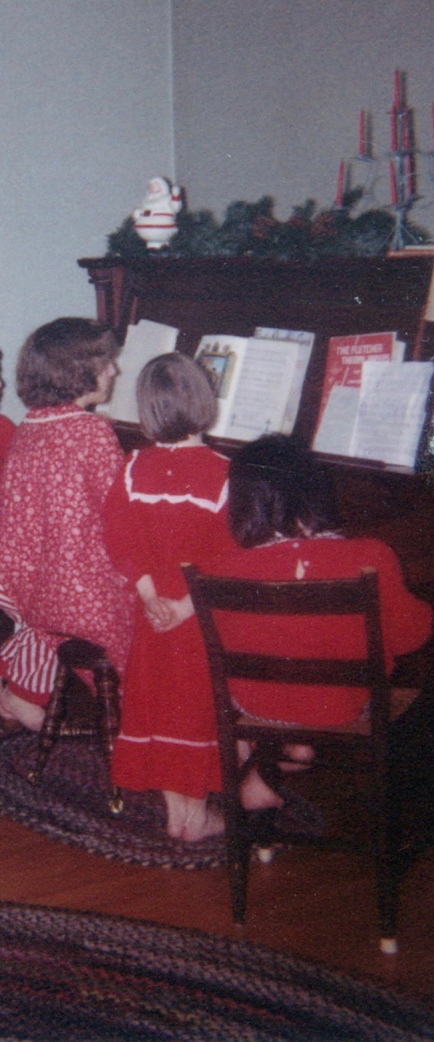
Here I am playing Christmas songs for my two little sisters. My brother was off to the left, but I cropped him out keeping to my promise to not show living people without their permission. I played out of the Fireside Book of American Folksongs, a treasury of tunes including a handful for Christmas. We seem to be singing We Three Kings judging from the illustration.

Despite the totally non-religious household in which I was raised I learned numerous Christmas songs. My grade school music classes taught most of them, culminating with an annual Christmas pageant and songfest. No one in my 1950’s era questioned the overtly Christian atmosphere in the events. It was Christmas vacation and Christmas concert and Christmas play each year. I was pretty oblivious that there were any Jewish people in my neighborhood. When I grew older I learned that was probably a result of housing covenants preventing them. The first Jewish boy arrived in my class in sixth grade, but nothing changed around Christmas.

Now that I attend church regularly I can belt out Christmas carols without ever looking at the song sheets. It is ironic that my ability comes from secular settings, but that is how pervasive Christian culture was when I was a kid in Oregon.

“Wrapping Things Up”

52F66C4B-FA7D-4C58-9F3B-1955D96923DF

A toy store in town will wrap purchases with a choice of five different papers they keep on rolls behind the cash register. This free service used to be customary when I was growing up. Eventually the stores charged a nominal fee to wrap gifts. The amenity seems to have disappeared in most places I shop. Sometimes during holiday seasons nonprofit groups set up gift wrapping stations in stores offering their expertise for a donation. All these efforts confirm what I have always experienced: most people struggle to wrap gifts and would like someone else to do it.

I am certainly one such person. When paper came in folded sheets I could barely figure out what size to use. Now that it comes in rolls, I am hopeless. I either have way too much or just a tad too little for whatever object I am attempting to cover. Fortunately in recent years I have discovered the magic of the gift bag.

Pictured above are the four gifts that are headed to church for the recipients I mentioned a few posts ago. Each sits happily in its gift bag, purchased at a small cost at Party City.(A whole store for parties!) I had only to estimate the necessary size bag and plop the present inside. A sheet of tissue paper for a cover, staples to keep the bag closed, and labels from the church tags completed the wrapping.

Gift wrapping sanity at last. And when the recipient has removed the gift she will have a bag handy to shop at the stores that now require her to bring her own sack. A double win this Christmas season.

“Three Little Kittens Have Lost…”

ECA856FE-EEB7-4A4E-B8A6-4E6B11A820B9

When the three little kittens lost their mittens, not only did they start to cry, but their mother was irritated at them and told them “you shall have no pie.” Clearly the cat couldn’t just run down to the store and buy an inexpensive pair of replacement mittens. Losing their mittens had in fact been a serious mistake. The same held true when I was a child, and the solution was to have a braided cord that joined the two mittens and ran across one’s shoulders under a coat. Most mittens in my group of friends were hand knit and worth holding onto. When we hung our wet wool on those radiators it was clear which mothers didn’t trust their kids to keep their mittens. Those tell-tale cords told us all.

Yesterday as I parked my car at the grocery store I saw one bedraggled glove, propped up on the curb, missing its mate. Perhaps most people in my neighborhood still can hear their mothers yelling “where did you lose your glove?” (As if we knew!) All over I see lone mittens and gloves propped on signs, sticking off fire hydrants, wedged onto parking meters. People have spotted lone gloves or mittens in the snow and, not wanting them to be covered by the next snow, have placed them up off the ground. I think it is an optimistic gesture, and maybe sometimes it helps the panicked glove loser.

I think that mittens and socks should all be sold in threes. They are interchangeable after all.  At least that way when one disappears–as it inevitably will–a matching replacement will be at hand.