“Salt-Free and More”

I have restricted my sodium intake for many years since it helped lower my blood pressure. My husband had not needed to do that until very recently, and he was fairly oblivious of the sodium in various foods. For the first time his blood pressure rose and I reminded him that his mother had been quite salt sensitive in her later years, so he probably was also. He immediately began to study the labels of the snacks he loves and learned how sodium rich they were. Of course they were very tasty! He was able to substitute many low sodium alternatives for his favorites, but one solution escaped him.

My husband loves a big breakfast, cooked by himself, devoured on the weekend with the New York Times open before him. For years this has meant orange juice, milk, bacon and eggs. He reluctantly gave up bacon, but he wanted to keep his eggs. Sadly, his eggs had always been liberally salted. He said, “What these eggs need is salt. Maybe ketchup!” I had to gently break it to him that ketchup was salt heavy. But Penzey Spice company makes a salt-free blend called Arizona Dreaming which has restored tasty eggs to his breakfast. It combines all sorts of spices, including several chilies, peppers, onion and garlic. Problem solved.

Penzey Spices has been much in the news lately because the owner Bill makes his politics known. He believes that cooking brings people together and that everyone around the world shares a love of good food. He vocally and financially opposes any moves to separate people, whether through walls, raids, or legislation. It’s his company; he can spend his own money as he sees fit. A concerted effort to boycott Penzey’s seems to have backfired. The more people attack his politics, the more others flock to his stores.

I go there for the salt-free seasonings. But I rejoice that he encourages people coming together instead of apart. His bumper stickers, such as the one above, promote love and hope. And at the checkout he stocks badges that say “I will vote 11/3/2020.” Thanks Bill.

“Mindfully Distracted?”

Sometimes I am struck with one of the deep ironies of contemporary American life. Everywhere I go, people are talking on their cell phones while they are walking, sitting at a bus stop or sitting with friends at a restaurant. Whole families eat together with each member texting away. We are bombarded with ads urging us to not drive distracted. Still all around I see drivers texting and driving. Once I saw a man in the adjacent lane talking on the phone with one hand and eating with the other. Since he only had two hands, guess how he was steering. With his knee! I hurried quickly past before he landed in my path.

Meanwhile everywhere I go I am told the benefits of mindfulness. Mindfulness supposedly improves schools, work places, and home lives. Mindfulness teaches a person, as far as I understand it, to be in the present moment. Classes, retreats, guides and experiences are available, for a fee, to teach you to be mindful.

Herein lies the irony. People who are spending hours of their lives removed from the present moment by their focus on electronic devices are now going to workshops to teach them how to be in the moment. I offer my no fee suggestions. Hang up the phone. Look around. Enjoy your surroundings. Without any further training you can find yourself present!

“That time of year thou mayst…”

9E07C9DF-9107-48C6-A648-5133CDF068A0

That time of year thou mayst in me behold
When yellow leaves, or none, or few, do hang
Upon those boughs which shake against the cold.
Bare ruined choirs, where late the sweet birds sang.

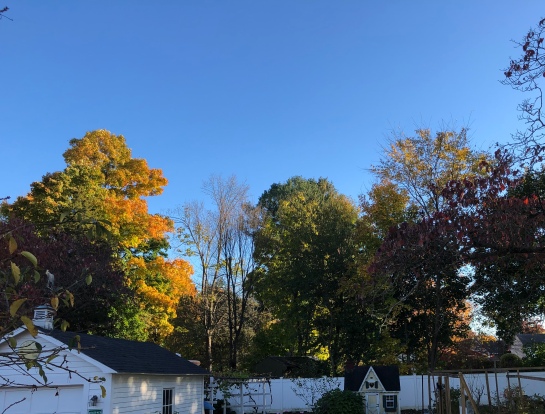
I grew up among evergreen Douglas fir trees which, as their name implies, stay green year round. So when I read Shakespeare’s Sonnet 73, I had only an idea of what he meant by the opening lines. Yesterday when I looked out the back door at the variety of trees, the poem came immediately to mind. There I saw one tree completely bare of leaves, one with some hanging on, and a large maple in various stages of color change from green to orange, red and yellow.

Only seeing New England fall colors in magazine photographs, I somehow gained the erroneous idea that trees all changed color in some kind of lockstep. Living here I realize that it is possible to frame a picture so that several trees in the same degree of change align, but that is not how the landscape actually looks. In fact what I enjoy most these days is to look across a street and see all the leaves’ colors intermixing with each other. Most amusing are the trees which have changed color on just one side or just the top.

Of course looking at the backs of my fellow parishioners’ heads at Mass I can see the same phenomenon. Some have white hair, some grey, some salt and pepper, some brown still. Some have luxurious manes, some thinning hair, some large bald patches. Many of us, like the trees, are in the autumn of our years. A lovely time for a tree and a person, no doubt, but still tinged with some sadness.

As Shakespeare says at the end of the sonnet,

This love perceiv’st which makes thy love more strong,
To love that well which thou must leave ere long.

“I Cannot Tell a Lie”

IMG_0707

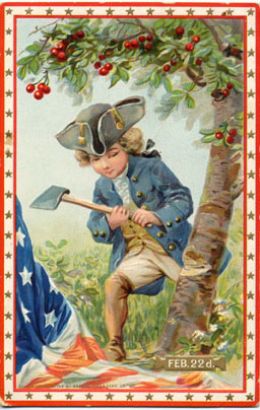
When I was a child a much repeated moral tale was of George Washington who, after cutting down a cherry tree, confessed the deed to his father saying “I cannot tell a lie.” Apparently this never took place, but we were given a model to emulate. When we made a mistake we were to admit it, not gloss it over with a lie.

Yesterday I went to the dentist to have a crown replaced on a back molar. It had only been four years since this crown was laid, so insurance wouldn’t cover any of it. (We have very good dental insurance, a rarity these days.) Here such a procedure costs upwards of $2000, so I was already trying to figure out how to budget the unexpected expense. But as he began to work, my dentist said “I don’t know how this happened, but it is my fault.” That’s right. The dentist said it was his fault. And then he said he wouldn’t charge me for the replacement since it was his fault.

I had already had another unexpected encounter with the receptionist when I checked in. I asked her why she had called me at the last minute to move the appointment forward twenty minutes. She replied,”I made a mistake. I overbooked.” On my way out the dentist told this woman that there would be no charge because he had made a mistake. I joked that this seemed to be a day of atonement at the dental office.

So far since he became president, Donald Trump has lied, as of October 9, 2019, 13,435 times according to Fact Checker which keeps track. These only include public lies told with a straight or an enraged or a victimized expression to the American people. He has managed to so confuse the public that half of Americans distrust anything coming out of the mouths of the other half of Americans.

May more of us act like the staff at the dental office. Whether of not George Washington actually said it, “I cannot tell a lie” is a good habit in our lives.

“Nostalgic Recycling”

The other day I read about a company which was going to discontinue putting cardboard tubes in the middle of toilet paper rolls. It made me reflect on all the uses we had as kids for them. And then I thought of many other items which we happily reused for craft and toy projects. With the exception of apparently disappearing toilet paper cardboard tubes, all these items have vanished from our shelves, having been replaced by plastic. Near our home a large craft store sells kits to make the things we used to make for free from discarded packaging.

Metal coffee cans had numerous uses. The most common one when I was young was as a base for stilts. Turned upside down, equipped with loops of rope, two cans made simple and sturdy platforms to stand on and stomp around. Smaller ones were used in the kitchen to steam brown bread and in the work room to  store nails and bolts. An old neighbor used many for picking huckleberries. Now coffee comes in plastic, of much less practical use.

Cardboard egg cartons went to school to be cut apart and made into Christmas ornaments. These hung from pipe cleaners, taken from home from our fathers’ supplies. No modern colorful pipe cleaners sold not for pipes but solely for crafts, ours were always white. The plastic egg cartons sold in my store are simply tossed out.

Baby food came in little glass jars. These were highly prized by teachers, Girl Scout leaders and Sunday School teachers. They could store individual colors of poster paint. They could be filled with rocks and sand to make tiny landscapes. We used them to contain homemade candles. Discarded baby food pouches of today have no utility.

In addition to these, we used the cardboard from my father’s shirts for many projects, his wooden cigar boxes for treasure chests, wooden fruit crates for toys and dismantled and reassembled many other things we found around. We spent time rubbing crayons on paper placed over the embossed front cover of old books. And of course our Halloween costumes were never purchased, but always hobbled together from old clothes.

Was it better in the “olden days?” It was certainly less expensive and obviously, though inadvertently, very Eco-conscious.


“Mixed-Up Drawer”

mixedup drawer

When I was growing up we had a place in our kitchen aptly called the “mixed-up drawer.” Anything that we couldn’t put in a predictable place ended up here. Ours wasn’t as chaotic as the one shown above. Instead it had items such as swimmer’s nose plugs, random jigsaw puzzle pieces, kids’ scissors(“quit using my sewing scissors to cut paper!!”) and cereal box tops being saved by one kid or another. When anyone couldn’t find something we were told to look in the mixed-up drawer. Failing to find it there we were given the useless advice that the lost object was “where you last put it.”

When I began blogging I read much advice about focusing a blog. It needed to be very clear when someone first encountered your writing or your photography that your blog was about something. You should be able to neatly articulate this focus in your “about” page. When I was asked to be a guest on another’s blog, I was asked to explain my blog in a few words. Tags were supposed to make it easier for new readers to find me.

I didn’t follow this advice. Nonetheless I seem to have a steady group of readers who have come along for the ride. I am grateful for every one of you, old and new, who drop in to read and often to comment. I think about many different things, some of which become a sequence of themed posts, many of which don’t. It turns out that my blog has become my own “mixed-up drawer”–a very important container for my reflections on life, past and present.

“Saved By Others’ Words”

I originally titled my blog “Saved By Words” for a variety of reasons, but among them was an understanding that reading often kept me sane. I have gratitude today for two publications to which I subscribe. One is The Sun, a monthly magazine. The other is Plough Quarterly. Both have strong on-line presences, and it appears that you can read quite a bit of each on line without a subscription. The Sun is free of advertising. Plough Quarterly has announcements of books and conferences, but no commercial advertisements.

A friend at the gym recommended The Sun to me because it features an intriguing variety of thoughtful essays, poems, fiction and contributions from readers around the world. Each issue announces the topic for the next several issues, soliciting short pieces from readers. For instance, this month’s readers reflected on “The Mall.” I enjoy all of the writing in the magazine. One particularly strong piece this month recounted the experience of a woman whose baby died before birth. Restrained and powerfully moving, it is a piece which will stay with me for a long time.

I am not sure how Plough Quarterly got my name and solicited a subscription. (I often wonder who exchanges mailing lists with whom.) At any rate it was a good move on their part. This magazine comes from a Bruderhof  community in upstate New York. The members of this Christian pacifist intentional community attempt to live out the Gospel in all aspects of their lives. The magazine presents challenging articles focused around a common topic. This quarter’s focus is on vocation. The quality of the issue, both in its art, its design, its writing and its ecumenical reach puts most other magazines to shame.

I am thankful that amidst all the garbage both on the air, on television, and in print, I have found company in the words of others. Both magazines are  saving presences in my life right now.


“Is the Sky Falling?”

cyclone

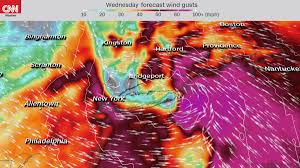
By the time the third friend from around the country called on Wednesday to see if we were all right, I finally learned why they were asking. Apparently a “cyclone bomb” had hit the Northeast of the United States, including where we live. I had never heard of a cyclone bomb, nor had I experienced one on Wednesday. Wednesday had been quite windy and it rained a great deal. Nothing had alarmed me, nor had we heard the signal to hide in the basement until a tornado passed.

It turned out that there had been very strong winds in some places, and about 38,000 customers out of one and a half million or so had lost electric power in Connecticut. Many trees had fallen down knocking breaking power lines. Apparently there was also significant wind damage scattered around the Northeast. Of course there are occasional strong windstorms which knock out power and fell trees. So why were my friends so concerned?

For some arcane reason of weather forecasters, this particular event got the specialized name of “cyclone bomb.” That phrase has specific meaning to some scientists. However, it has no such meaning to the general public. Clearly if you take two very charged words, “cyclone” and “bomb,” repeat them frequently on the air and say that a large part of heavily populated areas will be affected, you will scare millions of people. It worked, whether they meant to frighten listeners of not. Hence my worried friends’ phone calls.

Just a head’s up readers. It is bound to snow very heavily for a long time some time this winter. Undoubtedly the wind will blow during this blizzard. However, be wary of terms such as “buried,” “catastrophic,” “unprecedented,” and “crippling.” We are ready and we will shovel and plow and return to regular life in a short time. No need to panic.

“Opening Pandora’s Box”

C703D1EE-E29F-4884-8B74-FC3A2722BC22

A popular afternoon television show here used to feature an angry woman and one or two scofflaw men denying fathering a baby. We would get to hear lengthy rants by the woman followed by righteous denials by the men. The camera then would show us the adorable baby waiting back stage to be united with the true father. After endless commercials, the host would open an envelope and announce either “You ARE the father” or “You ARE NOT the father.” The woman would yell, the man run off the stage, the crew would try to calm everyone down, the baby would be brought out and placed in the suddenly eager arms of the real father.” Supposedly all live happily ever after when the show concludes.

Lately a great deal of attention has been paid to the chaos in some families resulting from DNA testing done by one of the family members. Here there is no crew member waiting to calm everyone down. Instead a daughter discovers that her “real” father is someone else. Or a man learns that he isn’t the “real” father of the children he has raised. Or a woman discovers that the sperm from an unknown donor really came from her gynecologist who also impregnated many other women. One woman has sold many copies of her memoir “Inheritance” recounting her life being totally disrupted by such an event.

I think that many times children wish that they had different parents. One of mine yelled at me “I wish I were adopted and you weren’t my real mother.” But I am distressed by the kind of turmoil that happens by learning that things are not as they seemed. What does it mean to have been raised by a man who is now told he isn’t the “real” father? Why this sudden insistence that biology is more important than lived reality?

Perhaps the problem lies more in secrecy. Secrets rarely stay secret forever. And DNA testing has uncovered many secrets. I wish that more people could just acknowledge the toll that secrets can take on families. And I hope that fewer people would take the opportunity to abandon the people who raised them as they go searching for their “real parents.”

“This is the Way We Mend Our Clothes”

74D8529B-E97D-43CD-B2B1-EA23B510FF46

Last week I was reading an article describing what a disastrous effect manufacturing of clothing has on the environment. Apparently for many people fashion now dictates that they must constantly buy the newest clothes, wear them for a short time and then discard them. Accordingly, much of this clothing is poorly made, designed to fall apart fairly quickly, needing to be replaced with more up to the minute fashion. The solution proposed by the activists worried about this situation was to buy sturdier clothing and wear it longer.

After I recovered from laughter realizing that I was now in the forefront of an environmental movement (I had always bought sturdy clothing and worn it a long time), I thought of something the article failed to mention at all. Mending clothes! Growing up, everyone I knew had the basic skills to mend clothes. My mother kept an active mending basket near her chair where she did repairs. Seams were resewn, knees reinforced and buttons replaced. My mother darned socks, using a darning egg such as pictured above.

We wore clothes longer using the time honored skill of letting out hems. At that time everything seemed to come with large seam allowances, so that they could be adjusted as children grew. If a dress had been worn long enough to make an obvious line after the hem had been let out, rick rack covered it jauntily. Sleeves went up and down, waists in and out. Clothes lasted through many children. When they were finally totally worn out, garments became cleaning rags.

My title today reflects how common mending once was. Even the nursery rhymes we sang included not only washing and ironing, but also mending. Maybe it has gone the way of fish on Friday. A once ordinary event now needing explanation for the young.