“Contemplating Contempt”

50AB1AA5-9697-4827-B4E2-47C7BB8B110E.jpeg

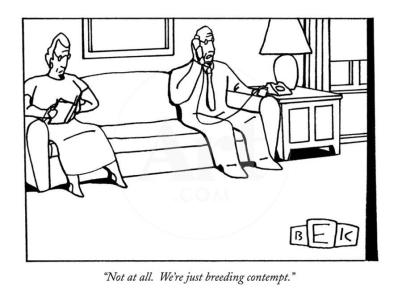
The above cartoon from The New Yorker illustrates an aspect of marriage that John and Julia Gottman, of a marriage institute in Seattle, say is the “single greatest predictor of divorce.” Contempt occurs between people and at the moment is widespread in the political arena. But what sets contempt apart from dislike or anger?

Contempt claims a moral superiority over another. Often it extends beyond a single target to a whole group of people. At the moment it seems that half of Americans are contemptuous of the other half. If the Gottman’s view of divorce applies to nations, we are approaching a civil war. What would it take to pull back from this toxic precipice, whether at home or in the public sphere?

We could start with the simple statement: “you may have a point.” Contempt is much easier. It provides television stations with viewers. You can choose your program to suit your own particular contempt targets. It can be amusing when we watch comedians skewer those we disagree with. It can stroke our egos when we look down on another part of town, another kind of dress, or other people’s habits. Contempt really tempts us because it gives us a chance to feel superior. And feeling superior can feel good.

Instead of saying “how could anyone believe anything that stupid?” (one of my standard expressions) I am going to try a new approach. Why does the person believe that? Is there any merit in their point of view? If there isn’t, can I share another view with the person? Not, clearly, if I go into any conversation with contempt at the ready!

“Changing Habits”

86A7A5A8-8D75-4FE7-83A6-23856327D758

In late spring, the Connecticut legislature imposed a 10 cent tax on most single use plastic bags, such as ones at the grocery or drug store. On August 1st, this measure took effect. Rather than charge customers the 10 cent tax, the stores I frequent eliminated them altogether and began to charge for paper bags. The alternative provided was to supply one’s own bag. Previously, Whole Foods had eliminated plastic bags and given a 5 cent rebate for using one’s own bag. While its procedures stayed the same, all other stores changed.

Skeptic that I am I expected many people would arrive at the store empty handed, complain loudly about being charged for a bag, and leave in a bad mood. To my surprise, nearly every person I saw entering any given store had a bag of some sort in hand. Those without bags were leaving stores with unbagged goods. I was amazed at what a disincentive paying for a bag turned out to be for a majority of my neighbors. Previously I only occasionally saw people with their own bags. Now they were everywhere.

Perhaps we need to have to dramatically change habits more often. Who knows what governments could achieve. We could be charged for riding elevators instead of using the stairs.(Doctor’s excuses would be valid.) Parking meters close to shops could be more expensive. Cigarettes could have $25 dollar taxes. But who would put up with being made to change their habits? Apparently Connecticut shoppers! Who knew?

“Bittersweet”

bittersweet

Long before I knew any other meaning of the word, bittersweet was the type of solid chocolate I used to make brownies. As a child, I found the taste more bitter than sweet, as did my siblings, and my mother never worried that one of us would eat the baking chocolate. In high school I remember coming across an essay by the prolific John Leonard in Life Magazine musing on the word bittersweet in relation to feelings. (I actually tried to find the essay today, but had no success.)

The word captivated me and I vividly remember realizing that it was the perfect word to describe some of the feeling I had had  but been unable to express. Perhaps you can recall your own experience of a happy feeling tinged with sadness. Leonard said that after childhood with its more clearly delineated sad and happy, we need a new word for this complex emotion.

Lately I feel it most strongly around my grandchildren. Somehow I failed to realize that they, like my own children, grow up. I delight in their growing maturity, their expressive vocabularies, their distinct developing personalities. At the same time I miss their eager toddler selves, ready to plop onto my lap and just snuggle. I realize that it is time to once more pack up the Fisher Price little people, used by my daughter, then stored and brought back out for the grandchildren. Sturdy toys, bought used in 1977, they will still be useful for any eventual great grandchildren. But I may not still be alive to watch their play. A bittersweet thought, for sure.

So take a minute and ponder the word for yourself. It isn’t exactly nostalgia, nor is it melancholy. It is its own perfect self: bittersweet.

“Some Day and Around To It”

8FBBBAA4-6E13-4FFC-802F-2D49176A8C6C

My husband and I have finally managed to take a number of day trips this summer, exploring different waterfalls in our area. I have been using a wonderful handbook about New England waterfalls which gives precise driving and hiking instructions to each waterfall and rates each one from 1 to 5. But I have been saying I wanted to take day trips during the summer for several years. What was different this time? We actually blocked Mondays out on my husband’s work calendar! Since I am retired, I would often propose a day trip but find he had a work conflict. Now he is free on summer Mondays. Vacation spaced out instead of taken all at once. Problem solved!

I have long been a victim of  “some day” and “when I get around to” planning. The desire and intention is there, but without the specific step of scheduling. In some cases, this has been beneficial. My “some day I would like a motor home” has changed to “I am happy to stay in nice hotels.” My “some day I would like a motor boat” changed to “I prefer our canoe.” But other times I have not followed through on a “some day” idea.

“Bucket lists” seem to be very popular right now in the United States. They address this issue in a kind of morbid way as in “before I die I want to…” This really isn’t much more specific than “some day.” However, I am trying to reframe this concept as “I want to do these things while I am still alive and able to do them.” That narrows the window significantly and adds some urgency to my planning. At 72, I can no longer calmly assume that “some day” will come along on its own!

So this year I want to go to Portland, Maine with my husband and next year I want to take a cruise with my best friend. The hotel is reserved in Maine. The deposit is down on the boat. “Some day” has actual dates assigned. Progress finally.

“Our Daily Bread”

A0DF586F-ECBF-4732-AB32-5C6C7FB92365

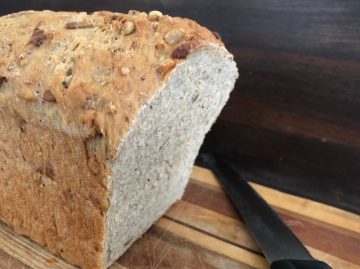
I have always enjoyed baking, mostly everyday kinds such as bread, muffins, pies and cakes. I have made many different loaves of bread over the years using many different techniques. But for my daily breakfast bread I have stuck to one recipe and one method for several years. I use a bread machine, but I only use it on the dough setting. This allows me to have a warm place for the dough to rise, be punched down and rise again without my attending to it. I then put the dough in a pan for an additional rise and bake it in the oven for 35 minutes.

Many people fail with bread machines, I think, because they never made bread by hand first. Despite the careful measurements dictated by machine instructions, I find it necessary to get the right feel of the dough before I leave it to rise. Different weather affects flour, and what is too much one day is too little the next.

I want my morning toast and almond butter to carry me through until lunch. Accordingly my bread(pictured above)is loaded with white whole wheat flour, bulghur, sesame seeds, poppy seeds, pumpkin seeds, and sunflower seeds. Local honey provides a touch of sweetness. Water, salt, oil and yeast combine with them all to make a hearty and chewy bread.

My granddaughter loves to eat my bread. I cautioned her one day to wait until it had cooled before slicing it. Deciding it was cool enough, she cut a big slice for herself and happily munched it while reading one of her countless books. I was stunned when I went in the kitchen to find two halves of the loaf with the middle missing. I asked her why she had done that. She replied, honestly enough, that the center of the loaf was the best part!

“Remembering”


In January of 1953, my sister Patsy came into the world, two weeks late and weighing nearly ten pounds. My mother delivered her in a record forty-five minutes with only a martini consumed earlier for pain relief. The first two children, my brother and I, had light brown hair and blue eyes. This third baby was to be named Jeannie, as in “I Dream of Jeannie With the Light Brown Hair.” One look at the new baby with a full head of black hair and brown eyes and that name was discarded. She was nameless for a week, and they finally named her Patricia after a friend’s daughter.

Patsy was a happy, outgoing, very social kid. She made friends easily, much more easily than I. She spent many hours at other people’s homes, deciding that the tension in our family was not typical and that she could do better. She hitchhiked through Europe after high school with a close friend, even going to Morocco. I never got to hear the details of that foolhardy trek. She went to college, finished nursing school, got a Master’s in Public Administration, and spent her working life in Kaiser Permanente as an executive.

Two years ago today she died in her sleep, the way she had hoped, after a lengthy and ultimately fatal third bout with breast cancer, a disease she endured for twelve years. I was able to FaceTime with her shortly before she died and we had a final connection of tears and laughter. She said that she would wait for me and that we would see each other again. Her faith was rock solid, and I borrowed some of it as we talked.

Losing Patsy, the only sibling I had any connection with, was a great loss. But her struggle had utterly worn her out and she was more than ready to go. Peace dear one.

“But Everyone Does It!”

EyeExamCheat

At the gym on Wednesday I overheard a conversation among three people in their twenties. They were comparing ways that they cheated at college. One was particularly pleased with finding the answers for an exam  on-line. Her justification was that she needed a high grade point average to get into nursing school and she was doing poorly in two classes. I shuddered thinking of her as a nurse tending to me. What other shortcuts would she be willing to make?

As a college professor I used only essay questions on the exams I gave. I also allowed students to use the literature texts while they responded. There was no need to cheat, nor was there any way to do so. Critical responses to the readings could only come from absorbing the works and reflecting on them. I did discover that essays written for admission to the college were remarkably better than ones written in class. I assumed that in many cases someone else had done the work for admissions.

Only once did I encounter blatant copying. The essay written at home was so polished I knew the young man couldn’t have written it. Entering a few words into Google identified the actual author. I stapled the plagiarized essay to his paper and handed it back with a failing grade. I don’t think he had any idea that after years of correcting essays I had a pretty good sense of the abilities of most first year students.

When I heard the people at the gym justifying their behavior with the time honored “Everyone does it, ” I couldn’t help thinking of a common parental statement from my  youth. “If everyone jumped off a tall building would you?”

“Geographic Cure”

F070C26D-C956-4617-BEDA-00C0E2A97716

“You can’t get away from yourself by moving from one place to another.” (Ernest Hemingway)

In 12 step meetings people are introduced to the concept of the geographic cure, an idea that all one’s problems can be solved by moving to a new location. It’s a tempting idea, one that many people believe. In Connecticut, at the moment, there seems to be an underlying malaise that has led one third of those interviewed saying they will leave the state in the next five years.

Many good reasons exist for relocating. Better jobs might be available somewhere else. Perhaps family members want to live closer to one another. Some people prefer a different climate, either hotter or colder than the one they currently inhabit. People may want to move into a retirement community and there isn’t a good one nearby.

But a general grumpiness about one’s location can’t be solved by moving to another, not if the problem is internal, not external. As the old bumper sticker used to say “Wherever you go, there you are.” Right now North Carolina seems to be luring many Connecticut residents. The taxes are lower there. The weather is warmer. But as any place grows rapidly, so do the needs to build more roads, more schools, more services. Eventually either taxes will go up there or services will stagnate. So what seems ideal might lose its shine after a while. Portland, Oregon, once my home town, has now been “loved to death” by the influx of new residents looking for a place that no longer exists. Housing prices have soared, traffic is impossible, and quiet neighborhoods are being disrupted by tear downs of single family houses replaced with two or more houses.

A dissatisfied Connecticut resident might soon find himself a dissatisfied North Carolina resident. I hope not. I hope he isn’t looking for a geographic cure.

“Curses, Foiled Again!”

squirrelbuster

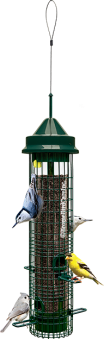
I love feeding the birds and I even love watching squirrels trying to eat from my feeders. Their antics can make me smile no matter my previous moods. However, I tire of starlings taking over my feeders and pushing away the birds such as nuthatches, goldfinches, and tufted titmice, seen in the above promotional photo . Last month I invested(truly–it was expensive) in a Squirrel Buster feeder. It attracted me because of the little perches which allow access to the feed through small openings in the feeder. These perches, weight sensitive, pull the feeder over the openings when a larger bird or squirrel lands there. The accompanying brochure listed the weights of various birds, and I was cautiously optimistic that starlings were too heavy to feed at it.

Starlings, an invasive species here, fight aggressively with each other and all other birds. They can empty out a feeder in record time. But despite the repeated attempts of various starlings to access the tasty tidbits in this new feeder, they were all unable to eat a thing. I think the word must have spread among the thieves, since they no longer try to feed there. Sadly they still try to eat all the suet cakes set out for the three varieties of woodpeckers which frequent our yard. For the time being I have stopped using those treats.

As I gloated over my success, I could hear Dudley Do-Right cheering and Snidely Whiplash moaning:

snidely

“Cooling Down”

This is my first attempt to post a very short video taken this morning at Wadsworth Falls State Park outside Middletown, Connecticut. For those of you dealing with temperatures as hot as ours, please enjoy the sights and sounds of the falls. For those of you freezing in the Southern Hemisphere, take time to look forward to your summer.

Enjoy.