“Strawberry Fields Forever”

35B48A4E-7BF4-464A-96FE-B5A2F0A4AED0

Connecticut doesn’t stand out as a strawberry producer. The available berries are hand picked from local farms and sold for only a couple of weeks each summer. The first time we saw a sign for them saying “Native Strawberries,” we had no idea why an indigenous variety would be for sale. But it turned out that “native” just meant locally grown as opposed to imported from Florida or California. This week we went down the road to the produce stand and bought several boxes.

California and Florida strawberries flood our markets in May and June. They are big, bright red and usually pretty tasteless. They count on sugar and whipped cream to have much flavor. Local berries, however, don’t have to withstand long rides in refrigerated trucks, so they are more fragile and much more flavorful. The cost, usually twice that of imported berries, reflects the care taken to pick them by hand and bring them in each day. They are worth it.

Oregon, where I lived for most of my life, produces great strawberries. I would drive to a local farm, buy a couple of flats of them, and make strawberry jam. Here the price precludes that possibility. I remember Oregon berries tasting even sweeter than the native ones here, though that may just be nostalgia. At any rate, our local ones are good, available, and here for a very brief time.

In just a few weeks we will taste the first corn. “Native” of course.


“Literary Passport”

E835430C-FFD6-486E-9007-418352DE7E3A

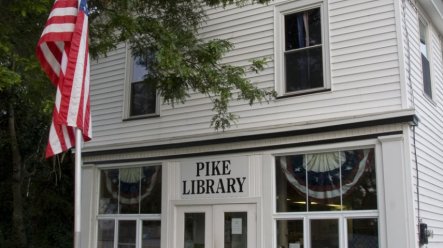
The other day when I was leaving my local library with books in a pile, I once again felt blessed that I could catch up on so many good books for free. I have written about libraries before, but I had some additional thoughts today. Pictured above is the library in the small(tiny) town of Pike, New York where my grandparents had their summer home. The library was open for brief periods in the week and had a limited selection of books, many no doubt donated by residents. But I didn’t need a library card to use it. I just had to tell them I was the granddaughter of the Carpenters and I was good to go. My mother told me that when she was a girl she decided to read every book in that library. I think she made quite a dent in the offerings.

My local library provides a computer hub for residents, many of whom have no internet access at home. The computers are usually full with people applying for work, researching for school or catching up on the news. The expansive DVD collection also sees heavy use. The librarian stays very current in her purchases of new fiction and nonfiction selections, and I often can find a book I have just seen reviewed in the newspaper newly arrived on the shelf.

One of the true benefits of a Connecticut library card comes with the ability to use all the nearby libraries as well as my own. Many times a library a few miles away has a book not owned by my library, and I can request it be sent to mine. Since there is no centralized library system, each town’s library features its own idiosyncratic collection. One has an extensive selection of mysteries. Another seems to have medical references for every ailment known to humankind along with every nontraditional healing approach for each. I can get a sense of the town from the choice of books.

May libraries continue to delight, inform and welcome. Where else can a person read for their entire life for free?

“Look It Up”

worldbook

These days any question can be answered by a quick look online at Google. My grandson even poses questions to Siri on the IPad, not wanting to be bothered by typing in the question. But when I was in school the only source for information was the “World Book.” This multi-volume encyclopedia sat in every classroom and in the homes of my friends who had more money than we did. Eventually, when all four of us were in the same elementary school, my grandparents bought a set for our home. We were absolutely thrilled to be able to do our homework at home rather than at school.

When we had to do reports, whether on countries, states, flags or crops, we consulted the “World Book.” In fifth grade I had to research diseases, though I have no idea why. I brought the bar chart to my teacher hoping for an explanation of the very prevalent “venereal diseases” illustrated in the graph. She very calmly told me that venereal diseases were ones that people gave to one another. I remember going back to my seat mystified by her answer since I figured most diseases were ones people gave to one another. The “World Book” had no entry explaining venereal diseases, so I remained clueless.

By the time I got to high school the “World Book” had been replaced by the “Encyclopedia Britannica,” the Google of its day. Their articles were more in depth and written by experts in their fields, at least according to the preface. There were many fewer pictures, however, and they were less fun to sit and read. I knew no one who owned a set at home. Many years later I actually had an encyclopedia salesman come to our door. I had always thought the job was apocryphal, but apparently not.

The last encounter I had with encyclopedias came at the grocery store. You could buy a volume each week until you had a full set. They were called “Funk and Wagnalls” and I passed. Something about that name didn’t evoke confidence!

“Why Recitals?”

bugsbunny

I learned to play the piano as a 6 year old and took lessons throughout my childhood. I loved playing the piano, singing along, entertaining myself. I learned to read music which has been a valuable skill when encountering new hymns at church. However, from the beginning, I hated recitals. If you have been spared either performing in or attending a piano recital, consider yourself fortunate. Basically each child has to stand in front of the audience, announce the name of the piece about to be played, play the piece, stand, bow or curtsy and return to his seat.

Yesterday we went to hear my granddaughter in her piano recital. She is quite good at the piano, with a solid sense of rhythm and good technique. I enjoy hearing her play at home. But we also got to hear fifteen other kids play. A majority of them sped up with notes they knew and slowed in the hard parts, finally loudly plunking out chords they recognized. While we clapped enthusiastically for each child, it was painful at times to listen. At the end of the recital my granddaughter announced “I hate recitals.”

Who decided that playing the piano also necessitated playing it in a recital? It seems to me that two skills have been combined: playing the piano and performing. They don’t necessarily go together unless one is going to be a performer. I think most kids are not going on to be concert pianists. Even as a adult I was told by one teacher that if I wanted to take lessons, I was going to have to be in the recital. I passed on the “opportunity.” I am satisfied with an audience of one–me.

“Whose Standard?”

standardizedtests

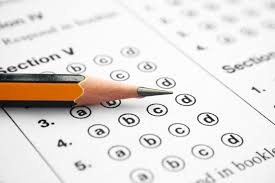
Starting in 4th grade, we began taking standardized tests. These continued every two years in grade school. Then in high school we took first the PSAT test, then the SAT test. Before graduate school we took the GRE test. Before I could teach in Connecticut I had to take the Praxis test. While there are now many courses available to help prepare students for these tests, I had no preparation for any of them. I just sat down and filled out the little answer spaces with my pencil.

But how was I at an advantage even back in 4th grade? I grew up in a white upper middle class home surrounded by books with college educated parents. I was a voracious reader. My parents spoke “Standard English” as it was called then. And the Iowa Test was designed for “Standard English.” I remember finding some of the choices comical, though I had no idea why. For instance was it proper to say “they were” or “they was?” Who would make that “mistake” I wondered. The vocabulary section of the SAT tests was also slanted in my favor. The words to be defined were used all the time in my household and in the books I read. The grammar and usage questions were similarly positioned to my advantage since they were the way people around me spoke.

Remember that I was in school before television was a common source for most children to hear language. Most kids when I was in 4th grade only heard their parents and neighbors speaking. If they heard “ain’t” they had no reason to doubt its correctness. If they hadn’t been surrounded by books, their vocabularies would be much smaller than mine.

It wasn’t until I was grown that I understood the problem with standardized testing. It really separated out kids more by socio-economic reasons than by aptitude or even accomplishment. When I taught “remedial” English to college students I was careful to say that there were many dialects in America. The one called “Standard English” was the one to use in formal writing. I told them that I had had the benefit of learning it growing up. They had the challenge of mastering what was, in essence, a foreign language. I hoped to equip them with this second language since it was still seen as “superior” and the mark of an “educated” person. But I encouraged them to never think their dialect was inferior. If the “standardized” test had been in their dialect, I would have flunked.

“Hmm.”

77F9B5D2-07DE-4827-AE2F-FE8C5C8C5607

By now you have probably heard of “failure to launch,” applied to adult children who have finished college and are now living in the basement of their parents’ houses, content to be housed, clothed and fed by their parents. For the last 36 hours we had the chance to observe the same phenomenon in the last of the three robin babies. The other two had flown away without our notice. However, this last one sat forlornly at the edge of the nest, hoping against hope that food would come her way. It had always worked before, so why wasn’t it working now? Meanwhile the adult robins were nowhere to be seen, though their persistent encouraging tweets came in a constant stream from across the yard. They were in a stand off, the adults refusing to came over, the baby refusing to leave the nest. Some time between 10 and 11 this morning the baby finally conceded and flew off.

The time one of our dogs had puppies, the process seemed a little more gradual. The mother did stop nursing, but she spent time jumping down off the couch onto the unsuspecting pups. Since she was a terrier, I figured she was teaching the babies how to pounce on prey. Eventually they caught on and pounced on her and each other. Satisfied that they were ready to leave home, she didn’t fuss when each was adopted.

Theodore Roethke has a line of poetry, “I learn by going where I have to go.” I guess that is the way for robins. They have to learn to fly by flying. No flight lessons for them. They have to launch themselves or go hungry. Flying looks much less daunting on an empty stomach!

“Boxed Readings”

srabox

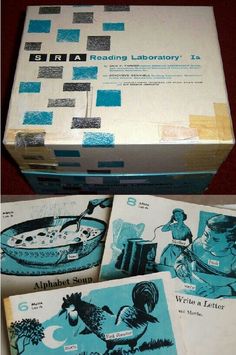
The other odd addition to our reading instruction in the 7th grade was a box of color coded sheets with short readings printed on them. They resembled the picture shown above, though ours were for a higher grade level than the illustration. You took a sheet from the box, read it, answered the questions, graded yourself, wrote down your score and went on to the next sheet. The idea was to gradually improve your reading comprehension.

Sadly, the selections were as dull as those early Dick and Jane stories I had endured in 1st grade. I imagine that our principal had fallen for the advertising from McGraw Hill, publishers of these SRA Reading Laboratory boxes. I went to the McGraw Hill web site and see that they still sell updated versions of the same thing. Apparently having children read on their own in these truncated bits frees the teacher to help other kids. It might be a great marketing ploy, but it is a waste of kids’ time. We were better served in other grades by being able to read full length books once we were finished with our other assignments.

Our grade school had a rich library and we went to it frequently. While I had the ambition to read every book there(I was a nerd even in those days!), it never happened. The savvy librarian kept buying new books! And every one was more interesting than anything in that box.

“Hurry Up”

I am delighted when I read other bloggers respond to reading challenges, such as going through 25 books in a summer. In a similar vein, I encourage my grandchildren to enter book stores’ summer reading programs with a free book as a reward. I appreciate those readers who keep track on Good Reads and similar platforms. But as for me, I am a recovering speed reader now focusing on slow reading.

In grade school we were constantly encouraged to read faster. This peaked in seventh grade when we were introduced to the contraption pictured above, a controlled reading machine. It projected filmstrips on a screen with just a portion of a sentence at a time. The speed increased every time we were shown these passages which were broken down into bits as illustrated in the right hand photo. The faster the filmstrip bits sped by, the more anxious I became. Anxiety shuts down the cerebral cortex, so I lost the ability to comprehend anything. Unbelievably, I still am haunted by a selection focusing on the stickleback fish and its mating habits! It totally confused me and I never forgot the ordeal.

In college my roommate took the Evelyn Wood speed reading course to try to keep up with her assigned reading. It seemed to involve moving one hand diagonally across the page quickly. I never tried it, but she thought it worth the tuition. I just tried reading ever faster, particularly the semester I had to read a 19th century British novel each week. I wasn’t able to because I kept falling asleep.

A good friend introduced me to the concept of slow reading. She really takes her time with each book with no intention of hurrying herself along. Remarkably she actually remembers what she reads! I am trying her method this summer, lazily reading my way through literary biographies a few pages at a time. I have more time to absorb and think about what I am reading. But I won’t come close to covering 25 books this summer. Maybe I need to establish a new reward for the least reading done!