“Down the Chute”

laundrychute

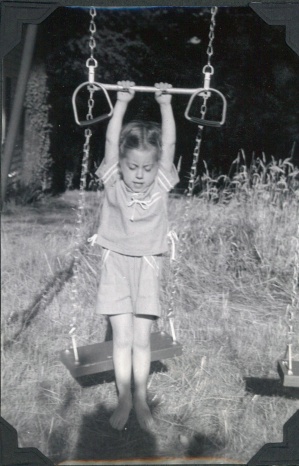
The house we moved into when I was eight had a truly fascinating feature: a door in the second floor hall. When you lifted it up you were staring down a long tube. We soon learned that it was a laundry chute and emptied into a cabinet in the pantry where the washer and dryer were located. Needless to say, we spent a lot of time daring one another to go down it, especially since we had been sternly forbidden to do so. I was too big and cowardly to try, but I am pretty sure one of my little sisters tried it out. But the chute was a great place to throw a sibling’s toy or shoe. No one ever thought to paw through the laundry to find a missing object, so it remained missing for up to a week.

I never did the laundry, but I always had to fold the dried clothes and linens. We had a large dining room table, and the clean wash was piled up on it waiting for me. I can remember coming home from school to be confronted with a gigantic pile. At least it smelled better than the pile that had accumulated in the chute!

I did have to do a lot of ironing, however. But ironing deserves a post of its own. I will get to it tomorrow. (Just as I did with the ironing!)
“Before the Electric Dryer”

clothesline

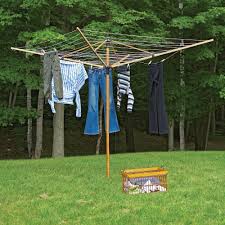
When I was young, my mother had a washing machine, but no dryer. I think that in the early 1950’s dryers were still considered luxuries. We had a contraption such as the one shown in the photo above. My mother didn’t take any photos of our actual drying spinner, probably never thinking anyone would want a photo of it!

I imagine it was a genuine pain to do the laundry this way in Oregon where it seems to rain much of the time. She also had clothes lines in the basement for times it was simply too wet to bother hanging clothes outside. She had three of us, with two in diapers for a while, so the wash was never ending.

I think, though, that things only seem a burden when you acquire another way of doing them. As long as neither she nor anyone she knew had a dryer, hanging clothes outside was simply part of her life. I never heard her complain about it. I only knew her joy when we moved when I was eight into a house which came with a dryer. She was thrilled and we knew it. And it came just in time for baby number four and another round of of dirty diapers!

“This Is the Way We Wash the Clothes”

laundry

Doing the laundry this morning, I thought back about all the different places I had done the wash and all the different machines and lack thereof that I had used. I will start this wash day series with a poem about my neighborhood. When we first moved in, my next door neighbor actually said the quote that starts this poem.

Reading the Lines

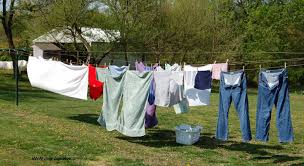
“I can’t believe you pay to dry them. The sun is free.”

Pampers won out so

Diapers no longer announce new births.

But the lines still tell stories.

Flannel pajamas reveal a marriage chill.

Khakis replace work overalls.

Lacy bras give way to sturdier support.

Men’s clothes suddenly disappear.

Make of it what you will–

Here we still value thrift over privacy.

“Back to the Gym”

1948-50s-148

It had been three weeks since I had been able to go to the gym for my twice weekly session with my trainer. First I had been sick for a week, then she had been sick for a week, then it had snowed. I wasn’t sure how much my strength had slipped during that time. But I was able to do a good 45 minutes of weights and stretches, only 15 minutes less than usual.

It was good to see the regulars; the women who come in at the same time I do each week. While we don’t know each other outside of the gym, we are great encouragers to one another and utterly noncompetitive. Each of us has her own goals, strengths and weaknesses, and we exercise in friendly proximity.

What I had forgotten in just three weeks is the beneficial effect that even this brief workout and socializing has on my state of mind. It is easy for me to slip into a mild melancholy without even realizing it. Since I am retired and my husband still works, I have a lot of time alone. While I enjoy the solitude, it can creep into isolation without my notice.

But today I went, I worked out, and my frame of mind improved. I was reminded of why I have committed to this routine. It’s more than my muscles that need a workout. My sociable nature needs one too.

“23 Hours”

hardlaborcreek

A close friend of our family had a difficult labor with her first child. The couple had prepared for the birth, as do most young couples, with classes and books and discussions with other new parents. However, little went as planned. After the ordeal was over, I offered this short poem as witness to the seeming battle that went on for nearly a day.

Hard Labor

You led us in a lockstep march

broke to take a rest

then plunged ahead

onto the front line.

We camped to wait a word from the field.

You and your mother struggled

she contracted

you advanced.

The battle plans gave way to actual terrain

rockier than scouting  reports

more treacherous than plotted.

Outcome uncertain

we longed for armistice,

combatants lying down

for a well earned rest.

“At Seventy”

9F543364-90FD-414C-89B3-9A50B5D62A98
Great-grandmother Jennie Nash

It is a lot of fun to see where I got my tendency to “fill out” in my later years. But it is also lovely to see the demeanor of my great-grandmother who seems to have an almost smile as she sits for this portrait. I often have a hint of a smile, though I am trying to keep a straight face.

Anyone who has arrived at seventy will notice that time does funny things. Parts of it stretch out endlessly, such as late at night. Other parts zip by as grandchildren, only recently babies, approach adult height. I learned long ago that the Greeks had two words for time: chronos and kairos. Chronos seems to refer to time in our ordinary use of the word. Kairos has a more clear sense of the perfect moment. The following short poem shares my reflections as I turned seventy.

Seventy

And so I join them

out walking mornings,

lingering at checkout stands,

smiling at babies.

Taking time.

Chronos a fabrication.

Kairos the only solid ground.

“What’s a Meta-for?”(bad pun)

crossstitch

One of my students’ loudest complaints about poetry was the use of metaphor. “Why didn’t poets just say what they mean? Why did they have to “hide” their meanings?” As I have mentioned before, poets aren’t by and large intentionally obscure. Rather they are doing their best to communicate an image or an observation to the reader. So why use metaphors anyway?

I find that many times in regular conversation we will speak in metaphors without realizing it. We will say we have a “killer” headache, when we really don’t think we will die from it. Rather, we are saying that the intensity of the pain is like someone trying to kill us. So poetry uses the same device to help the reader understand something. (I realize that many people already know this. I am addressing the reader who is put off by poetry because of the “hidden meaning” stumbling block.)

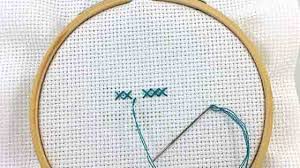
In the little poem that follows I am using needlework, a hobby of mine, as a way to comment on the difficulties of contemplative prayer. In this case, the literal mistakes on the canvas reveal my lack of concentration on the task at hand.

Contemplation 101

You may think

you kept your focus

without wavering.

One glance

at the needlework

under your fingers

reveals the folly.

Thoughts drifted off.

Stitches record the detour.

“A Tribute”

breastcancer

The wife of a colleague of mine at work learned that she had a genetic predisposition to getting breast cancer. She chose to have a prophylactic mastectomy–the removal of two healthy breasts. I was moved by her decision and wrote her this poem.

For Laura

Needing a steady place

to rest her bow,

the Amazon woman

sacrificed her right breast.

Fair trade, she thought,

for good aim and clear direction.


You, now, warrior yourself,

flatten the playing field

altogether.

Hoping, we know,

for a steady place

for E and J

to grown and gain

your good aim and clear direction.

“Take a Chance”

lottery

Connecticut is a strange state. Rather than having counties as the seat of government, here we stick to the 169 towns which originally made up the state, many begun in colonial times. This means that there is great disparity between adjacent towns. A very wealthy town can butt up against one with great poverty. I live in such a town–the poorer one–and take note of the differences. In the next town over, people walk for exercise and ride bikes with their kids for fun. In my town, people walk many places and what bikes there are carry adults to work or stores. The following poem comes from my observations of the many people who walk by my house every day.

EAST HARTFORD

Here we walk to get somewhere.

We long for the day we can drive,

Park right at the store,

Load our trunks to overflowing.

Instead we buy what our arms can carry

From overpriced stores within reach,

Dropping used scratch-it tickets–

Our one hope of transport–

Like crumbs along our way home.

“I, Too Dislike It”

poetry

The title quote is from Marianne Moore’s poem “Poetry” where she agrees with those who find poetry obscure, but also defends the writing of it. Since I have been choosing which poems of mine to post, I have been thinking about the barriers between poetry and readers. Poetry was never meant to be full of “hidden meanings.” (Well, I take that back. There are poets who are intentionally obscure. I am not one of them, nor do I have any interest in reading them.) English teachers often do poetry a disservice by implying it is something that you have to “figure out.” Worse are the teachers who ask leading questions which only have one answer–their answer–about poems.

I like poetry because it has a unique way of putting words and images to experience. Many times poems will help me to see something I have overlooked. Other times I feel companionship when I read a poem, feeling that at least one other human being understands something I understand.

In the following poem I reflect on the neighborhood boys who spend hours shooting baskets down the street from my house. I admire their perseverance, a trait I sometimes lack.

Practice

Mostly they miss,

Those boys endlessly

Trying, trying, trying

To make the ball

Swoosh lightly through the

Battered, wobbly, rusty hoop.


They dream, too.

And, more willing than I,

Keep aiming

Keep missing

Till sundown.

I hope that as you read this you can tell that my neighborhood isn’t wealthy(see the description of the hoop.) I hope that you think about boys whose one avenue out of the neighborhood might be sports. I hope you admire their sticking to it, no matter the odds against them. But I would rather you come to these ideas on your own just from reading my words. There is no right way to read this little poem. I just hope to communicate something about those kids to the reader.