
For those younger readers who don’t know who the guys are talking about, I give you Annette!

For those younger readers who don’t know who the guys are talking about, I give you Annette!


My best friend in 5th grade was Dixie. As you can guess, she had moved to Portland from Georgia when her father was transferred. She lived within easy walking distance from me, and her house was on the walk to and from school. I often stopped for a while at her home after school . They had a “nigra” maid(this provoked a long discussion with my parents who explained that while Dixie’s family thought this was more polite than its alternative, it was still a very rude thing to call someone)who had a snack and a glass of milk for us waiting when we arrived.
After snacking, we settled ourselves in front of the television for our two favorite shows–American Bandstand and the Mickey Mouse Club. In those days, Dick Clark was famous not for New Year’s Eve, but for his hosting of this wonderful show of singers, top ten songs of the week and real people dancing to the music. It wasn’t until I looked up the video for “Itsy Bitsy Teenie Weenie Yellow Polka Dot Bikini” yesterday that I realized that they were all lip syncing. (And how creepy that it’s a kid in the bikini!)We didn’t have a clue and were totally in awe of all these “famous” stars appearing “in person” “live” for our entertainment. Neither of us knew anything about dancing, but we studied the participants carefully, imagining one day we might get to be on American Bandstand.
With only one radio station playing hits and one television show playing songs, we all knew exactly the same music. I am being delighted to realize that some of my followers memorized the same songs. Unlike later, when musical tastes really diverged, for white middle class kids across America in the late 1950’s, there was only one sound. And we heard it on American Bandstand.
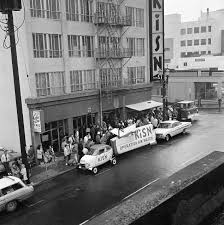
Ok, so now I had a radio I could carry around, but this was Portland, Oregon in 1959. If you are young, you probably think Portland is a place on the cutting edge, full of hipsters, restaurants, naked bike rides and legal marijuana. Forget all that. In 1959, Portland was solidly, boringly, dead. There was no radio station to hear music that was new. But in 1959, radio station KISN began broadcasting and even listing the top 50 songs every week. Unlike people in big cities, we had no choice of stations, nor were we able to pick up signals from other cities, since they were hundreds or thousands of miles away. So everyone under 20 listened to KISN.
And what were we listening to in 1959? Well, one of my best friend’s and my favorites was the “Flying Purple People Eater.” Its redeeming quality? There was none. But it was certainly fun to sing at inappropriate times such as when our mother asked “Who did that?” We could respond, “It must have been that one eyed one horned flying purple people eater.” Then when she remained unconvinced, we could single out any available sibling. (As a side note, one of the terrible things about having kids leave home is that there is no longer anyone to blame for things!)
“Purple People Eater” was just one of many terrific “novelty songs” of the 1950’s. Another that comes to mind was “Splish Splash.” Though Bobby Darin’s real hit was “Mack the Knife.” Amusingly enough, my grandson loved the song about Mack the knife when he was four years old. He liked to shout out “look out old Mack is back!” At one point both my daughter and I realized that it was really quite a gruesome song. We had overlooked that basic fact and had to stop encouraging him. I would have been safer teaching him “Purple People Eater,” but that would have driven me nuts. And maybe given him nightmares.

One of the most amazing developments in my lifetime has been the technology to shrink things. When I was in college, I worked for a neuroscientist whose computer took up an entire room which had to be air conditioned to keep it running. Televisions took up considerable space in the room, not because they had a large screen, but because the picture tube was so big. Telephones were weighty enough that when my sister in a fit of pique threw one against the wall, it made a sizeable hole. Cars, as I have shown, were big enough to allow me to sleep in the back seat. But the first object to really capture my delight was the transistor radio.
Until then, to listen to the radio I needed a large radio and an electric outlet. This meant listening to the radio in my room if I wanted to hear music I liked. But the invention of the transistor changed things entirely. I could put it in the basket of my bicycle when I went to visit a friend. I could take it outside to lie in the sun “working on my tan.” I could smuggle it into my sleeping bag and take it to camp. A friend and I could sit on the porch and listen to a song together.They were not inexpensive, and I did not have one until the sixth grade when I was 12. I guarded it with my life since my three younger siblings were eager to use it.
Before writing this post, I read about the history of the lovely device. One entry said that the transistor was poised to take off by a combination of large numbers of Baby Boomer kids, disposable income(not in my house!) and of course rock and roll. I had to babysit to earn the money to buy mine, but I certainly was a Baby Boomer who could now happily listen to rock and roll without someone yelling to “turn that stuff off!”

When I was five years old, I had a beloved baby sitter named Mrs. Dully, an Estonian refugee.(How ironic that Estonia is again feeling threatened by Russia.) She lived near by and usually came to our home to watch us. One afternoon, however, I was at her home and saw this magnificent large machine. I had been hearing a lot about television, but had never seen one and had no real idea of what they looked like. So I asked her,”Is that a television?” She laughed and laughed and told me it was just a very large, very fancy radio.

Our radio looked like the one pictured above. A simple squat brown box with a dial for the stations and a dial for the volume. No wonder I was in awe of her cabinet with its large speaker. It was the kind of radio families used to gather around to listen to shows together. We still listened to our record players and didn’t yet have a television. The radio was in my parents’ bedroom and was unimportant in my young life.
That would change soon. While I was outdoors playing, scientists were perfecting a miniature radio you could carry around with you. Unbelievable!

In 1956, when I was in fourth grade, our school had a record sale in the gym. I don’t know why they decided to do that, but it was my first chance to buy my own record. I was nine years old, and I had already heard about Elvis Presley. He had appeared on the Ed Sullivan show, which we watched every week now that we had a television. Usually we gawked at the Chinese plate twirlers and the ballet dancers, but the appearance of Elvis was a big deal. Everyone was talking about his performance.
In 1956, television shows with married couples in them showed them sleeping in twin beds. Any discussion of sex was completely taboo on television. Here came Elvis, apparently writhing his pelvis, and the cameras only showed him above the waist. We had no idea what they were keeping from us, but it certainly got our attention. So when I had a chance to buy a 78rpm record of my own, I chose Elvis.
I actually held on to my copy of “Don’t Be Cruel” for many years. I have no idea how it finally disappeared. Perhaps it was when I gained more musical knowledge and learned that Elvis had “stolen” “race music” and made it palatable to the white listening audience. I don’t think that anyone owns any kind of music, but this was a source of great contention when I was in my 20’s, and perhaps I unloaded the record then.
At any rate, it was my first–but certainly not my last–music purchase. I played that side over and over, driving everyone in my family crazy. And then I turned the disc over and got everyone yelling at each other,”you ain’t nothing but a hound dog!”
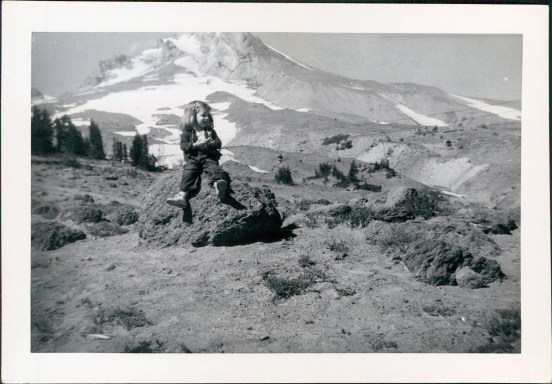
Taken in the summer when the snow pack has withdrawn to the mountain, this photo shows me at the base of Mt. Hood, the 11,250 foot mountain which towers over Portland, Oregon, fifty miles away. Later in my life, I climbed it to the top with a group of friends, but today I am thinking about skiing on it.
In seventh and eighth grade, everyone in my grade school took skiing lessons at Ski Bowl on Mt. Hood. We met up at Riverdale Grade School , loaded our skis in the back of the school bus and were driven to the slopes. 
In the late 1950’s, skiing was not a particularly expensive hobby. We mainly used row tows to get up the hill as pictured above from a 1930’s photo. Every year our school had a ski swap sale and you could sell your outgrown equipment and buy the next size up. Nothing was aerodynamic; boots were clunky; skis were fat; we all wore a lot of wool.
But about the singing–the purported focus of this post! We sang all the way up to the mountain, but unlike the camp bus, this one had boys and girls. There were no sentimental songs. Instead we tried, usually successfully, to drive our chaperones crazy with our singing. Our two favorites were “One Hundred Bottles of Beer on The Wall.”(children say pop, not beer!) and “The Ants Go Marching.” Perhaps you were spared learning these ditties. They share a trait of going on forever. In the first case, singing down one by one from 100 to 1. In the second case, singing up from 1 to however high you could count before someone yelled, “Shut up!”
We did this every Saturday throughout the winter, from November through March. 40 kids, singing two insane songs over and over. Somehow we loved it. Of course, there was nothing much else to do on the ride except make plans about who to sit with on the ride home. We girls liked the boys, but we still rode with each other on the way up. We rode with each other on the way back, too. But we had enjoyed the delight of plotting who we MIGHT get to sit with coming back. And that was almost as much fun as pestering the chaperone.


Earlier this year, I shared this picture of me getting ready to go off to Camp Namanu, a Camp Fire Girls camp I attended one week each summer for six years. The Ford station was used to get me to the school bus which took us to camp. Riding the bus to camp was wonderful since, after all, we were on the way to camp. But also it was heavenly because we sang all the way there, about an hour’s drive.
I see kids on buses now, listening to their phones or texting whatever friend isn’t within arm’s reach. So I am sure that the concept of everyone singing together would seem very alien today. But it was a normal activity for groups of kids when I was in elementary school. Tomorrow, I will write about the ski bus and its songs, but today it is all about camp songs.
Singing on the bus was my first introduction to the songs which we would sing at camp. My first year, of course, I didn’t know any of the songs, but they were easy to pick up, and I knew them for the next year’s ride. My favorite was the one a counselor would begin when she could tell we were almost there. She would begin a loud repetitive song with the straightforward lyrics of “We’re Here Because We’re Here Because We’re Here Because We’re Here!” The link will allow you to open a rendition of the song. Beware–it may get stuck in your head.
Singing at camp after meals was one of camp’s highlights. All campers ate together in a large dining room, probably 200 people in all. After each meal someone would rap their knife on a water glass and begin a song. Then everyone would join in. There were silly songs like “John Jacob Jingleheimer Schmidt”( a song which ends with everyone yelling, a perennial favorite.) There were camp specific songs sung about different camp units:”We are the Balagan bold, brave as a two year old, we cry when we get cold” but we all sang together “and in our memory dear to our hearts will be, Camp Namanu’s sure to shine all of the time.” At the very end of camp we sang a very melancholy song about leaving for home.
We rode home in silence. I think no one was very excited about getting back into what was usually a very long, boring summer vacation ahead. And most of us were not glad that “we’re here!”

One of my great joys as a kindergarten student was singing. We sang all the time, since Miss Hilen could play the piano that stayed in our classroom. I went to A.M. kindergarten, which meant that everyone was wide awake and ready to sing. There was no particular singing instruction, nor were we to read music. We were just taught a song and then sang it out at the top of our lungs.
The highlight of the first half of the year was our Christmas concert. In 1952, they were still called Christmas concerts, not winter festivals or solstice celebrations. I don’t know if anyone objected, but that was typical in those days.
We got to stand on risers and perform for our parents. Just standing on a riser was very exciting for me since I was tiny, probably the shortest kid in the class. On a riser, however, I was even taller than Norman Smith.(My good friend who that fall had broken his arm showing me how to fly off the roof of the shed. I fortunately took the demonstration to heart and didn’t imitate him.)
We belted out “Up On the Rooftop” and “Santa Claus is Coming to Town.” I had just learned to snap my fingers, a monumental accomplishment. “Up on the rooftop–click, click, click.”( three snaps in a row.)
We had no doubt that we deserved all the applause from those moms.(And of course in 1952 it was all moms and younger siblings in attendance.) Christmas was right around the corner and we had “watched out”since Santa knew “if we’d been bad or good!” I don’t know if anyone else believed in Santa Clause, but I certainly did. And I had been very, very good.(well, mostly!)

My grandparents had a large 78rpm record collection. Grannie liked classical music, so her favorites were symphonies. In fact, after they retired to Chicago, Grannie had a subscription to the Chicago Symphony. Grandpa was no such classical connoisseur. He liked all sorts of what Grannie called “hillbilly music.” They owned a Victrola such as the 1920 model pictured above. You had to wind it up and carefully place the needle on the record. We loved winding the machine which seemed very old-fashioned to us after our little electric player.
When Grandpa would regale us with his music, my grandmother would mutter, “Oh Niles!” in a long suffering voice. We ignored her and listened intently. Grandpa was partially deaf, and he played the music LOUD which also delighted us. One of his favorites was “Hallelujah I’m A Bum.” If you have never heard it, this recording is the one he entertained us with.
My grandfather liked the almost risque, which was amusing since he was an Episcopal priest. We learned almost dirty limericks from him. My favorite was and still is:
“There was an old woman from Boston Mass–Who went in the water up to her ankles–It doesn’t rhyme now–But it will when the tide comes in.” “Oh, Niles!”
He also had a favorite recording of “Lydia The Tattooed Lady.” This video clip shows Groucho Marx singing the song. Of course as kids we didn’t get the double entendres, though we caught the drift that it wasn’t written for kids.
Unfortunately, I have never been able to find his very favorite record of “The Runaway Train.”(The runaway train went over the hill, The last I heard she was going still.”) I did, however, sing his version of “Mary Had a Little Lamb,” called “Mary Had a William Goat” to my child. It still makes me laugh when after swallowing TNT, “Mary’s soul to Heaven went, but William’s went to whoopsidoodle, doodle doo, William’s went to Heaven too.”
 Saved By Words