Communion

ritz_crackers

This is the first day of the new liturgical year and the first day of the season called Advent in the church. It is seen by some as the time to anticipate the birth of Jesus. But, since in my faith Jesus has already been born, it is instead a time to look for Him in the people and situations around us. He has said that whatsoever we do to the least of these we do to Him.

After reading some very disheartened writings from people over the last two weeks, many trying to figure out what they should do with the state of the nation, I pondered an appropriate answer. It came to me as I reflected on the “small” things that people had done for me throughout my life and what enormous impacts they had. And in most of the cases, they never knew. I hope as I write about these occurrences during Advent, people may both remember similar instances in their own lives and also gain appreciation for the power we each have to make a difference in the world.

Grace lived next door to me from when I was three until I was eight. My mother was usually overwhelmed taking care of the younger kids, and I was on my own much of the time. Grace welcomed me into her house any time I wandered over. She gave me Ritz crackers once, and I told her how wonderful they were. We didn’t have snacks at home. Grace kept them in an upper cabinet and got them down each time I came over.

One afternoon, Grace told me she had moved the crackers. She had put them sideways in a lower drawer in the kitchen. I asked her why she had done that, and she replied, “So you can reach them.” That “small” gesture soothed my heart and gave me a sense of being cared for that I can still recall sixty years later.

Here’s to every such person in a child’s life.

She Called Me “Ort”

l-assorted-fam_00012a1948-50s-418

I have written before of the death of my beloved Aunt Cary, but I am thinking about her a lot this Thanksgiving weekend. It was Thanksgiving of 1969 that Cary walked off a ledge in Manhattan and fell to her death. We didn’t learn about it for several days, since she had no identification with her. I came down with Hepatitis A that weekend, courtesy of a contaminated restaurant worker, and was unable to go to Chicago for her funeral.

She was only seventeen when my parents left me in Buffalo with my grandparents for several months while they went West to establish a new life and career.( A whole other story.) That means that it was Cary who took major care of me from 11 months until 14 months. She was there when I learned to walk, and she occasionally came West to visit us.

She always called me “ort.”  I found her chain smoking, insomnia, fast talking and loud laugh a wonderful contrast to my parents. Yes, she was probably bi-polar, but I didn’t have a clue. I loved her without reserve.

By the time I was in college, she was more seriously ill, unable to hold a job, and held for a while in a pre-enlightened Chicago psychiatric hospital. I visited her there on my way to Cambridge, and she looked so wistfully at me saying, “you look so collegiate.” In 1967, she was living in Manhattan, and  I had tea with her in the Russian Tea Room (where the men bring their girlfriends, she confided) when she was living at the Barbizon. That was the last time we saw each other.

So here’s to you Aunt Cary. You were and are a true blessing in my life and I give thanks for you tonight.

“Over the River and Through the Woods”

1948-50s-319

My parents had moved across the country from their parents and relatives, so at Thanksgiving we celebrated with another family who had similarly left their families behind in the East. Our good family friends had tried for years to have children, and finally adopted two, including this little one on her father’s lap.

We had a very predictable dinner for the times: turkey, stuffing, potatoes, green beans(without that crunchy topping.) But the real fun was before dinner when we would stick ten blacks olives on our fingers, one per finger, and chase each other around. We would also stick our fingers in the wax dripping off the candles and make little wax fingers. We had the opposite of helicopter parents, for sure.

My mother did teach me one important skill I use every Thanksgiving, how to make giblet gravy. I remember how when I start making it, but I would be hard pressed to explain how I do it. My husband, who grew up in the South with very different ordinary foods, was knocked over the first time he had the gravy. Now it is his most looked forward to food each year. I also converted him to the New England whole cranberry sauce. He missed the little ridges from the canned cranberry jelly the first year we were married, but he has come to prefer mine.

Happy Thanksgiving all.


Compassion For One Another

1948-50s-357

Yesterday in church we had a healing Mass where you could go forward for anointing and prayer for healing. You were invited to bring illness, addiction, despair, affliction and burdens for others to be prayed over. At first only a few went forward. As time passed, however, more and more parishioners got in line. In the end, I imagine 75% of the 300 or so people went to be prayed for and anointed.

It is humbling to realize how many around us are in pain and in need of a healing touch. Once, when I was in college waiting for the MTA train in Harvard Square, I was feeling very sad. I was thinking that everyone around me looked happy and I felt very alone in my pain. Then, unbelievably, the girl next to me jumped in front of the train as it pulled into the station. I ran up the down stairs, back into the light, into the arms of the people I had just left. I simply had no idea that other people might be in despair around me. Since that day, I have never been so presumptuous about how other people are doing.

Still, yesterday’s service was a visceral reminder that most of us are burdened. We need to remember that whenever we interact with another person. Some hide with their pain; some lash out, but we are mostly just trying to move through our lives. No one really “has it all together.”

“Only Connect”

1948-50s-354

My grandfather(second in from the left) had a group of colleagues from academe that he loved to visit with at his summer place in rural New York. I, too, loved the collegiality of the college where I worked for 25 years. I also treasured the influx of new freshmen every fall with their excitement, dread, talents and traumas. Each spring I delighted in the senior class going out into the “real world” with their excitement, dread, talents and traumas.

Since retirement, I don’t have a chance to be handed a new crop of interesting human beings each year. Instead, I deepen the relationships already in my life. Still, I have missed the serendipity that comes from those new people delivered, without effort on my part, into my life.

A surprise for me from blogging has been that I have begun to make connections with several very interesting and very diverse writers. They remind me of my students, most of whom were in their early twenties when they came to my college. They are full of excitement, dread, talents and traumas. I write the kinds of things I used to talk about in the classroom. An assortment of ideas with no central theme apart from “what is on my mind today–what’s on yours.” I get to comment on their posts without the pressure of correcting their spelling or grading their efforts!

Thanks everyone. E.M. Forster in his novel Howard’s End stresses we need “only connect.” It’s begun to happen for me in these pages.


Let’s Hear It For Technology

1948-50s-370

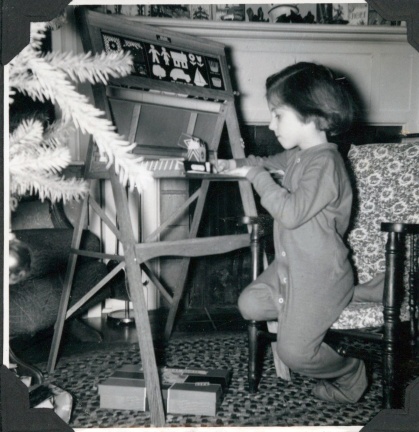
Here I am writing with chalk on blackboard in 1953. Now I am “writing” on a keyboard on a computer about to “publish” my thoughts on a blog which will go out on the internet. There is not a single noun in the preceding sentence which I could have understood in 1953.  Well, maybe “thoughts.” I look very thoughtful here.

I was reminded of how swiftly things have changed when my seven year old grandson was examining a turntable.

“What is this thing? What do you put on it? How does it work? Do you pick up this lever(the arm) and put it down again? Does it go around?”

I tried to explain the whole thing to him. When I was done he remarked, “Boy, that’s some technology!”


Our Own Unending Misinformation

propaganda-truth-liberty-government-public-domain

Today it isn’t television that is our biggest supplier of misinformation. For that, we get to turn to Facebook. Apparently 45% of Americans rely on Facebook for their news. In past times, countries had to mount disinformation campaigns to try to control their citizenry. We have saved our government the trouble by running our own.

On any given day you can find photoshopped images presented as facts. Lies presented as facts. Facts painted as lies. Apparently many still believe that President Obama is a foreign born Muslim. Of course if you keep repeating a lie over and over it can get stuck in the brain as a truth.

I wouldn’t ask my plumber to fix my stove. I wouldn’t rely on my car mechanic to take out my appendix. In these spheres we still seem to appreciate knowledge and competency. In the world of genuinely challenging issues such as climate change, world poverty, racial injustice and religious intolerance, many Americans apparently rely on faceless fake news articles which they distribute (for free) to their friends.

George Orwell couldn’t have dreamed up such a scenario.

Au Revoir Leonard

leonard_cohen

I wrote about Leonard Cohen a few days ago as I was baking the 36 minute apple pie. I followed him all his musical(and not so musical) life and continue to be moved by his last album.

We all will come to the end of our lives and will have a chance, God willing, to do some deep reflection on how we used our, to quote the poet Mary Oliver, “ one wild and precious life.” Cohen does that in the last album asking for a treaty with God, history and those he has loved.

Some times in history call for contemplation of our individual and collective purposes. I think this is such a time. We can surrender to either despair or jubilation, depending on our political outlook. Neither is ever warranted by the election of any flawed human being to the presidency of one country. Instead we can look to the Beatitudes for our blessings. They provide cold comfort for the entitled, close-minded and smug. But they provide sustenance for those who keep putting one foot in front of the other in the pursuit of peace, justice, elimination of suffering, and hospitality to the stranger.

THE EIGHT BEATITUDES OF JESUS

“Blessed are the poor in spirit,
for theirs is the kingdom of heaven.

Blessed are they who mourn,
for they shall be comforted.

Blessed are the meek,
for they shall inherit the earth.

Blessed are they who hunger and thirst for righteousness,
for they shall be satisfied.

Blessed are the merciful,
for they shall obtain mercy.

Blessed are the pure of heart,
for they shall see God.

Blessed are the peacemakers,
for they shall be called children of God.

Blessed are they who are persecuted for the sake of righteousness,
for theirs is the kingdom of heaven.”

Gospel of St. Matthew 5:3-10

Thinking About Yeats

The Second Comingyeats
Turning and turning in the widening gyre
The falcon cannot hear the falconer;
Things fall apart; the centre cannot hold;
Mere anarchy is loosed upon the world,
The blood-dimmed tide is loosed, and everywhere
The ceremony of innocence is drowned;
The best lack all conviction, while the worst
Are full of passionate intensity.
I am a retired English professor, and I once spent a semester in college reading Yeats for a tutorial. This poem comes from World War I, but the first stanza resonates especially strongly with me today. In the United States at the moment, half of the population appears to be in mourning while the other half is jubilant. Clearly this is no way to coalesce to face the very real problems facing this society.
There is no going back to a mythical “great America,” as I have written previously. The very notion damns a sizeable proportion of our citizenry for whom America was anything but great. It is like a 19th century Confederate longing for the “good old days of slavery,” with our “happy Mammies” and “nigras” who “knew their place.”
The way forward is the only way available. No one knows what it looks like, but it certainly won’t be full of steel mills and “the little woman” at home. May we face reality with hope rather than bitterness and blame. May we find a way to  redirect our “passionate intensity” into rebuilding a nation with “justice and liberty for all.”

Micah 6:8

1948-50s-353

“He has told you, O man, what is good; And what does the LORD require of you But to do justice, to love kindness, And to walk humbly with your God?”

My grandparents lived through two world wars, the Korean War, and the Vietnam War. They survived the Spanish Flu, which nearly claimed my grandfather. They lived through the Great Depression. During that economic crisis, the faculty at the University of Buffalo where my grandfather was a Dean, chose to take an across the board pay cut rather than lay off junior faculty members. They understood ordeal, suffering and sacrifice. Yet they remained loving and hopeful throughout their lives. Their faith gave them a firm foundation on which to stand.

My foundation is God, not the United States. This morning as I deal with a new and troubling national reality, I look to Micah for instruction. It is pretty clear that despair is not from God. I will continue to try to walk out my life justly, kindly and humbly.

As the New England abolitionist Theodore Parker said in 1853: “I do not pretend to understand the moral universe; the arc is a long one. . . . But from what I see I am sure it bends toward justice.”