“Electric Bathroom”

The other day I was at our local library and went to wash my hands in the restroom. No water came out of the faucet no matter how I tried to move my hands in front of what I thought was the sensor. (Even this ability was fairly new to me. My granddaughter has had to teach me how to make various fixtures in restrooms operate.) When I still failed to get any water I went to tell the librarian. She calmly replied, “Oh yes. It needs a new battery.”

I stopped to wonder what persuasive sales people had taken over the fairly standard fixtures in public restrooms. Clearly different pitches appealed to different buyers, so there is no standard. Some faucets go on as soon as something is set on the rim of the sink. I learned this when I rested my purse there! Others need one to wave one’s hands in some sort of pattern. When the water comes out, there is no way to change its temperature or the length of time it flows. Somewhere somebody has made those decisions for the fixture, ignoring the various demands of users.

The biggest con has been the substitution of high speed air machines for paper towels. Knowing that users don’t like them, there are frequently signs touting their “environmental advantages.” They leave off the fact that they distribute germs from the room onto your hands as they circulate the air. And they are useless for washing off a toddler’s face or dabbing a new stain on clothing.

What towel machines still exist seem to have fallen victim to the “automatic” versions. They each have an idiosyncratic way of operating from waving to holding to staring dumbfoundedly until a grandchild takes over. Fortunately they also sport signs saying “if no towel comes out, roll the gear on the side.” I guess even their inventors don’t trust the reliability of the technology.

I never thought I would wax nostalgic for the faucets and towel dispensers of my youth. But it appears that I am.
“Temporary Truce”

9EF025CA-D5EF-42A6-A647-165EB42E182B

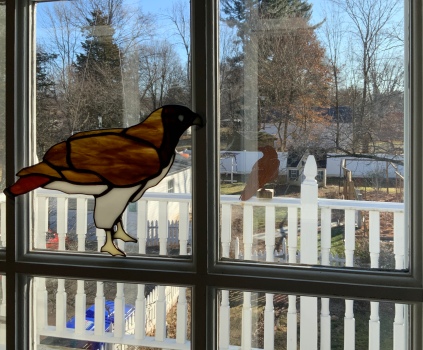
My husband, knowing I love both hawks and crows, has given me one of each. The stained glass hawk hangs on the inside of my office door. The door opens out onto a little porch, and a rusted scrap metal crow sits perched on its railing overlooking the yard. For the moment at least, separated by the French door, they are at peace with each other!

“Crow Convention”

BCF5D112-7F79-4795-A211-68EAD31F1FF8.jpeg

I have always loved crows and have learned as much about them as I could. I enjoy watching them walk, soar, fly and settle. Fortunately for me there is a large winter roost in an adjacent town. That roost has about 13,000 crows in the winter, filling trees, having a great time chatting with one another. Just before dusk, groups of crows gather everywhere before flying on together to the major roost. Flying over the car as I drive, they seem to be as excited to get together with their roost mates as I am to go meet my friends.

Apparently the Hartford winter roost, a tiny bit of which is pictured above, attracts many crows from Canada and more northern New England. While it is somewhat warmer here, I am surprised that they don’t join other migratory birds heading even further south. Hartford must have a great Trip Advisor rating among crows, so this is as far as they need to travel.

I had a cranky relative who hated crows. For some reason he seemed to take their call personally and would fire his gun at them when they landed in tall firs near his house. Fortunately he was a terrible shot and never even grazed a crow. I always rooted for the crows if I happened to be visiting during his temper fit.

My only conundrum comes from my mutual love of crows and hawks. Hawks like to go after crows. Crows retaliate by grabbing a few friends and chasing the hawk. I always hope that all the birds escape this fight to fly another day.


“Catastrophic Volcanoes”

terwilliger

When I woke this morning I read a blog post from my friend Arlene in the Philippines reporting the beginning of a massive eruption of the Taal Volcano, about fifty miles from her home. The volcano had not erupted since 1977, and it is posing a danger not only to those living near by, but also to a wide area on all sides. The government has called it an Alert 4, which suggests an imminent explosion.

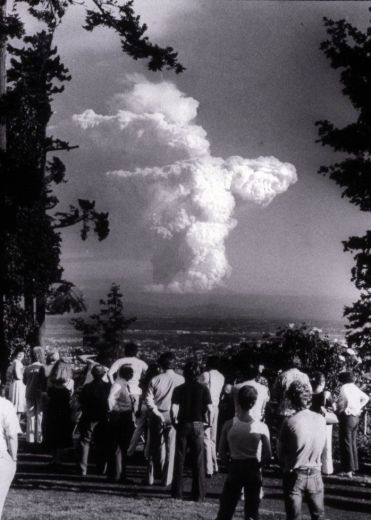
On May 18, 1980 we were heading home from church when the radio alerted me to an eruption of the usually serene Mt. St. Helens, 47 miles from our home. At least 130 years had passed since its previous major activity. This time many more people lived near the mountain and many towns were built along the river below. I drove to a ridge above our home and stood, with a crowd pictured above, to watch the astonishing sight. It turned out I could see it from the neighbor’s porch when we drove home even though we were at river level. Soon ash began to fall all around us. This heavy ash resembled tiny pebbles more than light ash. It filled gutters, covered cars, and made breathing challenging for a while.

In floods you can usually find higher ground. In blizzards you can usually hunker down even without power. Tornadoes find us in the cellar. Heavy winds keep us away from windows. But volcanoes don’t give you any options. You can’t know when and for how long the eruptions will last. Like earthquakes, they remind you that we are at nature’s mercy much more than we like to think.

My love goes out to Arlene, her family and her country. And, by the way, you will never intrigue me with the offer of “volcano tourism.” I’ve seen enough.

“Parenting an Addict”

house.jpg

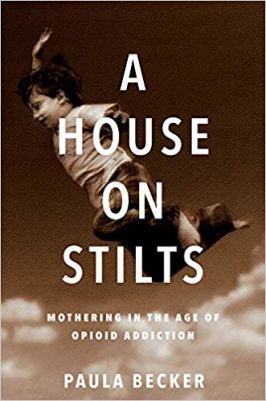
Although I do not have an addicted child, I have a close friend at church whose son in his 20’s has struggled with heroin addiction for some years. In an attempt to better understand her and to avoid all the platitudes that inundate her regularly from well meaning friends, I read A House on Stilts by Paula Becker. Becker, a writer, and her physician husband dealt with the various addictions of their oldest child for a long time. This book honestly portrays both the love they have for their son Hunter and the unending ways they attempted to help him. She struggles with the line between mothering and enabling throughout the years.

The book brought the specific pain of my friend home to me in a way that other depictions of addiction haven’t. I am not sure if it was the clarity and truth of the author or the timing of my reading, but it illuminated the anguish of a mother watching her beloved son turn into an angry, lying, stealing adult. Becker encounters denial from health professionals and school administrators for a long time as they see a white, friendly, well spoken teenager and assure her his behavior is normal. We know from what she has seen that it is not, but she struggles to believe them.

And of course the Beckers bring their own denial to the situation as would any parent heartbroken at the possibility that their bright, energetic son has become an addict. They pay large sums for treatment, continually struggle to get him food and clothing, and overlook the money and items disappearing from their home every time he is allowed in for a visit after they have banned him from the house. Relatives believe they know better and offer to help, as is the case with my friend. However, they too finally see that “tough love” won’t cure addiction.

From now on when I see young addicts on our streets or in my church’s sandwich line, I will pause to think about the mothers and fathers in deep pain over their children. And I will not judge them.

“Come On In!”

289C7292-32FF-4FA0-8B93-07CC495545F8

I have friends who love to entertain, invite people over for meals, spruce up their homes, cook special treats, settle in and relax with guests around the table. They totally mystify me, although I am grateful to be the recipient of their hospitality. If I am ambivalent about cooking, I am not ambivalent about entertaining. I don’t like to do it!

I struggle, therefore, with the reciprocity factor of enjoying other peoples’ invitations. At the last wonderful meal we enjoyed as guests, I finally just stated that I wasn’t going to reciprocate. Amazingly enough, this host said he was fine with that. He loves cooking and sharing and actually prefers being at his own home rather than going out. I still have trouble believing that, but he seems completely sincere. In fact he has already invited us back twice.

Years ago I took what the church called a “spiritual gifts inventory.” I think this was a thinly veiled effort to get people to volunteer more. I scored very low on hospitality. But thinking back on that questionnaire, I realize that it defined hospitality in a very narrow way, somehow equating it with entertaining. But hospitality, more accurately defined, can mean an openness to others and a general welcoming attitude. There I am on firmer ground. In fact the host I mentioned earlier constantly tells me how welcoming I am at church.

So yes “come on in” to share with me your story, your struggles, and your victories. But don’t wait for an invitation to dinner!

“Cooking Ambivalence”

These two titles express the ambivalence that I often have about cooking. These books were in my mother’s estate, so I know that she had the same ambivalence, though she more often embraced Peg Bracken’s I Hate To Cook Book, finding much less  joy in cooking. And who could blame her, expected to feed her family every day, year in year out. There were no fast food places, no Uber Eats, no Grub Hub to bring food to the house. When we went out to eat, probably twice a year, we went for Chinese food. The first pizza place didn’t even open until I was in seventh grade. No food was “convenient,” though my mother was thrilled about frozen vegetables, a relatively newly available item.

I learned to bake as a child, totally self taught from her copy of The Joy of Cooking. Baking had precise measurements and instructions, and they were easy to follow. Baking wasn’t necessary and I never felt any pressure do it. Baking rewarded me since everyone in the family was glad to have the cookies, cakes, and muffins I created. I went on and learned to make candy using the same book. Camp Fire Girls encouraged my love of baking and I also learned some candy making techniques from our leader. But I never cooked dinners. And baking, however delightful, does not a dinner make.

My late sister unapologetically never cooked. She had no ambivalence about that stance. She had, perhaps knowingly, married a man who did all the cooking! I, on the other hand, emerged into adulthood with the same ambivalence of my mother, but with many more choices available as time went on. I actually love cooking once I get started, but I still carry the vestige of that expectation to have dinner on the table every night. This expectation is mine alone, and is not shared by my husband. In fact, he is pleased whenever I cook and is content to fix himself something if I don’t.

Should I cook, should we go out, should we order in, should I open a can of soup? My sister clearly chose a simpler path, never having to quiz herself daily. I continue to deal with my ambivalence. Clearly you can take the child out of the 1950’s, but you can’t take the 1950’s out of the child!

“What’s In A Name?”

1940 Family_00039A

Maybe a rose would smell as sweet by any other name, but what about the rest of us? When parents choose a name for a child they are giving her an important word which will be associated with her for life.(Exceptions follow below.) My parents settled on Elizabeth Anne for my name after agreeing with my father’s insistence that I be called “Betsy.” Elizabeth had been in my mother’s family since the 1500’s; Anne seems to be a flourish added without family reference. I am not sure where my dad first heard “Betsy,” but it was what I was to be–and am–called. My mother–another Elizabeth–was called Betty. Only Great-Aunt Elizabeth called herself that throughout her life.

I’ve always like both the long and short version of my name. The long one sounds like an author, while the nickname has just enough spunk to fit. But two of my friends changed their first names as adults. One given an “American” name Carol by her Russian immigrant parents, changed it to a Hebrew Sura once she was grown. Another, named Roger, apparently liked the more dashing sound of his middle name, so he morphed into Lorenzo.

No matter how original parents think they are being when they name their baby, certain trends arise anyway. Each year the Social Security Administration lists the ten most popular girls’ and boys’ names. Emma ranked tops for girls, Liam for boys. A few years ago Liam would have sounded unusual here. Now it is number one. When I taught I would see this phenomenon on my class lists. In the 1970’s I had lots of students whose names started with “J.”

I wrote a while back about nicknames. Now I would like to know how people feel about the names they were given at birth. Have you changed it? Do you prefer your nickname? Please share if you have the chance.

“No Longer on the Sidelines”

australia

I have always done better with the specific rather than the general or the abstract. While I have compassion for problems in the world, they have always seemed to be happening to “other people.” I have never been able to feel personally connected to the situations.

That all changed when I began to blog. At first I just had a few sites that I followed. But after a while I realized that I was now corresponding regularly with writers around the globe. Of course they began to share news not just personal, but frequently about conditions around them. So I found myself, for the first time, in relationship with people in the middle of elections, or weather patterns, and health challenges that I had previously only skimmed over when I read the newspaper.

As I watched video of the catastrophic fires in Australia I began to wonder where the blogger I followed lived. I know that Australia is enormous and didn’t presume that she necessarily was affected. But, as it turns out, she lives where the fires are raging. Her parents have had to evacuate and her sister just extinguished embers in her yard.

And while I know that the climate is changing, as I read posts, including from this friend, I become increasingly deeply aware of the effect it is having world wide. From things blooming out of season, to drought, to record breaking rain, to flooding, I read first hand accounts from my correspondents.

We truly are all in this together. It would be wonderful if the caring community of blogging could be replicated in the larger world. Until then, know that I care about each of you and the challenges you face.


“Resisting Change”

43D14AE5-0D3B-4AF3-B742-F517393E2209
Highland sheep 1974

Sometimes I feel that I have encountered just such a recalcitrant sheep when I try to make a change. I may think I want to change, but inside there is a steady resistance. The new year is a time many make resolutions about change. You rarely hear of anyone wanting to watch more television, spend more time on-line, eat more, exercise less or waste more time. These habits seem to sustain themselves! Resolutions usually target these patterns and propose reversing them.

“There’s the rub!” All those entrenched behaviors, like the sheep above, are perfectly content to stay put. They challenge me with the same expression of that animal–I dare you to make me move! I am reminded of a terrific song by blues master Keb Mo: “I like the old me better.” As he says “I had a lot more fun” before you got me on a self improvement campaign.

A body at rest likes to remain at rest. Sadly that rest results in less than ideal health consequences, hence the impetus for change. But let’s be real–there’s a lot to like about those unhealthy habits. You can tell that when 12 step speakers talk lovingly about their “before” self. Despite losing their jobs, their families, their self  respect, they have a certain sentimental nostalgia about those times.

So change is hard, the rewards often pretty subtle and the sheep stares out at my resolutions challenging me daily. Nonetheless I plow ahead, one grumpy step at a time. The path to health needs to be paved with more than good intentions!