“But Everyone Does It!”

EyeExamCheat

At the gym on Wednesday I overheard a conversation among three people in their twenties. They were comparing ways that they cheated at college. One was particularly pleased with finding the answers for an exam  on-line. Her justification was that she needed a high grade point average to get into nursing school and she was doing poorly in two classes. I shuddered thinking of her as a nurse tending to me. What other shortcuts would she be willing to make?

As a college professor I used only essay questions on the exams I gave. I also allowed students to use the literature texts while they responded. There was no need to cheat, nor was there any way to do so. Critical responses to the readings could only come from absorbing the works and reflecting on them. I did discover that essays written for admission to the college were remarkably better than ones written in class. I assumed that in many cases someone else had done the work for admissions.

Only once did I encounter blatant copying. The essay written at home was so polished I knew the young man couldn’t have written it. Entering a few words into Google identified the actual author. I stapled the plagiarized essay to his paper and handed it back with a failing grade. I don’t think he had any idea that after years of correcting essays I had a pretty good sense of the abilities of most first year students.

When I heard the people at the gym justifying their behavior with the time honored “Everyone does it, ” I couldn’t help thinking of a common parental statement from my  youth. “If everyone jumped off a tall building would you?”

“Geographic Cure”

F070C26D-C956-4617-BEDA-00C0E2A97716

“You can’t get away from yourself by moving from one place to another.” (Ernest Hemingway)

In 12 step meetings people are introduced to the concept of the geographic cure, an idea that all one’s problems can be solved by moving to a new location. It’s a tempting idea, one that many people believe. In Connecticut, at the moment, there seems to be an underlying malaise that has led one third of those interviewed saying they will leave the state in the next five years.

Many good reasons exist for relocating. Better jobs might be available somewhere else. Perhaps family members want to live closer to one another. Some people prefer a different climate, either hotter or colder than the one they currently inhabit. People may want to move into a retirement community and there isn’t a good one nearby.

But a general grumpiness about one’s location can’t be solved by moving to another, not if the problem is internal, not external. As the old bumper sticker used to say “Wherever you go, there you are.” Right now North Carolina seems to be luring many Connecticut residents. The taxes are lower there. The weather is warmer. But as any place grows rapidly, so do the needs to build more roads, more schools, more services. Eventually either taxes will go up there or services will stagnate. So what seems ideal might lose its shine after a while. Portland, Oregon, once my home town, has now been “loved to death” by the influx of new residents looking for a place that no longer exists. Housing prices have soared, traffic is impossible, and quiet neighborhoods are being disrupted by tear downs of single family houses replaced with two or more houses.

A dissatisfied Connecticut resident might soon find himself a dissatisfied North Carolina resident. I hope not. I hope he isn’t looking for a geographic cure.

“Curses, Foiled Again!”

squirrelbuster

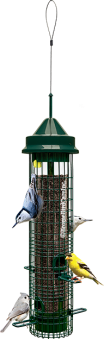
I love feeding the birds and I even love watching squirrels trying to eat from my feeders. Their antics can make me smile no matter my previous moods. However, I tire of starlings taking over my feeders and pushing away the birds such as nuthatches, goldfinches, and tufted titmice, seen in the above promotional photo . Last month I invested(truly–it was expensive) in a Squirrel Buster feeder. It attracted me because of the little perches which allow access to the feed through small openings in the feeder. These perches, weight sensitive, pull the feeder over the openings when a larger bird or squirrel lands there. The accompanying brochure listed the weights of various birds, and I was cautiously optimistic that starlings were too heavy to feed at it.

Starlings, an invasive species here, fight aggressively with each other and all other birds. They can empty out a feeder in record time. But despite the repeated attempts of various starlings to access the tasty tidbits in this new feeder, they were all unable to eat a thing. I think the word must have spread among the thieves, since they no longer try to feed there. Sadly they still try to eat all the suet cakes set out for the three varieties of woodpeckers which frequent our yard. For the time being I have stopped using those treats.

As I gloated over my success, I could hear Dudley Do-Right cheering and Snidely Whiplash moaning:

snidely

“Cooling Down”

This is my first attempt to post a very short video taken this morning at Wadsworth Falls State Park outside Middletown, Connecticut. For those of you dealing with temperatures as hot as ours, please enjoy the sights and sounds of the falls. For those of you freezing in the Southern Hemisphere, take time to look forward to your summer.

Enjoy.

“Calling In”

welcome

Much name calling fills our newspapers, newscasts, internet writing and tweets. People are insistent on “calling each other out” for every view or statement they make. I was challenged this week reading an interview in The Sun magazine July, 2019 with a food activist Leah Penniman. (The article “To Free Ourselves We Must Feed Ourselves, Leah Penniman on bringing people of color back to the land is worth reading for those interested in the intersection of social justice and farming.) She stresses the importance of calling people in rather than calling them out.

I quote her since what she said struck me as deeply important: “Yes, people are not disposable. Rather than dismissing, shunning, or shaming those who make mistakes, I believe it’s our responsibility to call them into awareness and support them in their learning journey, so long as they have a desire for healing. We can’t excommunicate one another. We’re all here on this planet. Let’s try to figure it out together.”

What connections might come if we stopped fearing that every opinion out of our mouth might be labeled as one thing or another. What if we stopped shaming each other about our ignorance about religion, gender, race and ethnicity. I remember years ago in rural Oregon a white man saying to an African American friend of mine, with genuine delight, “You are the first ni—-er I have ever met.” My friend had a choice to recoil or to engage. His first response might have been “how can you use that word? ” Instead I remember him extending his hand and shaking the man’s hand. Then some conversation could begin.

“Antidisestablishmentarianism”

4B942DF5-5694-4620-B2D0-FA54090AF69A

When I was in the fourth grade, my friends and I had a great time saying “antidisestablishmentarianism” to each other since it was the longest word any of us had ever heard of. Of course we had no idea what it meant, although it seemed to be “anti” something. When my daughter and her friends were young they enjoyed saying the word from the movie Mary Poppins: supercalifragilisticexpialidocious with the same glee.

Vocabulary skills were stressed throughout school and were seen as a reflection of one’s aptitude for college in the SAT tests. Some students took vocabulary building classes or bought books on increasing your vocabulary. Those practices seemed odd to me since I thought my vocabulary was mainly a reflection of all the reading I had done. The only drawback from learning words by sight alone was that occasionally I would mispronounce a word I had only ever seen but never heard. In a movie yesterday, for instance, a woman pronounced “Persephone” as per-se-phone(as in telephone.) The same mistakes show up as I listen to some audio books.

At some point I stopped acquiring new words except neologisms such as “meme” or “byte.” The words that I never really grasped continue to elude me when I encounter them in crossword puzzles. Avow and aver trip me up continually. I mastered eponym only after many clues about a stadium in Queens, New York.(Ashe) As for apotheosis, I still turn to the dictionary. I am not sure why words never cemented in early life fail to take root now.

And crossword puzzles? While they are supposed to stave off dementia I think they really only develop the ability to do crossword puzzles! A useful skill, for sure, but not essential for most people. Yours truly excepted!

“No Worries?”

E62983CE-7265-45E6-B340-136125E28E5C

As a retired English professor and lifelong lover of language, I listen carefully to phrases that seem to proliferate at any given time. Recently it has been the phrase “no worries.” It would make sense to me if the context was one where I had been worried. However, in its present usage, I remain frequently baffled.I am driving through Taco Bell, ordering food, thanking the cashier who responds, “No worries.” I order coffee and thank the barista who responds, “No worries.” In both of these cases, whether over a loudspeaker or in person, I would expect the reply to be “You’re welcome.”

Of course, my curiosity of this usage took me to the internet. There I learned that this usage has “infected the American language.” I laughed at the verb “infected” since it implied a disease caught from some other place. My response to the phrase has been somewhat similar. “Who started this misuse anyway? Must be an import!” It appears that I could blame it on the Australian beer drinkers. This seems unlikely, however. Surely Australian beer drinkers can’t have had that much influence.

How far has this usage spread? Does anyone where you live still reply “You’re welcome” when they are thanked?

“What’s In a Name?”

33F23C58-F679-4E57-8B2D-7511235D864A

My parents named me Elizabeth Anne as a compromise. My mother wanted me to be named Elizabeth after a long line of female forebears. My father agreed on the condition that they would call me Betsy. So legally and formally I am Elizabeth. When someone calls and asks for Elizabeth, I know they are probably a telemarketer. I write as Elizabeth because I like the name in writing. Everyone in my off-line life knows me as Betsy. People close to me often shorten it to “Bets” which I also enjoy.

Throughout my life I have known women with nicknames of Muffy, Winky, and Sissie. I assume they acquired those as kids and kept them as adults. My two closest boy friends when I was little were Skipper and Dude, names they kept into adulthood. I’m not sure why all these people hung onto what might seem like childish names, but they did.

I have given people around me nicknames. My granddaughter was “squirt” until she asked me to stop calling her that. My husband is “CW” because it makes me think of an undercover intelligence operative. A good friend is Tinarooni, because we have fun together and I enjoy playing with her name Tina.

Of course nicknames can be applied maliciously as is done with regularity by the leader of the United States. Ex-partners often have nasty nicknames. Archie Bunker called his son-in-law “Meathead” which managed to convey contempt under the cloak of affection. (Or affection under the cloak of contempt. Hard to know.)

I would love to know either what nicknames you had as kids or ones you have or use now. Please share. Thanks.

“Three Years On”

7394B837-A747-433D-A14D-6ECA8A8EE4E1

I started writing this blog in July of 2016. I didn’t have any particular goals for it, since I had never written for the public before. Armed with just a library book, I started “Saved By Words,” titled after the reality that words had been a lifesaver for me throughout my life. Word Press helped me get started. A terrific blogger named Pete gave me much needed advice when I got stuck. His assistance introduced me to the community that writes in my corner of things.

I began by commenting on posts that I read. I also responded immediately to the first few readers that found me, goodness knows how. I especially appreciate Rachel of Cricket Pages and Arlene for their early consistent attention to my writing.

Never particularly interested in the statistics WordPress makes available, I find that they are a helpful way to reflect back on the three years. My followers have increased very gradually, and many who are listed as followers really aren’t, I think. The biggest growth has been in interactivity, the aspect of this medium I appreciate the most. My comments have tripled, and I now have a pretty consistent group of readers I can count on to comment.

I intentionally keep my posts short. I like the idea that it is easy for a reader to sit down and  read a group at one time. That turns out to be true in many cases. While I try to write most days, many of my followers seem to catch up in batches. I love that.

And most surprisingly of all, I have now had readers in 117 different countries. What an amazing gift for a retired English professor typing away in Connecticut, United States. Thanks to every one of you, whether you follow regularly or you just dropped by. I haven’t run out of things to write, much to my amazement. I look forward to my fourth year.

“Lured By Broccoli“

94539AFA-5B8E-4D81-8892-D3BD98031593.jpeg

Something had been eating my sunflowers at about one foot off the ground. They stood as a row of bare stalks, reminiscent of a few years ago when my cosmos had suffered a similar fate. Then, as now, it appeared to be the work of a woodchuck, munching happily along. At that time we bought a Have-a-Heart trap but succeeded in only catching a skunk. The neighbor’s dog caught and dispatched the woodchuck before he was trapped.

Yesterday when driving into the driveway I spotted a fat brown animal waddling quickly away into the raspberry patch. It took me a few minutes to realize that it wasn’t a fat squirrel but a woodchuck. Out came the Have-a-Heart trap, this time baited with broccoli which You Tube assured us was a go-to food for woodchucks. After all, I couldn’t bait the trap with sunflowers.

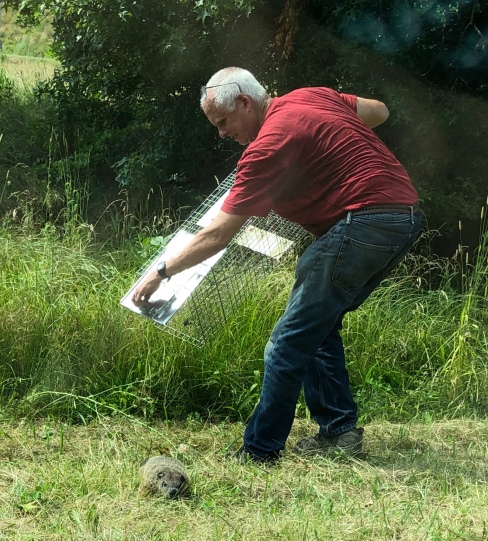
This afternoon, in the scorching heat, my husband found the fat, happy woodchuck lying contentedly on his back in the trap, the broccoli eaten. To release him near the house was to guarantee his return. Instead my husband decided to take him across the river, hoping he wouldn’t swim back, and release him in the meadow there. In the above picture the brown fat blob is the woodchuck running at record speed away from the Have-a-Heart trap.

The only question remaining is “do woodchucks swim?”