“An Apple a Day…”

apples

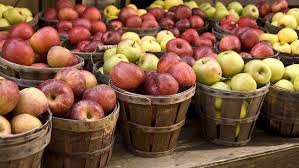
New England may be most known for maple syrup, but apples thrive here and are available in abundant varieties in baskets shown above. Because many varieties of apples are not ideal for either transport or storage, we can sample older kinds not commercially viable. We can try different kinds and decide what kind of apple we prefer.

Yesterday I bought a couple of a variety new to me called Smitten. After getting home, I saw it had a sticker Smitten.com on it, so I knew something was up. This was clearly not an old variety. I cut it up and ate it deciding I liked it crisp texture but that it was too sweet for me. I then went to Smitten.com and discovered it was a new variety, developed in New Zealand and now being grown in the United States. It is very popular, apparently, along with the Honey Crisp. Both are too sweet for me: I prefer the sharp tang of older varieties. But many Americans have a craving for sweet and apparently apples are being developed to satisfy the desire.

Until recently fresh apples were really only tasty in the fall. But apple tree are prolific bearers and my forebears were faced with what to do with the bounty. So we made apple cider, hard cider, apple cider vinegar, apple butter, apple pie, and applesauce. The peels were used to make the pectin that thickens jelly. Studying the early 1800’s ledger of a store I found that one of my ancestors traded apples for goods. Unfortunately, he traded for rum. Apparently hard cider wasn’t enough!

Of course I spent the afternoon making an apple pie. Simple recipe really: 2 and 1/2 pounds of apples(I mixed three varieties), 1/2 cup of sugar, 2 tablespoons of brown sugar, freshly grated nutmeg, a little cinnamon, a dash of lemon juice and two teaspoons of cornstarch. Pie crust for top and bottom. Bake for 30 minutes at 400 degrees then 30 minutes at 350 degrees. Enjoy!
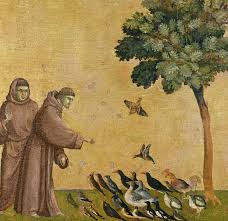

 

“Veneration of a Saint”

st.francis

My church is staffed with Franciscan Friars, men who have dedicated their lives to living as priests or brothers in a religious order. As such, they bring a particular veneration of St. Francis to our parish. Despite some misconceptions, Catholics don’t worship saints. We venerate–honor–them and try to take what inspiration we might from contemplating their lives and service to others.

Our calendar is full this week with events around St. Francis. Tonight we observe his Transitus–passing from this world into the next. St. Francis was not afraid of dying, but called it Sister Death, an integral part of life. We will have a quiet service to honor that way of facing death with joy and hope not despair.

Tomorrow is his feast day and Mass will highlight his life in the homily. Clearly a feast day is more light than an observance of his death, and I look forward to celebrating Mass with others in my parish.

Saturday we are invited to bring our animals to the church courtyard for a blessing. St. Francis is particularly remembered for his love of all animals. My grandchildren look forward to dressing up their little rescue dogs and taking them to be blessed. Last year there were no cats, only dogs. In the past there have been birds, pigs and a ferret. We will see who shows up Saturday morning. For those who prefer the toy kind of animal, the priests bless all stuffed animals that come to Mass on the weekends, recognizing what comfort they are to children(and some adults, too.)

The weekend is finished with a flourish as we have an outdoor party to celebrate 60 years of an Italian parish joining with an Irish one. One parishioner owns a fire truck converted into a pizza oven and will supply endless slices of various pizzas. There will be dessert tables full of items baked by many of us. My grandson associates church with dessert. Not a bad connection I think. For me both provide me deep satisfaction!


“Help Along the Way”

DC6C0300-FCEA-4162-863C-D7AC340944DB.jpeg

I spent part of this morning meeting with my spiritual director. I have been meeting with the same wonderful Sister of Notre Dame du Namur for the past 12 years, an hour every month or so. The title of director is very misleading, since there is no directing involved. Instead we chat about what has been going on in my life in all of its aspects. Occasionally she or I will identify a specific moment when God seemed most present. But there is no pressure to be “spiritual,” because all of my life matters both to me and to her.

Spiritual direction has found its way into Protestant circles in recent years, but it has been a Catholic tradition for centuries. It is a recognition, I think, that we all need to have a chance to consciously reflect on our lives with a caring person. Not therapy in the mental health sense, spiritual direction is more the opportunity to have a companion along the way.

I am extremely grateful to Sister Virginia, who just turned 80. May she continue to walk with me as long as we each are able.

“Searching the Stacks”

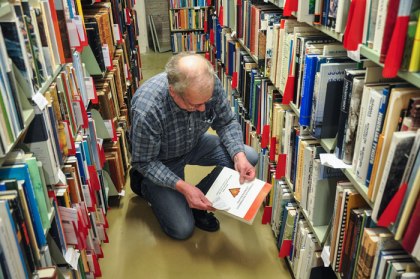
C458D451-F92E-4EFE-BB77-EAAFAD49A8CC.jpeg

When I was in school, many of the books I needed were in the stacks of the library and had to be retrieved by a page. This person took the slip of paper with the needed title and disappeared for a time until reappearing with the requested volume. Depending on where the book was housed, this could take from 5 to 30 minutes, and it wasn’t possible to predict the wait.

I find that my fact retrieval system lately seems to be operating in the same way. If I need information that I frequently use, it usually is immediately available to me. However, if I haven’t needed to know something for a long time, my retrieval is delayed. I imagine a little page running around my brain, going into the back recesses trying to find where something is stored. I can imagine it going,”When did she learn this and where did she stash the answer?”

Take state capitals, for instance. I learned all the capitals of the then 48 states of the U.S. when I was 10 years old. I had never been to a majority of the cities, so the capital was the only name I knew. Then I didn’t need the information for 60 years. No random person stopped me on the street to inquire about the capital of Iowa. But since my grandson is studying state capitals, he asked me the capital of North Dakota. No matter how long and hard the page searched the back nooks of my mind, he couldn’t find the answer.

Apparently, at some point, just as the library eventually discards books no one asks for any more, my brain functions to clear out space. Unfortunately there is no handy reference to let me know that no matter how hard I look, I won’t find the answer. Google to the rescue. Bismarck, not Fargo, is the capital of North Dakota. I knew that. (Once!)

“Gradual Change”

4FE69BE2-5ADC-4B02-85C7-FC88B84F750D.jpeg

One of my favorite maple trees is a couple of blocks down the street. I enjoy watching it slowly turn from green to orange and red. Trees don’t change all at once, but rather gradually move from one season to the next. I have the privilege of living in New England and watching them daily transform then shed their leaves.

I am grateful that age comes on me in the same way. It would be dreadful to have the Dorian Grey experience going from youth to advanced old age in an instant. Instead it comes on little by little, giving me a chance to adapt to the changes. More often than not, my conversations with friends also include mentions of new physical changes. At church a couple of weeks ago I compared my crooked little finger with a parishioner’s  crooked wrist, both signs of arthritis. We compare status of our “age appropriate” cataracts and wonder which one of us will have the eye surgery next. The group of us who work with the same trainer at the gym constantly have our exercises “modified” to adjust to our bodies’ quirks.

Millions of Americans are coming into old age since we were born right after the War in the baby boom. After we give up trying to plead that “70 is the new 50” (it isn’t) may we accept the gifts and the losses that come with aging. A.R. Ammons puts it beautifully in his poem on age “In View of the Fact:”

until we die we will remember every
single thing, recall every word, love every

loss: then we will, as we must, leave it to
others to love, love that can grow brighter

and deeper till the very end, gaining strength
and getting more precious all the way. . . .


“Finally!”

D500DE6A-7E2C-4970-B2E2-A2272338D91F

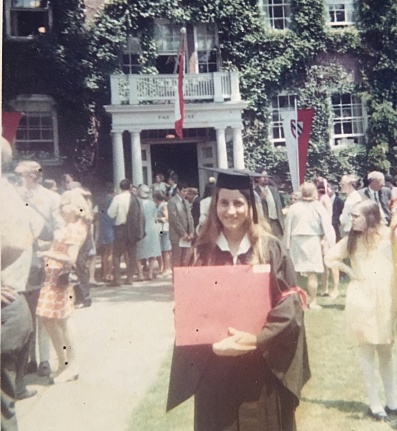
I was finally able to post my 50th anniversary report to Harvard. I thank especially Des who steered me in a productive direction. I had certainly made too big a deal out of it. Perhaps because, as I mentioned in a previous post, the questions included “what do you consider the most important accomplishment of the past fifty years?” When all was said and done, I realized that I don’t look at my life in terms of accomplishments. Instead, I wrote of my marriage, my teaching years, my family and my faith. It has been a rich fifty years, but very little of it had any relationship to my formal education.

My classmates included Al Gore, former U.S. Vice President and other notables. For many years I felt somehow inadequate when I answered the questionnaires every ten years about what I had been doing. I wasn’t racking up prizes and professorships and honors as were many of my former classmates. But at 71, those things really fade in importance for me. I look instead at the people in my life and am grateful that I put my time into relationships, not outside achievements.

(For the curious, the red arm band on the sleeve of my gown was a protest symbol. Harvard had used the Cambridge police force to deal with campus Viet Nam war protestors. At graduation we wore these arm bands to show our solidarity with our fellow students who had been assaulted.)

“A Last Hurrah”

wW5QdRd3SEGl5Az1mc7lbw.jpg

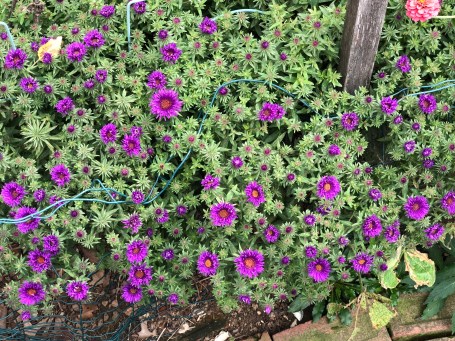
It’s almost October, the month when we get our first killing frost. But just before all the other annuals bite the dust, our asters come out in full force. Here they are just starting to open. They started as a tiny plant purchased by mail from an offer from some magazine insert. I didn’t have much hope for the scrawny plant when it  arrived, but put it into an empty spot nonetheless.

That bedraggled little plant has actually thrived and has grown from a three inch specimen into a plant which now spreads across three feet of the corner. It emerges slowly, allowing the zinnias to outshine it, the hollyhocks to emerge among its sprouts and the cherry tree overhead to blossom and fruit. Just as every other plant winds down for the winter, the aster announces its presence.

I read once that late learners usually catch up if they are given enough encouragement. Boys especially seem to learn to read later than girls, but in a supportive atmosphere they can flourish. The race isn’t always to the swift. Neither is the aster, though late to the party, any less of a welcomed guest.

“Persistence”

RnqfNCyORSC33h0lHsqQAw

Since early spring, my husband and I have been fascinated by the growth of this little beech tree which has been growing up from under our deck. The only light for this spot is from above. The enclosed deck itself is about 18″ off the ground and pitch dark underneath save what filters down. We have left the plant alone and just enjoyed watching its tenacity. Its parent beech tree, at least 75 years old, had to come down last year since it was in danger of dropping one enormous limb onto either our or our neighbors’ garage. But we knew it hadn’t left willingly, and here is its offspring sneaking its way between the floorboards.

I was totally delighted yesterday when I noticed that its leaves had begun to change to the lovely rust of the beech in autumn. Clearly this little shrub was following along with its natural growth cycle, confident that it would be able to leaf out again in the spring. I could make an obvious metaphor out of the tree, but suffice it to say I admire its persistence in the face of odds. I enjoy its optimism about next spring. I thank it for reminding me that solid saplings will spring back up and replace the sad bare stumps, all that’s left of earlier trees.


“You Say To-mah-to”

7D4FE37A-6B72-4464-B40E-AE9A08BCDF95

Our tomatoes didn’t do well this summer, probably due to a combination of  too much rain and too little sun. Or maybe it was just an off year. At any rate, I needed a couple for a salad and we went to the local farmers’ market for them and any other produce that looked promising. The farm stand owner recommended the variety pictured above, one we had never heard of, seen or tasted. The tomato had all sorts of folds, and slices looked unusual to say the least. Nonetheless, the taste was excellent.

I reflected on the perfectly proportioned,perfectly smooth skinned, perfectly bland tomatoes on sale in our supermarket year around. As a culture we seem to prefer standardized tomatoes year round rather than quirky short lived ones available only in their natural season. So we have sacrificed taste for availability.

Quirky in general seems to be an undervalued trait at the moment in the United States. Kids who used to be seen as odd are now diagnosed and treated. Big nosed kids(I among them) now plead for plastic surgery so they can have “normal” noses. Small busted girls want implants while large busted ones seek reductions. Apparently there is a perfect size there too.

But looking at and then tasting this wonderful tomato I am reminded of what we lose any time we decide that vegetables, fruit and people need to all conform to a very narrow standard. Here’s to variety in all things.

“Why I Stay”

stainedglasswindow

This stained glass window graces the front of my church and forms the backdrop for the celebration of the Mass each Sunday. My husband is head usher at one of the services, so we arrive early and I sit waiting for others to arrive. I have a lot of time to gaze at the window.

While everything I do and write is informed by my Christian faith, I rarely am explicit about it. But for this post, I want to answer the question “why do you remain a Catholic with all the sex abuse and cover up that has gone on?” I stay because sex abuse and denial of it exists in every home, school, neighborhood, work place and faith community. It is a grievous truth that many still refuse to believe victims. Those in power, no matter the setting, continue to exploit that power and harm those weaker, whether children or subordinates. As I write, vitriol is being hurled at a woman who as a teenager endured a sexual attack from a boy who now wants to deny it. I don’t know a single woman who hasn’t had such an experience, either in school or at work. Most of us never spoke of it because we knew it would open us to attack and blame.

I am sickened by predators, whether family members, priests or bosses. But I would have to go live alone on a desert island if I left every place they exist. Instead, I will remain an active member of my faith. I will listen to victims wherever they are. I will believe their stories and join in the task of holding  the perpetrators responsible for their actions.