“Woods? And Irons”

93E1A60D-3C9B-452A-A7DD-0C5CA500FB29.jpeg

My grandson is learning to play golf, being taught by the father of a friend. We were chatting about it Saturday and I asked him if he used woods to drive the ball. He looked at me strangely and said,”What are woods?” I told him that there were irons and woods, and that woods were the four golf clubs for driving the ball long distances. “You mean they used to be made out of wood?” he replied. Things had certainly changed since I last caddied for my father 60 years ago!

The public course where my father and his three friends played early Saturday mornings is pictured above. I loved going along with them and carried his golf bag over my shoulder until I was tired. Eventually he purchased a little cart to use to pull the bag around and I used that. No one used an electric golf cart since walking was a big part of the game. Walking was where you discussed where the ball had landed, which club you needed to use next, what sand and water traps were on the hole being played and how likely it was that you would make par.

I loved my jobs as caddy, especially the one where I waded into the water traps and retrieved balls. There was a little gizmo to wash off the ball and I would present my new finds to my dad and his friends. I knew which club was which when I was asked for one.  I knew to be quiet when anyone was putting. I learned to duck my head if someone yelled fore.

But best of all was the so-called 19th hole where we went after they played 18 holes of golf. My dad and his friends would get beers. But I had a root beer float. I can still remember struggling to keep the root beer from overflowing the glass as I pushed the ice cream down into the liquid. So I guess woods are now made of metal. But I bet my grandson would still love a root beer float after a game.

“ My Kingdom For a Horse”

14C41B6A-60E3-4B03-BAB5-DB8A458D1210.jpeg

Posting the photo of my sister Patsy on a horse, I began to think about girls and horses. In my childhood some girls, such as Patsy, were horse crazy. She had Breyer model horses, read Marguerite Henry’s books such as “Misty of Chincoteague,” and took riding lessons. She really wanted to own a horse, but we had no place to keep one. I had several friends who were similarly smitten with horses. At the Camp Fire Girls camp I attended there was a special unit called Ranch where girls spent the week riding and caring for horses.

Me not so much. I rode them when we were at the Oregon coast, as in the picture above. Riding horses on the beach was fun and the horses knew their way up and down the sand and then back to the barn, so no skill was required. But that was the extent of my interest.

I last rode a horse 35 years ago when I was at Canyon de Chelly with my daughter who wanted to ride. A Navajo rancher had a few horses to rent and after sizing us up sent me on an ancient horse, my 8 year old daughter on a pony, and his 10 year old son as a guide. My horse was irritated at having to move at all. Meanwhile my daughter and the little boy hightailed it off across the canyon floor, laughing as they went. And proving my genuine disinterest, I didn’t envy them at all.

“Get Us Out of Here!”

8B01F214-170B-47A9-BF74-F88789E7DC77.jpeg

Our local library provided an opportunity to both financially support the library and have a great time as a three generation family. Today for $30 for the family, my husband and I, our adult daughter and two grandkids spent 35 minutes in an “escape room.” We could have used 60 minutes, but we “solved” the puzzle in 35, making us 10th on the  leader board so far.

The set up was amazing, a full room of oddities and mysterious clues, locked doors, hidden messages and costumes. The premise was that we had to find three items to make an antidote for a poisoned visitor. None of us had the faintest idea of what we were doing. Fortunately a guide came with the experience and we were able to ask her for three hints. She encouraged us to open everything, to not worry about making a mess, and to keep our eyes open for anything that might be a clue.

First we ran around like crazy, especially the kids. Who doesn’t like the opportunity to look for clues and tear a room apart? Theoretically we should have calmly strategized as a group, but we didn’t. We were having too much fun. Amazingly enough, at key moments we did actually listen to one another. Each of us found an essential clue, and together we found and unlocked the three items–including a unicorn horn and dragon’s blood–to bring the poisoned man back to health.

This was a first experience like this for each of us. But now we will be on the lookout for more opportunities. A truly great time for all ages and a benefit for the library too.

“Dona Nobis Pacem”

I lost my little sister Patsy one year ago. She died after her third bout of breast cancer which hit her over a period of 12 years. She was ready to go, she said, and died peacefully in her sleep.

She was the joyous child among us four. I miss her laugh and her optimistic view on life.

Peace dear one.


“Rainy Days—Dry Shoes”

It’s been raining here off and on for several days reminding me of the back to back snowstorms we had this winter. Unfortunately the heavy rain isn’t followed by cooler temperatures but rather continued humidity. I guess we are benefiting from weather coming up from the southeast United States. It reminds me why I have never wanted to live in the southeast United States!

I began to think about boots from my childhood and youth. My shoes were leather, not vinyl or “man-made materials” in those days, and it behooved me to keep them dry. As a child I wore the type of boot on the left which were pulled on over shoes. They were the bane of my young years. I could never successfully pull them off without pulling my shoes with them. And, at least in kindergarten, this meant asking the teacher to help me retie them since shoe tying and I had yet to achieve a happy connection.

In high school I wore leather pumps and I needed to keep them dry using the kind of clear boots found in the right hand picture. These went on over my shoes, keeping them dry. Unfortunately they had the sex appeal of a rutabaga. I had to sacrifice allure for practicality(a seeming theme of my life) since I didn’t have the money to replace my pumps.

Today I just dry off my feet when I venture out in my sandals in a summer downpour. Many people seem to spend the summer in flip flops, another excellent solution. Those clear boots seem to have disappeared from the scene. I can’t say that I am sorry.

“Moons, Junes and Ferris Wheels”

6CFAE3DC-2EE5-4B41-9FA5-C8CB3A405597.jpeg

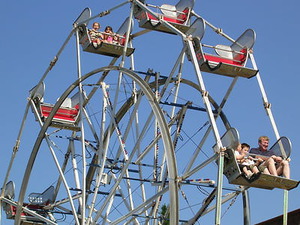
I’m not sure why Joni Mitchell in “Both Sides Now” linked moons and Junes and Ferris wheels when she sang about love. I suppose that the moon and June are often connected with love. As for Ferris wheels, perhaps she is referring to that sinking feeling you get when the wheel stops with you at the top as new passengers are loaded on. Particularly if your seat partner, ignoring all warnings, likes to make the car swing back and forth.

I realize that cities have installed giant enclosed wheels to give one a view out over the city. They seem to have gondolas for passengers. I prefer the old fashioned, open air, smaller scale wheel such as pictured above. Each summer many little towns in Connecticut host some kind of summer fair, complete with a midway with a few rides and a few games. Ferris wheels commonly set up at these fairs.

We introduced our children and grandchildren to carnival rides. At first the Ferris wheels was too scary without one of us. Eventually they became brave enough to ride alone. Now the grandchildren crave the dizzying rides which spin, twirl, upend and generally nauseate. I have trouble even watching them.

Summer to me will always be populated with corn on the cob, watermelon, iced tea and at least one town fair with a ride on the Ferris wheel.

“Shoes For Every Occasion”

There was little doubt about what shoes I would wear throughout grade school. School shoes were brown and white saddle shoes. Party and holiday shoes were patent leather Mary Janes. I also kept a pair of sneakers at school for use in gym class where we dressed down to a blouse, shorts and sneakers. Shoes were handed down in my family, but since I was the oldest I had the benefit of new shoes.

Buying new shoes still seemed like an adventure, even if it was predetermined which shoes I would take home. The shoe store had an x-ray machine that looked to see how much growing room there was in the toe of the new shoe. Previously, the salesman would press down hard to see if there was room to grow. I imagine the x-ray machine was terribly dangerous rather than intriguing, but we didn’t know any better. We never bought shoes that fit at the time of purchase, only ones we could grow into. This meant that not only were the new shoes stiff, but they were also too big.

I kept my saddle shoes clean with saddle soap. I don’t know if it was really for saddles since it was sold in the shoe department. I enjoyed getting them clean enough now and then. I spent hours out of doors, so naturally they got scuffed and dirty. But those shoes were seemingly indestructible and they never wore out before I outgrew them. The shine on the Mary Janes was spiffed up with Vaseline.

Today children wear many different kinds of shoes and actually are often involved in picking them out. I was spared the choice, but fortunately I loved both of the ones chosen for me. I still stick to an Oxford for days and a low heel for special occasions. And they wear out, an experience I never had as a child.


“Money on the Road”

08DADD6F-995A-4521-AE0F-155861560297

Many many years ago, there was no such thing as an ATM dispenser of cash. There were not credit cards except ones for specific department stores or gasoline stations. A common occurrence was remembering to get enough cash for the weekend. Well established residents could write checks at the grocery store and get a little extra back. But if you were in a strange town, you needed to have cash if you wanted to purchase anything.

Enter the American Express Traveler’s Check. These were purchased at the bank for cash plus a small fee for the service. Sometimes the handling fee was waived for certain customers who kept enough money in the bank. As soon as you bought them, it was important to sign the top line. Otherwise, anyone could cash them.

When you needed to buy something, you would fill out the check to the vendor and then write your signature on the bottom line. As I remember, no further identification was ever asked for. As long as your signature looked pretty much like the first one, you could cash the check. It was essential to keep a list of the serial numbers of the checks so that if you lost them you could immediately notify American Express. I remember being careful to keep the list of serial numbers in a separate place from the checks.

Traveling through Britain in the mid-1970’s I remember becoming aware that we were nearly out of checks. Fortunately, our air fare home was paid for and we practiced extra frugality for the last few days. Hard as it is for the VISA carrying, ATM using present day American to believe, we would have been in serious trouble if we had run out of Traveler’s Checks. They were the only money we had on the road.

“Fashion Policeman”

02741F9E-6B2D-4A7C-B624-7017FA9EDE41.jpeg

In the spring of our senior year in high school, the principal called Mary down to the office. He told her that she was not allowed to wear sandals without stockings. She could either wear nylon stockings or socks with her sandals, but she could not have bare feet. It made no more sense then than it does today. But he was in charge and had the power to suspend her, so she capitulated.

All the girls wore stockings to school, held up by garter belts or girdles. Pantyhose had yet to be widely available. Stockings were purchased at the hosiery counter in the department store. You would ask the clerk to show you what was available. She would bring out a couple of flat boxes(such as those pictured above), remove one stocking, place her hand inside it to show you the color and see if that color satisfied. If not, she would bring out another color. After a while I recognized I liked anything named something like Sun Tan.

During the end of my high school years someone invented a “run-proof” stocking. Runs or “ladders” were the long line of detached stitches that occurred when you got a hole in a stocking. Fingernails commonly snagged causing runs. While it was true that the “run-proof” stockings didn’t run, they did develop enormous holes. I still remember one of my classmates darning those holes to make the stockings last a little longer.

I am still astonished when I see bare legged women at church wearing high heels. Apparently, while I wasn’t paying attention, wearing stockings, including panty hose, went out of style. I can’t imagine any high school girl getting sent home today over her lack of socks with sandals!

“White Glove Treatment”

5EA29DA3-BFB3-4487-A60B-DCB29ED437F7.jpeg

I saw an advertisement the other day for a furniture company which promised it would deliver its goods with “white glove treatment” for an extra fee. I found this an interesting anachronism for a current offering. Beyond a vague idea of what this might mean–after all it costs more so it must be special–what would a young adult make of this phrase?

When I was a little girl, white gloves had a specific function. They were what you put on your hands to go to church. I wasn’t taken to church, but my churchgoing friends filled me in on the dress code. My own first encounter with them came in Mr. Billings’ Dancing School, a rite of passage at my elementary school for all seventh and eighth graders. (As I wrote some time ago this did not apply to the Haitian girl who was the daughter of a live-in domestic. She was not invited.)

To attend dancing school, I was required to wear black shoes, fancy dresses and white gloves. The gloves were  heavy cotton and buttoned at the wrist with a little pearl.  The boys were dressed in suits, button down shirts, ties, oxfords and DARK socks. (Woe to the poor boy who forgot and wore white ones.) They did not wear gloves.

At Mr. Billings’ Dancing School we were taught proper etiquette which apparently included wearing white gloves to dances. Of course by the time I started going to dances, white gloves had bit the dust in favor of short skirts and “rock and roll.” I never did get to use my fox trot skills.

I have no idea why we were expected to wear the gloves. They did perform an important function however. They absorbed all the sweat from those extremely uncomfortable boys. We needed to wash the gloves after every Friday night class!