“Gender Reveal?”

1940 Family_00056A

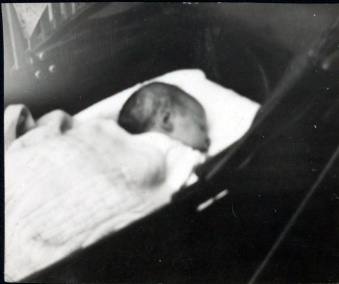
When I was born, my parents learned that I was a girl after I emerged into the hospital room. Until then, while they had to guess. Early shower gifts were in pastel green, yellow and white, colors considered neutral and appropriate for each gender. In 1975, when my daughter was born, the doctor(based on nothing)had assured me that the baby was a boy. Accordingly, we named him Leon James. Fortunately, our shower gifts were also pastel green, yellow and white. I had painted the nursery yellow. We were ready for whoever was born. To my surprise, it was a she, and we had to quickly find another name.

By the time my grandchildren were born in 2007 and 2009, high resolution ultrasound images made it possible to see who was going to be born. The surprise was gone and shower gifts could be geared accordingly. Now couples have to choose to remain ignorant of the gender by asking to not be told.

The suspense that used to be associated with the actual birth has been transferred in some instances to a “gender reveal party.” These are elaborate affairs where friends and family gather after the ultrasound has revealed the news to the parents. Then some gimmick such as a blue or pink cake is sliced open to the oohs of the guests. I have seen examples of blue or pink confetti being sprayed as the announcement.

It is somewhat ironic that all this hoopla is going on at the same time that parts of the culture are debating the very definition of gender. There is cisgender, transgender, and gender neutral being discussed in the news. So it may be back to green, yellow and white clothing again.

All I know is that I miss the suspense of guessing the sex of the expected baby. I miss all the ways of telling a woman who she was expecting from where the baby was carried to holding a string and seeing which way it moved. It was a source of endless discussion and a great opportunity for betting. The old way was a lot more fun than any gender reveal party.
“End of Downtown?”

4CF2397A-23E8-4BCA-B5FB-CFC8270CBB22.png

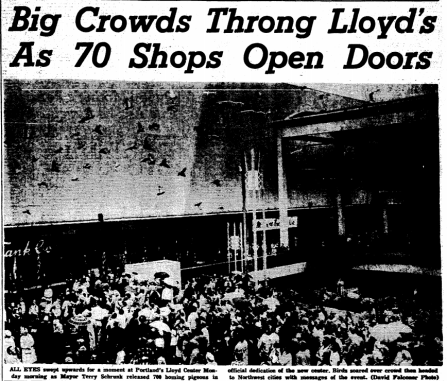
I was 13 when the first shopping center was built in Portland. It was a completely new concept and drew large crowds, including my family. Until then, there were two ways to purchase clothing and household goods. We could order them from the Sears or Montgomery Wards catalogs, or we could go DOWNTOWN. All the major stores were downtown, along with smaller shops such as jewelers. Shopping took most of a Saturday, tromping from store to store. Stores would deliver your packages so you didn’t have to haul them around with you.

The Lloyd Center opened across the river from downtown Portland. It had rows of stores in a large grid with open walkways. You parked in a large lot and then strolled the traffic free lanes. They advertised that “it never rains at the Lloyd Center” because the walks were covered. This was a direct jab at the downtown merchants who had to deal with Portland’s rainy climate with only awnings to protect shoppers.

The Lloyd Center has gone through many iterations since 1960. It has been enclosed, then opened up again. But now it is one of many “shopping malls,” a term that still makes me cringe when I hear it. While most of those are enclosed, they seem to be losing out to a “new” concept called “lifestyle malls.” These turn out to be strips of stores outdoors with music playing out of speakers disguised as planters.

And then, in some kind of ultimate irony, people are back ordering things, though now it is from on-line sites instead of paper catalogs. And many small towns are revitalizing Main Streets to the excitement of young people who are discovering the delight of DOWNTOWN.

“In The Service of Style”

0A2E411C-6743-4B5B-938F-97C01970F916.jpeg

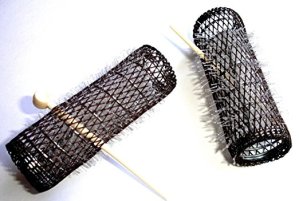
Points if you can identify the objects above. Years before the invention of blow dryers and circular hair brushes, rollers were the only way to achieve curly hair. My hair was stick straight in a time when poofy hair was in style. The solution was to roll up damp hair on these objects and sleep on them. They were wire spheres filled with sharp nylon spikes to catch the hair. They were held in place by the little white rods.

That looks like it would hurt. Yup! Got that right. Besides the pain of the nylon spikes, the white rods had a tendency to move in the night and end up poking me in the ear. And these were relatively small for the hair style I was after. I also tried ones twice this diameter, but they proved impossible to sleep on.

But it was all worth it right? Well, no. Despite the fact that I religiously bought the 25 cent little booklets at the checkout stand which showed me the pattern to use with the rollers, my actual hair never came up even close to the pictures. In fact, the actual result looked likeL_00015A

The next year I decided to grow my hair out straight and long. Fortunately in time that became the style.

“Paying to Go”

2A41827A-1C09-4483-BC01-905BE97FD16F

The bus I took home from high school left from the Greyhound Bus Station. It was a cavernous place, full of many travelers. I had to wait inside until they posted a notice that my bus had arrived. That meant that I often needed to use the restroom.

The ladies room was lined with toilets, all except one requiring a nickel to unlock the stall. I am not sure why they kept one open for free, but it appeared to be rarely cleaned or properly stocked. The incentive was there to pay to go. However, no one liked the charge, so most people participated in a scheme to help others to avoid the fee. Because there was a bathroom attendant(who probably didn’t really care, but it made it seem more furtive!) the task demanded stealth. Once some of the stalls were unlocked, people casually lingered outside them. Then when someone exited, she gave you the “go ahead look” and held the door long enough for you to enter. Occasionally, someone would leave and purposely close the door behind her. I always guessed she hadn’t been the recipient of an open door, and she felt entitled to getting her money’s worth.

Some department stores also had pay toilets. At Meier and Frank, the largest store, the pay ones were marble and the free ones simply porcelain. Perhaps it wasn’t so different from first and coach class on transportation. At any rate, I always chose porcelain. I was only making $1.00 an hour, and didn’t want to waste even a nickel.

I stopped seeing pay toilets many years ago. I don’t know who had decided to install them or who decided to take them out. They are one piece of the past I don’t miss.

“Stay Off the Phone!”

2E7605F6-359A-4191-861B-16F397AAF152.jpeg

Some while ago I introduced younger readers to the pay phone booth and its features. Today, I am remembering the ever present home phone from my childhood in the 1950’s. It came in black. It weighed a ton and survived much abuse. Once a sibling even threw it into the wall. The wall got a hole, but the phone was intact.

The phone had two features. It rang and you could dial it. Today’s phones have so many options that many of the negotiating skills needed in my childhood are no longer needed. One common need was to stay off the phone because a parent was waiting to hear back from the doctor. Doctors didn’t appreciate a busy signal, the noise heard if someone was already on the phone. We all complied with that request. One that rarely was followed was a sibling waiting to hear from a boy friend or girl friend. I guess we figured a persistent friend would keep redialing.

Although we had a party line (shared with another family)  when I was little, by the time I was seven, we had our own phone number. But we still might be chastised for staying on the phone too long, especially if a parent was trying to call home and kept getting a busy signal. There were no answering machines, so whoever answered the phone was expected to WRITE DOWN a message. Needless to say, we often forgot and heard about it later. “How come you didn’t tell me ….called?”

There was no such thing as caller i.d. either. So it was not possible to avoid phone calls except by not answering the phone. However, that was not really an option and was sure to be met with “how come nobody answered the phone?”

The phone lasted forever. You always knew where it was. It was repaired by the phone company for free. Sometimes the old ways, though simpler, were better.


“Dressed to Code”

C4G 032


I was  laughing reading about a young girl who was sent home because her shoulders were showing in a blouse she wore to school. The blouse looked quite modest to me, but it didn’t conform to the dress codes at her high school. That had me remembering the dress codes at Lincoln High School in the early 1960’s.

Girls always wore skirts with blouses or sweaters or dresses. Pants were worn in p.e. only, and those were specific shorts sold to be worn in the gym. We wore nylons and shoes. The nylons were usually held up by a panty girdle with garter clips. Shoes were flats. When sandals became popular, they were allowed as long as we wore stockings with them. Mary S. was sent home for wearing sandals without socks or nylons. Our protests to the principal went unheeded.

Boys wore khakis or cords with button down shirts over white t-shirts or polo shirts. Shirts had to be tucked in. Steve M. had the shirt tails cut off his shirt one day in the hall by the vice-principal because he had not tucked them in. No one was surprised and no parent rushed to the school to protest.

Women teachers wore dresses or suits. Male teachers wore shirts, ties, and suit jackets and slacks or suits.

Despite the fact that the 1960’s were supposedly the beginnings of revolt against the norm, there were few indications of that among my friends. We never had to be given a dress code. It was assumed and we followed it.

“Remembering Tom”

vietnam

Today is Memorial Day in the United States. While it seems to have been taken over by barbecues and retail sales, it is actually a time to pause and remember. My generation of boys had no choice about being sent to Viet Nam. They were drafted and sent. If they were still in college, they were drafted after they graduated.

I had gone to college with a gentle and loving boy Tom. We served together bringing academic enrichment to young people in the town. He was drafted right after graduation and went to Viet Nam.

Tom survived the battles and came back home. He couldn’t survive the horrors that stayed with him. He took his life in 1972. With a gun. Knowing him, it probably seemed to be evening things out somewhat for the atrocities he was forced into. Not all the losses are inscribed on the wall at the Viet Nam Memorial in Washington, D.C. Tom was killed as surely as those who died overseas.

Peace to all veterans still scarred from the wars they were forced into. Peace to all veterans who “chose” to enlist when faced with economic hardship and limited employment opportunities. Peace to all veterans who went willingly to defend our country and found themselves in the middle of other peoples’ wars.

“Unnecessary Talking?”

1948-50s 221

The expectations for “deportment” were explicit throughout my school years. Children were to be quiet, respectful, attentive, and facing forward. Unless your pencil broke during an exercise, there should have been no need to sharpen it during class. You should have thought of that before class. You should time your bathroom needs to correspond to the recess times. Teachers had absolute authority, and there was no chance that your parent would come into school and take your side in any disagreement with the teacher.

Combined, these attributes were a challenge for all children. For me, the biggest hardship was being quiet. There was a subcategory of deportment called “avoids unnecessary talking.” A check mark meant improvement was needed. I got a check mark throughout my school years. Clearly teachers and I disagreed on what talking was “unnecessary.” We never discussed this, of course. I would always intend to correct this character failing, even though I really had no idea what it meant. I always thought that what I had to say was necessary. Why else would I be talking?

“Disappearing Ink”

penmanship

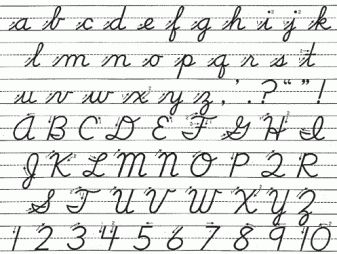
Among the other disappearing virtues from my childhood is decent penmanship. We were drilled on handwriting throughout elementary school. First we were taught to print in a block style on wide ruled paper. Then, just when we had been given a chance to master that, they sprung cursive on us. Cursive was not intuitive and the large chart at the front of the classroom demonstrated the correct way to form each letter. Interestingly, the capital Q shown above was required when I was in school but seems to have disappeared.

I have dreadful handwriting. I like to think it is genetic. My father was a commissioner and had to sign hundreds of bond certificates. He actually had to testify that, despite how it looked, that really was his signature. My maternal grandfather had nearly illegible handwriting. I never made the transition from block print to cursive, and my writing is some kind of quirky, but unreadable, blend of the two. Fortunately, I was able to read all the handwriting of my students, no matter how dreadful, since I had practiced by having to read my own!

Unfortunately we were graded on penmanship. My failing grades were consistent throughout school. I failed both penmanship and deportment. Deportment. There’s another term I am happy to forget!

“Height Challenged”

86F35B7A-D9CB-4D8E-B58E-C3B4FDE3A83E.jpeg

I am now a respectable height of 5 feet 4 inches, but I didn’t reach that until my junior year of high school. Up until then, I had always been the shortest person in my class. That had some advantages. Because I was so short, I was always put in the front of the classroom and it took me a long time to discover I needed glasses. When we lined up by height, I always got to go first.

However, my height(or lack thereof) was a definite disadvantage in some playground activities. I always lost, for instance, at tether ball as the taller girls hit the ball around and around the pole over my head. On the school girls volleyball team, which had all the girls on it, I was so short that when I rotated to the front line the coach always pulled me out. I could serve the ball, but my spike capability was nonexistent. He did give me a letter, however, for my tenacity if not my skill.

At our yearly Field Day, my long jumps were always short jumps. My high jumps were low jumps. But in activities that didn’t depend on stature, I did fine. I could carry an egg in a spoon across the field with the best of them. And once I partnered with a very tall girl in the three legged race. She virtually picked me up as she raced across the field, winning us a red ribbon!