“Just for the Halibut”

IMG_0190.JPG

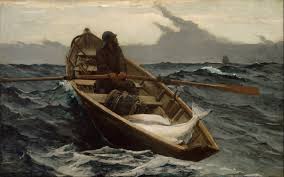
We are in Maine for our annual vacation. A year ago I was in search of scallops in Nova Scotia. This year I have decided to focus on halibut, paintings by Winslow Homer and Andrew Wyeth, and small bowls made by local potters. I have given up trying to spot a moose. I have to be content with the moose warning signs.

It’s fun to be in Portland, Maine after living in Portland, Oregon for 50 years. Oregon’s city was named by a coin toss. Heads Portland, tails Boston. The Maine city is also a large port. Even though Portland, Oregon is inland, it is a major Pacific Coast port via the Columbia River. The Maine city is much older with brick sidewalks and many cobble stone streets.

Tomorrow we will go to the Portland Art Museum to fill up on Winslow Homer paintings. Tomorrow night I’m hoping for halibut.

“A Long Hot Summer”

spl_32_20170902115205_2.jpeg

That summer when I worked for Challenge was the first time I had encountered a full East Coast summer. In Oregon, summer temperatures are usually in the low 80’s with no or very low humidity. Evenings are cool and comfortable. In Cambridge, to the contrary, temperatures were in the high 80’s and low 90’s with very high humidity and evenings that never dipped more than 10 degrees or so from the day’s reading.

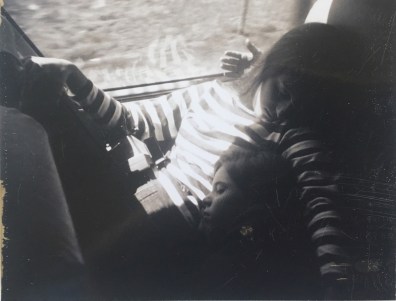
Here we are returning from a much needed field trip to the beach where we swam, ate and cooled off. Clearly, running after all those kids was exhausting, and someoneĀ  snapped this picture of me on the air conditioned bus with a tired student sacked out on me as a pillow.

Our apartment had no cross ventilation and was unbelievably hot at night. I remember my roommate Molly and I taking turns getting in the shower and then standing au naturel in front of a fan, creating our own private air conditioner. Sleep eluded us in the roasting apartment, but we had a good laugh over our cooling strategy.

At the end of the summer, neighbors wanted me to stay in the neighborhood for my senior year in college. We were allowed to live truly off campus as seniors if we wanted. When I told them rents off campus were too high, they assured me that I could have a full flat in one of the triple decker houses for a very reasonable price, at least 1/3 the cost of comparable apartments near Harvard. When I mentioned that, they said they never rented to students. In fact, they never even advertised when apartments were available in the area. It was their own effective hedge against gentrification. While I didn’t move there in the end, I appreciated the offer and realized that I had been accepted as one of the “town” and not the “gown,” a true compliment.

“A Real Challenge”

spl_32_20170902115153_2.jpeg

As in most places, there was a “town-gown” tension between Harvard and the surrounding city of Cambridge. To address that, many students volunteered through Phillips Brooks House, a center for community based projects run by students. I worked with “Challenge” an after school program for middle school Cambridge kids to supplement their math and science education.

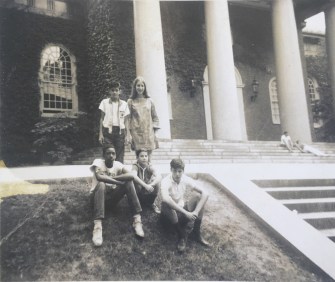
For the first time, in the summer of 1968, we ran a program during the day using Harvard classrooms. I am pictured above with four of the boys I taught in a math class. Not only did the kids come to the campus for class, but we lived in apartments in their neighborhoods. In my case, I lived with a roommate in a second floor flat in East Cambridge, at that time a working class, mainly Italian neighborhood. Our apartment was next to a sausage factory.

I earned just enough money for food, the bus and the apartment. Even knowing I would need to work more during my senior year to make up the short fall, I took the opportunity. The kids were pretty easy going, considering they were doing “school” in the summer. But they gained some prestige from going to “Harvard” and we were able to share our talents with some underserved kids.

“A HUGE Computer”

IMG_0186.JPG

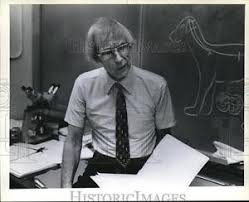
The next summer I landed a job at the medical school, working in the lab of the scientist pictured above. This job paid the astonishing $400 a month for two months. I also got to wear a white lab coat. I had really moved up the job ladder!

However, the work itself was no more exciting than peeling dimes off index cards. This time I got to walk and retrieve the professor’s mail, make coffee, answer the phone and do some key punching. Yes, key punching since he had a gigantic computer. Probably the computing capacity of that large room sized computer was the equivalent of my cell phone today, but it was cutting edge in 1967. Dr. Tunturi was studying brain waves and the effect of concussions, and he needed the equipment for his work.

Actually, the best part of the job was the office intrigue. One married man was carrying on an affair with one of the permanent lab assistants. This caused constant turmoil as some of the others felt that assistant was given more leeway than they were. She probably was! And though most of Portland was hot that summer, I had the advantage of air conditioning in the computer room, since it couldn’t be allowed to overheat. Few buildings had air conditioning at that time, so it was a real treat to stroll around in comfort, lab coat and all.