“Old Brooklyn”

E_00019A
73 Remsen Street, Brooklyn 1946

Inspired by my granddaughter’s query about all the places I had lived, I decided to take a break from my musical discussions for a while. It has been fun thinking back through all the places I have lived and looking for pictures I could find of them. Whenever possible, I am trying to add current photos if available.

This 3rd floor front apartment was occupied by my parents and by me in utero, so it technically serves as my first house. My parents were both working in Manhattan, he on Wall Street, her at Life Magazine, when they rented this 3rd floor Brooklyn Heights walkup. My mother always spoke fondly of their two years on Remsen Street.

Knowing that Brooklyn has dramatically morphed in recent years from the time when my newly married, and financially strapped parents rented here, I looked to see what the property looked like and was valued at today. The building has been turned into 10 coop apartments, with one of them recently selling for 2 and 1/2 million dollars.73remsenThe major change seems to have been the removal of the fire escapes running down the front of the building. How amused my parents would have been to know what had happened to their little inexpensive flat on Remsen Street.

“After Hours”

saxaphone

When I moved back to Portland, Oregon after graduation from college, I took a job with a travel agency. Eager to move out on my own, I went apartment hunting with a friend from work. She was white, married to a black man, and lived in a part of town with which I was unfamiliar. I quickly learned, however, that for $90 a month I could rent the entire downstairs of a house in that neighborhood. So, to the distress of some more cautious friends, I moved in.

Paula, my work friend, introduced me to a night scene I never would have found on my own. In particular, she took me to a predominately black jazz club that was upstairs over a downstairs bar. The club closed at the legal time mandated by the state, but then it mysteriously reopened “after hours” to those in the know. I was unfamiliar with jazz, but soon grew to enjoy nursing one brandy for several hours as I listened to a combo and singer. Better yet, at some unearthly hour I could leave with friends and head out to the all night pancake house for breakfast.

I can’t imagine having that kind of energy these days, but I was young and had the weekends off with no responsibility for anyone but myself. I enjoyed the first of many true cross cultural experiences which shaped me in many ways into the person I was becoming. My musical knowledge grew in yet another direction, courtesy once again of a friend. Thanks Paula.

“Fight Songs”

lincoln

Before I move into the music of my more adult life after college, I am backtracking to include the songs I learned to sing at sporting events throughout school. The proof of how enduring these songs are is that when a dear friend of mine went into early labor, I drove her to the hospital regaling her with these tunes. They worked, by the way, and she held onto the baby until full term. She has never let me live it down, but that was the encouragement that came out of my deep brain at 2 in the morning.

The grade school song went “Fight, fight, fight for Riverdale. For colors blue and gold. Fight, fight, fight for Riverdale for teams both brave and bold.” Then, more realistically, the verse went,”If she loses, if she wins, you may be sure it can be told, To our colors we’ll be true all hail the blue and gold.” How often does a fight song even suggest that the team might lose? At least we would still have our colors!

Our high school’s mascot was the cardinal, particularly ironic since there are no cardinals in Oregon. Here the push was “We’re loyal to you Lincoln High, We’re red and we’re white Lincoln High.” (Colors play a big part in fight songs.) No wimping out here, “we expect a victory from you Lincoln High.”

Finally at Harvard I was treated to the loud, but incomprehensible,

Illegitimum non carborundum;
Domine salvum fac.
Illegitimum non Carborundum;
Domine salvum fac.
Gaudeamus igitur!
Veritas non sequitur?
Illegitimum non carborundum — ipso facto!

Your guess is as good as mine. But it was fun to mumble along with everyone else!

“Heard It Through the Grapevine”

gladysknight

I went back to college in the fall of 1967 and started dating again. One of my first friends was a very white, prep school, jacket and tie man who took me to Boston ice hockey games. So imagine my surprise when he arrived at my house one afternoon telling me I had to hear something. Upstairs we went to my little stereo and after adding the 45 rpm adapter, he played “I Heard It Through the Grapevine” by Gladys Knight and the Pips.

One of the great ironies in my musical life is that with the advent of FM radio, local concerts and word of mouth recommendations about songs, my music had become re segregated. While AM radio had some “Negro” hits, they had disappeared from my listening world. They had disappeared from his also, hence his excitement about the song. I don’t know how he had stumbled upon it, but he not only played it for me, he taught me to dance to it.

The video I have linked is from the television show “Soul Train” which didn’t debut until the early 70’s. However, the dance steps they are doing are the ones he taught me. I never asked him how he knew the song or the steps. I suspect he had another life besides ice hockey! At any rate, we broke up in the spring, going our separate ways. No drama, just a college brief romance that was over. But I will always thank him for getting me “back in the groove.” I hadn’t danced that well since 7th grade.


“KINK The Underground Link”

klhradio
KLH FM Radio 1965

So I was now being introduced to new music on phonograph records and in person. The one place I was not meeting this kind of music in Portland, Oregon was on the radio. AM radio continued to play 2 1/2 minute songs. Occasionally they would play 2 1/2 minutes of a longer song, but then cut it off. Fortunately, both my brother at college in Ohio and I at college in Massachusetts had been introduced to FM radio. In Cambridge and in Oberlin, the radio to own was this small brown KLH model. Somehow, despite the fact that there was nothing for us to tune into, we convinced our mother to buy one so that she could listen to classical music.

But on Christmas Day, 1968, my brother and I turned on that radio and rejoiced together as station KINK, the underground link, went live. It was the first station in Portland to play the kind of music we had grown accustomed to in college. It played the whole song, not just 2 1/2 minutes of it. Here was the entire “Hey Jude,” not the AM truncated version. Here was the whole baffling “Whiter Shade of Pale.”(As I think about these long songs, I am reminded again that sans drugs I may have been having a less ecstatic experience than some of my friends.)

Car radio was still limited to AM, and most radios still had only an AM band. Even the KLH only tuned in FM, so we needed two radios in the house for other purposes. Still, we felt that Portland had begun to come of age. Hard as it is for the current enormous population of hipsters in Portland today to believe, Portland in 1968 was very much in the music backwater, along with the restaurant backwater and  the movie theater backwater. It was still a hamburger and drive-in theater town. But at least we finally had “an underground link.”

“Acoustic or Electric?”

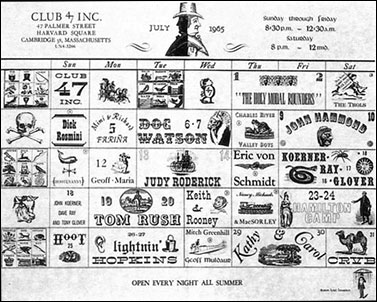
club47calendar.jpeg

I retrace my musical steps to introduce my experiences in Cambridge at the Club 47. This  coffee house, in the basement of a building across the street from the Harvard Book Store(The Coop) presented live acoustic music most nights of the week. It was inexpensive, easy to walk to, and hosted wonderful singers.

Here I first heard Tom Rush, Eric Anderson, Phil Ochs, and Judy Collins. The atmosphere was quiet so that you could easily hear the words to the songs. Songs explored issues pertinent to the crowd, from love lost to political action. I felt at home there in a way I often didn’t feel in the intellectual climate at Harvard.

Reflecting on this time in my life, I realize it was then that I chose the “path less traveled” and stuck with acoustic music, eschewing the more popular amplified sound. The Rolling Stones were very popular at that time, but I found their music ugly and disturbing. Perhaps my disinterest in drugs helped me choose which musical path to follow. Perhaps it was my abhorrence of loud loud loud sounds. Perhaps it was a distaste for bad lyrics. At any rate, I was an English major because words mattered. I wanted to be able to hear the words, think about the words and remember the words.

In the last twenty years, I have enjoyed discovering a whole new group of what are now called “singer-songwriters” rather than folk musicians.  There exists a whole raft of excellent writers playing acoustic instruments whom I now follow. I will write about them later on in this musical odyssey. Suffice it to say, I don’t need to follow the very popular “tribute bands” now raking in millions from my generation. I don’t need to remember those old loud songs. I can peacefully listen to the new singers who choose their words as carefully as the ones I listened to in Cambridge in the late 1960’s.

“If You’re Going to San Francisco…”

janisjoplin
Big Brother and the Holding Company 1968

My boy friend and his best friend had stopped in Portland on their way to San Francisco for the “Summer of Love.” It turns out that there is now a celebration of the 50th anniversary of that summer in 1967. Many people had responded to the idea to go to Haight Ashbury that summer, and there was even a song that went,”if you’re going to San Francisco, be sure to wear some flowers in your hair.”

I joined them for a visit and we went to see an act at the Fillmore West. The room was filled with “psychedelic” light effects. I was sitting near where they were originating, and it appeared someone had poured colored oil on glass and was tilting it around as light shone through it. The band was very very loud and the woman singer was screaming basically. That was my introduction to Janis Joplin and the Holding Company about whom I knew nothing.

The major problem I had in San Francisco was that I didn’t use drugs. Of any kind. Not pot, not LSD, not mescaline, not mushrooms, not peyote. I barely even drank. I had no objections to other people using, but I had a fragile enough grasp on reality that I was terrorized at the thought that I could lose it. I spent my time trying to stay grounded, not trying to leave my body.

As you might guess, this made me somewhat of a drag around my friends in San Francisco. It really highlighted a chasm between us. Not only did they love any kind of mind altering drugs, they were also very politically involved in anti-war activities.  I was just trying hard to study and write papers. On the other hand, they were facing the draft and I wasn’t.

For several reasons, then, that summer brought an end to my romance. And by the time I returned to Cambridge, I was greeted on campus by my former roommate. She announced that since I had broken up with the man in August, they had gotten together in September. I was startled, but accepting. They shared a love of politics and of substances. Probably a better fit. But I had gotten to see Janis Joplin!

“Stereophonic! Wow!”

IMG_0113

As I go through my history of music, I will continue to educate those readers younger than I am (about 90% of you) about the various devices I used to listen to music. The big leap in college for me was the purchase of this portable STEREO record player. Until now, all music came out through one speaker. With the amazing invention of stereo, the music came out of TWO speakers. And the music was closer(supposedly) to the way it really sounded when it had been played.

There was much debate about how to position the speakers to achieve the optimal sound. My dorm room was so small, however, since it was converted from a bay window and hall between two bedrooms of normal size, that there really weren’t any options. So the best I could do was to lie on the floor with one speaker against each ear and experience STEREO!

By this time there were people who were becoming audiophiles, and were beginning to spend real money on speakers. I was not among them. I didn’t have real money and I was still impressed by the improvement in sound over my previous record player.

In the summer of 1967 my boy friend arrived in Portland on his way to San Francisco for the summer of love. He had the new Beatles release “Sergeant Pepper’s Lonely Hearts Club Band” with him and he lay on the floor of my parents’ dining room between two speakers positioned next to his head. He couldn’t get over the amazing sound. (In retrospect, substances may have added to his delight.)

Later that same summer, I joined him in San Francisco for a few days. More about that tomorrow. For those keeping track, this was the same boy friend that my roommate married. And it all goes back to that summer of love.

“The British Invasion”

beatles

In August of 1965, a couple of weeks before I left on the train for college in the East, the Beatles landed in Portland and played two concerts in the then new Memorial Coliseum. My mother had somehow bought tickets for all of us and we went to hear the phenomenon

At 18, with my 15, 12 and 10 year old siblings, I was mortified at the thought that they might stand up and start screaming. I knew my brother would contain himself, but my middle sister had a crush on Paul, and I didn’t trust her to contain herself. All the way there, I stressed the importance of them being collected when the Beatles appeared. I was about to be a college girl, after all, and I had a reputation to establish.

There must have been some warmup acts to get us all restless before the Fab Four came out on the stage. Finally, they emerged. I stood and screamed my head off. My siblings sat still, obeying my orders to behave themselves. I surprised myself because I really thought I had not been caught up in Beatlemania. But, it turned out, seeing John in person let loose some primal excitement that needed to be expressed.

They never let me live it down! “Remember when you screamed at the Beatles?” How could I forget?

“Blowing in the Wind”

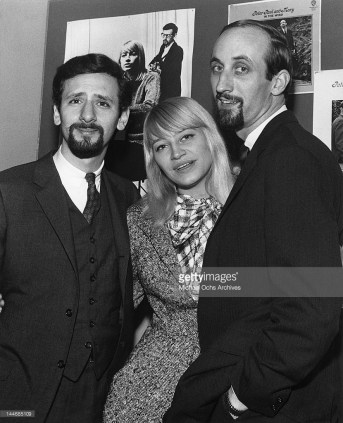
peterpaul

Bob Dylan’s voice certainly wasn’t for everyone’s taste. Fortunately for those music fans, the trio of Peter, Paul and Mary sang many of his songs. And they actually stayed on key and harmonized. They got short shrift among die-hard Dylan fans for popularizing his protest songs, but they definitely got many more tunes into the mainstream of popular culture than Dylan had.

In 1964 they toured many college campuses, and in that winter they performed at Lewis and Clark College, just five miles from our home. A good friend of my mother’s bought tickets for her three kids and our four and planned to take us. One of Oregon’s few snow storms hit just before and during the concert, but our neighbor was undeterred. Knowing that the concert would go on since it was at a college with a built in resident audience, she promised she would get us there. And she did. Fortunately it was downhill (literally) after the concert and going home was easy.

Having only seen them on television, I was delighted to see them in person. They sang “Blowing in the Wind,” “Lemon Tree,” and their delightful “Puff the Magic Dragon.” Comically enough, later writers would try to put “hidden” meaning into that last song, maintaining that it was about marijuana or about Viet Nam. I remain convinced that it was about a little boy and a dragon.

Soon many would discount Peter, Paul and Mary as being simplistic and naive. Harder edged music would take the stage in the years to come. Still, I have their tunes running through my mind at times, and I can still see Mary Travers shake her long blond hair over her shoulder.