“Canned (Shell)Fish 2

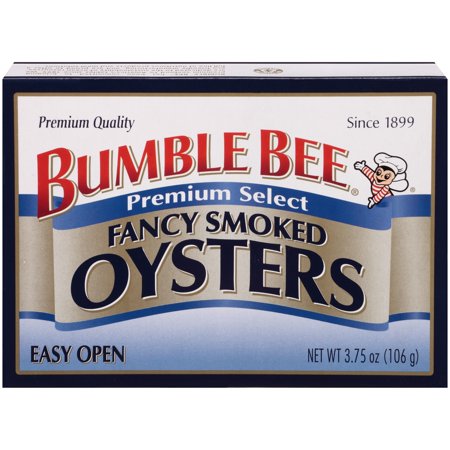
My parents threw dinner parties now and then for clients and associates from my father’s law firm. Each time the appetizers were the same. One standard was a smoked oyster atop a Triscuit cracker. The other was sour cream mixed with dried Lipton Onion Soup Mix, again with a Triscuit. I had the job of spearing each oyster with a toothpick, and leaving the open can next to the crackers. I also was responsible for mixing the sour cream with the onion soup mix. I enjoyed sneaking an oyster for myself and rearranging them so that its absence wasn’t noticeable before the tray went out.

I never tasted a fresh oyster until many years later when I was handed one on the shell and told to swallow it whole. I found the experience disgusting and still have trouble understanding the idea of trying different varieties as a gourmet treat. Perhaps if they were as tiny as the smoked ones I might have had a different opinion.

In college I encountered oyster stew, a favorite in New England. I liked it only slightly more than the raw one. For me the best part of oyster stew was the accompanying oyster crackers. Now that I know it is possible to buy the crackers and forgo the stew, that is what I have continued to do.

I still occasionally get an urge to eat the canned smoked oysters of my childhood. I get out a handful of toothpicks, a box of Triscuits, and open the can. I have never found anyone interested in joining me, so I get the whole tin to myself. A vast improvement over the one sneakily eaten many years ago.
“Canned Fish 1”

Despite the fact that my father liked to fish, the only time I ever ate fresh fish was on camping trips. All of the other fish I ate growing up was either canned or frozen. I ate tuna fish. A lot of tuna fish. Tuna fish sandwiches with tuna mixed with mayonnaise(never Miracle Whip.) Tuna noodle casserole with tuna mixed with white sauce. Creamed tuna on toast, the same mixture poured on toast. Scalloped tuna, the same mixture baked in artificial scallop shells giving it the fancy name.

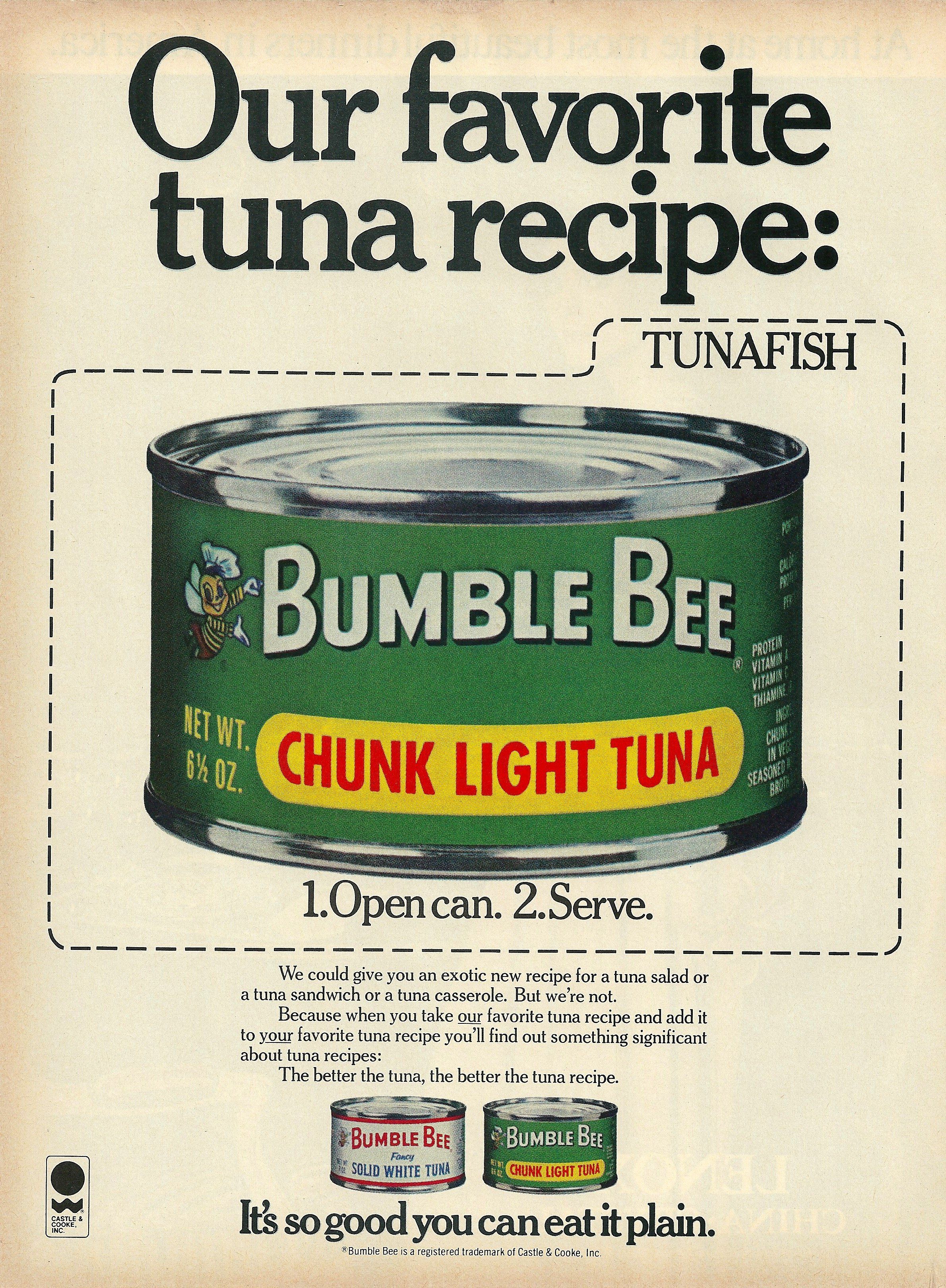
Fortunately we lived only 90 miles from a gigantic tuna packing facility, the Bumble Bee cannery in Astoria, Oregon. In fact until the “sorry Charlie” tuna ads ran for Chicken of the Sea tuna I never knew any other tuna existed. Bumble Bee frequently went on sale at five cans for a dollar instead of the usual four cans for a dollar. Needless to say, my mother had us pile cans in the cart at such times. We NEVER ran out of tuna fish at our house.

Of course times have changed dramatically in the intervening years. The abandoned cannery has been transformed into the Cannery Pier Hotel and Spa. Tuna fish now costs nearly $2 for a can now 1 1/2 ounces smaller than the one of my childhood. Tuna sandwiches with confetti topped toothpicks and a side of pickle and chips now seem unusual, save in a “retro” lunch spot.

But for many years if you had asked anyone in Oregon to name a brand of tuna fish, she would have answered “Bumble Bee.” And it would have been in her sack lunch at least a couple of times a week.

“Fish Tales 6”

While I had always gone fishing with men, one of my college students Jackie(on the right above) lived on a houseboat and invited me to go salmon fishing with her. Salmon run up the Willamette River in late spring, and it is legal to fish for them. Jackie and I went out in her little motor boat, dressed to get wet, but with little hope of actually catching a salmon. We joined a flotilla of similarly hopeful anglers around the base of the Sellwood Bridge near her home.

To our astonishment I got a bite on my line and the adventure began to haul it in. Between the two us we managed both to get the salmon into the boat and to keep ourselves in the boat. We nearly lost the fish and almost sent one of us into the river. Eventually we did reel in the fish and motored back so Jackie’s neighbor could give us the photo proof of our success. Jackie cut the fish into freezer size pieces and we split the bounty.

Having finally caught a huge fighting fish, I concluded my life as an angler. Future posts will discuss how I came to enjoy the fruit of others’ labors.

“Fish Tales 5”

Barview Jetty, Garibaldi, Oregon

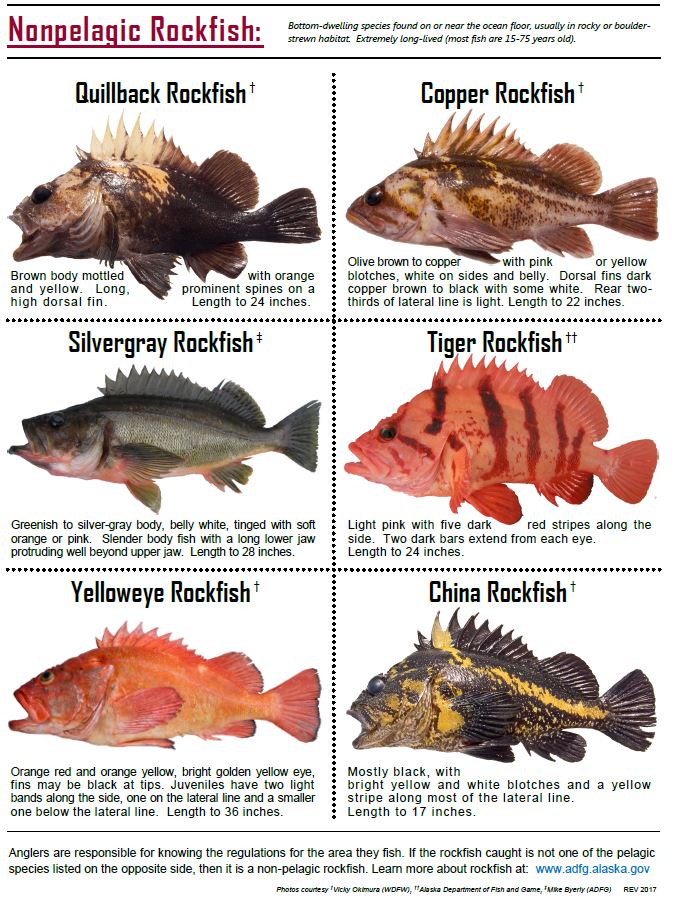
In my 20’s I also learned another fishing technique, casting for ocean fish off the rocky breakwater shown above.(not one of my photos.) This style required new skills, not least of them walking out over large rocks, often still slippery from earlier tides. The gear was similar to lake fishing, with a stronger line, a heavy metal weight, and sand shrimp as bait instead of worms. The fish, coming as they did from deep in the Pacific Ocean, looked prehistoric to me, including varieties of rockfish.

Key to fishing off these jetties was an awareness of tides. We had grown up near enough to the ocean that an understanding of tides was seemingly wired into our brains, so we recognized both the going out and the coming in of tides. The trick was to arrive as the tide was leaving and to pack up before the tide threatened our ability to walk back across the jetty to dry land. Little crosses on the jetty mark where some reckless fishermen neglected the incoming tide in their quest for the perfect haul.

Bringing the fish in out of the ocean was a true challenge. The lead weight sometimes convinced me that I had caught a fish, as had the times the line was caught up in rocks. I also wasn’t really skilled at staying balanced on rocks while reeling in a large ugly fish. I usually turned that task over to my fishing partner.

Truthfully my favorite part of fishing on the Oregon coast was lunch after we were done. We drove into town for, you guessed it, fish and chips.

“Doubly Thankful”

Today we filled our refrigerator with food prepared by the organization pictured above. Tomorrow I am sharing it with family members outside since it is to be fair and mild. I am grateful that I was able both to benefit an inner city job center and to get my Thanksgiving dinner cooked in one move. Happy Thanksgiving to my friends all over the world!

“Fishing Tales 4”

Well, this post isn’t really about crawdads, but it is about fishing holes, so I thought I would share the video. Until I was an adult the only fishing I knew about was on lakes and streams. I had watched fly fishing and trawling. But in my early 20’s I made friends whose roots were in the southern United States, and I learned about fishing holes. Trout and salmon didn’t frequent these warm water spots, so I also learned to eat a new variety of fish.

Sloughs dot Western Oregon, providing a perfect home for warm water fish. These required learning a new skill, seeking them with a worm, a rod and reel and a bobber. Basically I put a worm on a hook, threw the worm and line into the pond and waited for the bobber to—bob! When it began to go down or up and down it meant a fish was biting and I needed to set the hook and reel it in. One advantage of this kind of fishing appealed to me; a lot of time was just waiting, the perfect opportunity to drink a beer. Apparently beer was an essential element in this style of fishing. Discarded bottles and cans usually adorned the banks of these spots.

I hooked, bonked on the head, cooked and ate blue gill, crappie, sunfish, bass and catfish. I prepared all of these in the southern style of batter dipped, cornmeal coated, and fried. They were tastier than I remembered fish being. Perhaps it was the additional beer with supper.

“Fish Tales 3”

I think it curious that my parents kept taking pictures of me holding or staring at fish! Anyway, here is another one a couple of years later at Detroit Lake, a newly opened campground in the Cascade Mountains of Oregon. The Santiam River was dammed, creating this large lake in 1953. I would guess we camped there for the first time in 1954 when it was still pretty undeveloped. In high school I water skied here with friends and eventually it was fully built out for RV’s. This past fall the whole area was destroyed by forest fires.

These trout certainly show the skill of my father fishing from the little boat in the far distance of the picture. He drove the boat very slowly dragging a line behind him, trawling for fish. I was less impressed by this method since it lacked the artistry of the fly cast I had come to admire.

As for me, I am in a red wool bathing suit with little golf ball buttons. All these years later I can recall how I hated this bathing suit. Not only did it itch, it also sagged. It is no wonder that even this good haul has failed to produce my smile.

“Fish Tales 2”

Clearly by the time I was three as I was just as curious and skeptical as I had been when confronted with a bucket of smelt. Here I examine a rainbow trout caught by my father when fishing. Above my head you can see the wicker basket that my father used to keep the fish.

My parents loved tent camping when we were growing up. I must say, for those used to RV travel, that tent camping was a redundant phrase when I was a child. It was just called “camping.” We had a large tent, those war surplus mummy bags, a Coleman white gas fueled camp stove, a Coleman white gas fueled lantern and a Coleman ice chest. I don’t know if Coleman had any competitors at the time, but it was all we ever bought. In fact they were even referred to as “Coleman stoves,” rather like the ubiquitous “Kleenex” and “Bandaids.”

Oregon was full of campsites, basically flat places on the ground in the midst of evergreen trees. Sometimes they had running water and outhouses. Often they didn’t. In the latter case we dug latrines and hauled water from creeks. We didn’t know about the risks of that water, and we fortunately were spared any parasites.

But we were always next to a lake, and my father always fished. He was a fly fisherman who studied the bugs and spent much time casting and recasting his line. I never tried it. It was an activity that belonged to my dad alone. I did eat the trout every summer. I remember the camp fires, the metal grate and the cast iron skillet that cooked them. And I remember the bones. As a child I thought the effort of deboning a trout outweighed any value as food.

A few years ago, Charlie and I watched a waiter at an upscale Italian restaurant deftly debone a trout table side. In one quick movement the trout was ready to eat. He was what was missing when we went camping!

“Fish Tales 1”

A friend of the family likes to fish, and it began reminding me of the many times in my life I have been fishing. I thought I would post a few of these as a great distraction from the insanity now raging in my nation as a tyrant tries to overturn our legal Presidential election by pulling out all the stops he can invent each day.

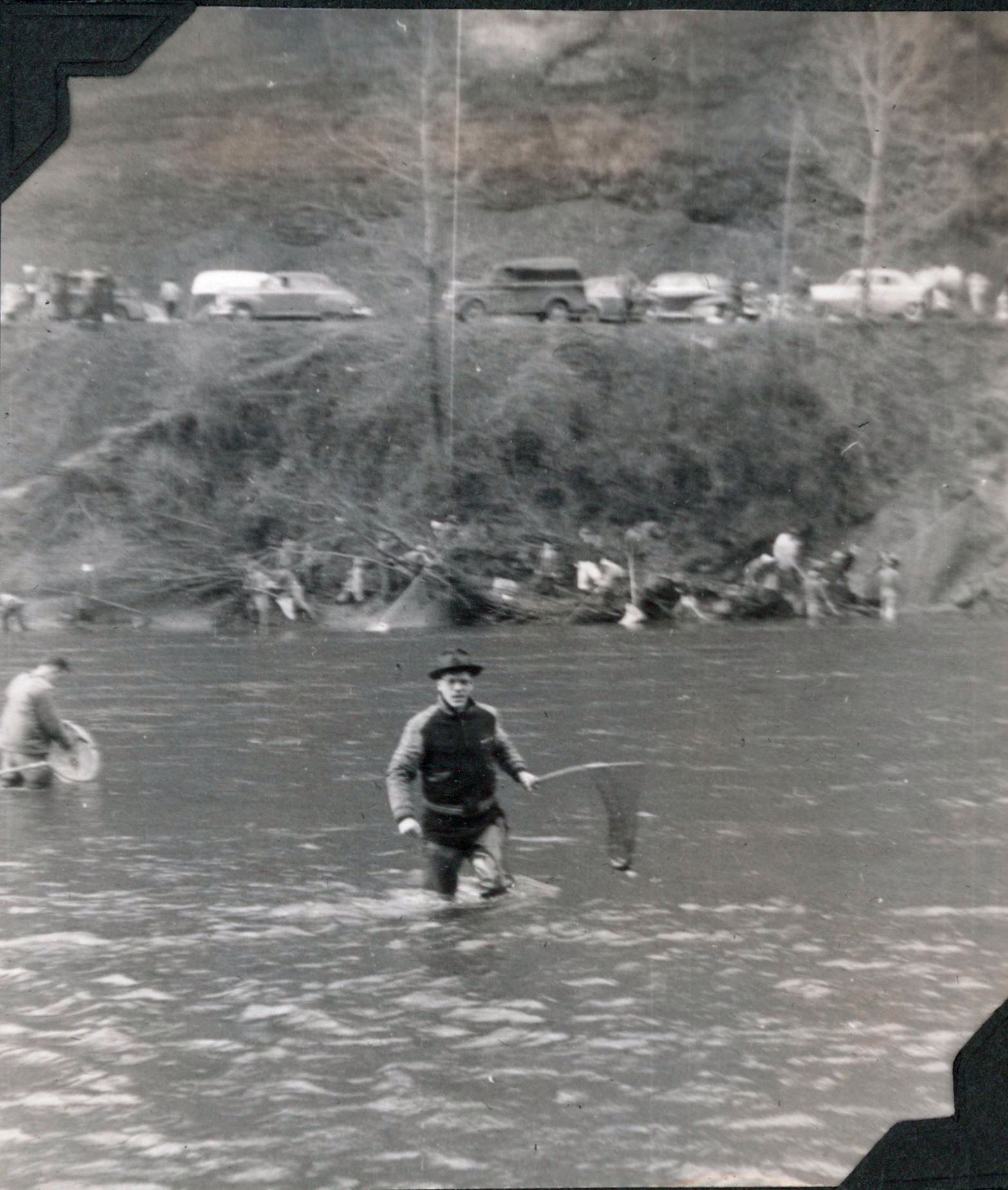
Above you can see the smelt run on the Sandy River in Oregon in spring of 1949. When the call went out that “the smelt are running,” crowds of people took their nets, drove a short way out of Portland and hauled them in. On the left you can see our friend Dick wading in the river and on the right I am either admiring or being horrified by the haul. My attitude towards fishing has often vacillated between the two reactions.

Curious if this still occurred, I consulted the internet only to learn that the last significant smelt run took place in 1980. Not only that, but in 2010 they were listed as an endangered species. Apparently that halt on their capture has led to a modest rebound of the smelt, though clearly nothing like the runs in the 1940’s.

I have no memory of eating smelt. But I am in awe of the plenitude of fish just there for the netting. In 1949 it didn’t occur to anyone that this tradition would ever end.

“Time Warp”

An elephant’s gestation period is 22 months. It has now been eight months since the order for people my age to restrict their activities because of covid. We have missed Easter and we are about to miss Thanksgiving and Christmas celebrations. Even if the vaccine is developed and even if a majority of Americans decide to take it (how likely is that?) Dr. Fauci, the nonpartisan head of the National Institute of Allergy and Infectious Diseases said this morning that it will be the third or fourth quarter of 2021 before things will begin to approach “normal.” In other words about another eleven months. But realistically given many Americans’ denial that there even is a disease, I figure it will be into 2022. In other words, time enough for an elephant to gestate and deliver a baby.

But the real question is why has my brain gone off the rails like this? I think that I constantly find myself in some kind of time warp, unlike any I have ever experienced. As such, I try to liken it to some known event. I have failed. I used to compare the length of this trial to my own pregnancy. But I guess should have thought instead of my paternal grandmother who had my father and his younger brother 13 months apart. Yep. 22 months in all.’

As the numbers soar and people scream at nurses that they can’t be dying of covid because it isn’t a real illness (a nurse in South Dakota) and the “leader” of my country keeps saying he won an election he lost, I feel that I have indeed gone down the rabbit hole and am living among the Red Queen and her minions. And all I can see is the white rabbit running around with that big watch ranting about the time. And all I can think about is the line from Chicago: “does anybody really know what time it is?”