“Timing”

When I was in the seventh grade I won a dance contest in the seventh grade/eighth grade couple event. I have no idea why Ralph asked me to dance, nor did I know that he could move on the floor, but he did and we did! I have always had a very soft spot in my heart for that song. I was thrilled to find a video of it, along with a photo of the singer.

I was contemplating how often timing is the missing factor in so much of our lives. We have great ideas and plans, but the timing may be off. I remember back to 1980. I was tired of being a broke single mom and a man proposed not only marriage but a house, a 1969 Chevy convertible and a good income to boot. I accepted. But deep in my gut I knew I was making a mistake, and I called off the wedding.

The right timing didn’t arrive until another six years of being a broke single mom. By then the man who is now my husband was available. He had no house, a broken down Toyota and an income after child support not much bigger than mine. And two and a half years later we married. It was the right man and the right time, and many years later we now have a house, two decent cars and a reasonable income. “All in good time” is a phrase much bandied about, but it can be true.

“Fools rush in,” as I nearly did in 1980. I like to remember that “good things come to those who wait.”


“Typhoon Vamco”

To those friends who follow our dear Arlene in the Philippines: She is ok after the Typhoon that hit there on Thursday. I hadn’t seen any posts and was worried. She replied to me that she was flooded with water half way up her legs inside the house. Her car was flooded and towed though still covered by insurance. She suffered terribly in a typhoon some years ago too. I know she would appreciate prayers from some and loving thoughts from others.

“Tale of Two Gym Teachers”

Thinking about competition and winning and losing, I thought back to my two very different experiences with gym teachers. Mr. Graven was my teacher throughout elementary school. Mrs. Allen ran the physical education program at my high school

For Mr. Graven sports were for fun with competition playing a minor role. All the girls in the seventh and eighth grade were on the school teams, both volleyball and softball. I was short, not particularly skilled, and pretty nearsighted. Nonetheless I played with heart in both sports. Mr. Graven used to take me out of rotation every time I got to the front row in volleyball, wisely realizing I was more likely to walk under the net than to get the ball over it. I was a pretty good batter, but a pretty mediocre fielder. Right field was perfect. At the end of the eighth grade I got a letter in recognition not of my ability but about my playing to the best of what ability I had. I didn’t feel patronized, but grateful that he had seen me.

High school athletics, run by Mrs. Allen, were a different matter. Team sports were just for boys. Gym class seemed aimed at shaping our bodies to cultural standards. We actually did one exercise where we chanted “we must, we must, we must build our bust” and another to the tune of “go you chicken fat go.” Our teacher wore a skirt and nylons and yelled at us to work harder. I learned that our bodies were unacceptable and needed improvement. Needless to say, I came to hate exercising.

As those of you who have followed me for some time realize, I eventually came to love exercise for the way it makes me feel. As I work out in my “home gym,” I often experience the same joy I felt with Mr. Graven. It is good to move with the body I have, not the one that Mrs. Allen would have approved of.

“Losing Twice”

The other time honored tradition in the eighth grade was the election of the Student Body President. My school went from kindergarten through the eighth grade, and all students could vote. We had been preparing for this capstone election throughout our years, with regular class elections. But this one brought out election posters up and down the halls drawn by all classes supporting one or the other. Me or Anne, as it happens.

I had siblings in kindergarten, second and fifth grade, giving me a slight edge over Anne whose siblings were only in second and fifth grade. We counted on their help in “getting out the vote.” But after all the politicking, the speeches and the posters, when the final vote was tallied, Anne won and I lost. To my eternal gratitude the actual numbers were never released in these races. I hoped I hadn’t been crushed by her, but I will never know.

I tried again in high school running for Student Body Treasurer against Rhoda. We came from two different elementary schools, with Rhoda’s being the more prestigious. She actually confronted me in the hall and said “I would be mortified if you won.” She wasn’t mortified and I didn’t win. Again the actual vote count was kept secret.

Why my involvement in school politics? My parents were very active in local politics with my father running for State Representative. He lost. My mother ran for the school board. She won. It just was part of my family life supported throughout with civics lessons during all of my education. I haven’t run again, but I always vote. It is just part of me now.

“A Well Earned Win”

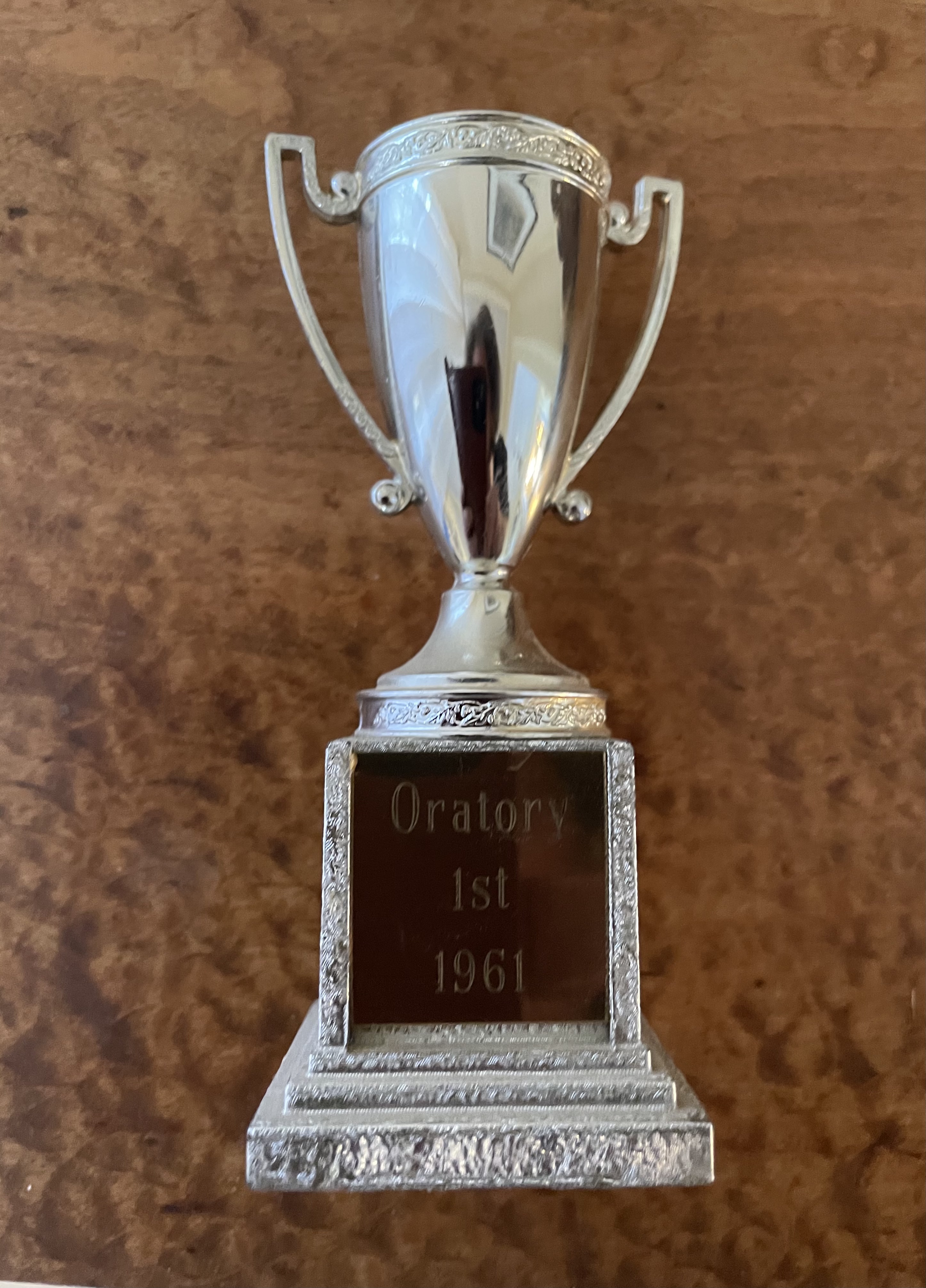
Above you can see the trophy from 1961 that I was awarded for first place in the school oratory contest. Thinking about competitions and winning and losing, I go back to that time at the end of 8th grade. I won that contest, but it took many hours of thinking, researching, writing and rehearsing to do so.

From the beginning of the school year we knew we would be participating in the annual oratory contest. Much of our education from the earliest years involved memorizing, whether of poetry, speeches or our own pieces. We had also had years of standing in front of the class to present these words. But 8th grade raised the stakes to a new level, giving a speech to the whole student body and invited parents. Then the winner had to repeat the speech at graduation.

The school made sure we were prepared. Each week in 8th grade presented new speech exercises. Most amusing were the extemporaneous five minute talks. Mr. Goodrich would give us a word and we needed to speak about it for five minutes. I will never forget the challenge of talking about a can opener for that length of time. Of course we were equally entertained by the five minute speeches of our classmates on paper clips, Dixie cups and sweaters.

Eventually we had to give our own talks every week. These had to be written out and then memorized. We were graded on content and presentation week after week. It never occurred to us to complain. This was how we always knew it would be in 8th grade. Finally we wrote and practiced our ten minute entry for the contest. I spoke on “The Value of a College Education for Women,” which unbelievably in retrospect was still being debated in 1961. And as you can see, I won. No one argued with the judges and no parents complained. Calmer times for sure.

I have been forever grateful for the training in oratory in front of a large group. It gave me the courage to address City Council, the School Board, zoning hearings, and my church community. And of course, as you can see from my 59 year treasuring of the trophy, I am proud I won.

“Competing?”

I had gym class every day in elementary school and played hard on the playground during morning and afternoon recess. Once a year the whole school community gathered for Field Day, an event with a myriad of events and a chicken dinner at the end. My school had about 200 kids in it, so it was quite a gathering.

My late sister Patsy was a much faster runner than I was, and here she sports the second place red ribbon for the dash in her grade. First, second and third place ribbons were awarded in many competitions. Entering was optional, but most of us entered everything. Most fun for me, not much of an athlete, were the three legged sack race and the egg carry. Each was so comical that when we collapsed in hysterics tangled up in a burlap bag or looking at a broken egg no one cared who won.

I have loved reading the comments that have come in around my post about learning to lose. It is refreshing to see disagreement among my readers thoughtfully expressed. You have enlarged my thoughts about the benefits and drawbacks of competition. You have also reminded me of something I had begun to forget over the last four years. We can respectfully disagree even about charged subjects such as the aim of education and the raising of children.

If you didn’t chime in yesterday, please feel free to add your thoughts about competition, winners, losers and contests. I will share more of my own experiences, both athletic and academic tomorrow.

“Learning to Lose”

I have played hundreds of board and card games as the oldest child of four, as a mother and as a grandmother. In all of these activities there is a winner and often several losers. One of the truths I have observed over the years is that we have to learn how to lose. Or, more importantly, how not to be what my father always referred to as a “sore loser.”

We learn this skill slowly. Usually we “let” the littlest players win as they learn a new game. But after a while we begin to let them lose occasionally if that is how the game is going. When that happens we are sure to hear a variety of complaints, most often “that isn’t fair” or “you cheated.” No one likes the feeling of losing a game and the easiest way to stop those feelings is to blame the other players.

But over time we are taught, in a variety of settings, how to gracefully lose. It doesn’t mean that we aren’t upset, nor does it always quiet the inner voice saying “it isn’t fair,” but generally we learn to be “good sports.” We are expected to congratulate others on winning and to nurse our losses in private. At the end of many athletic games, for example, the two teams line up and the players shake each other’s hands.

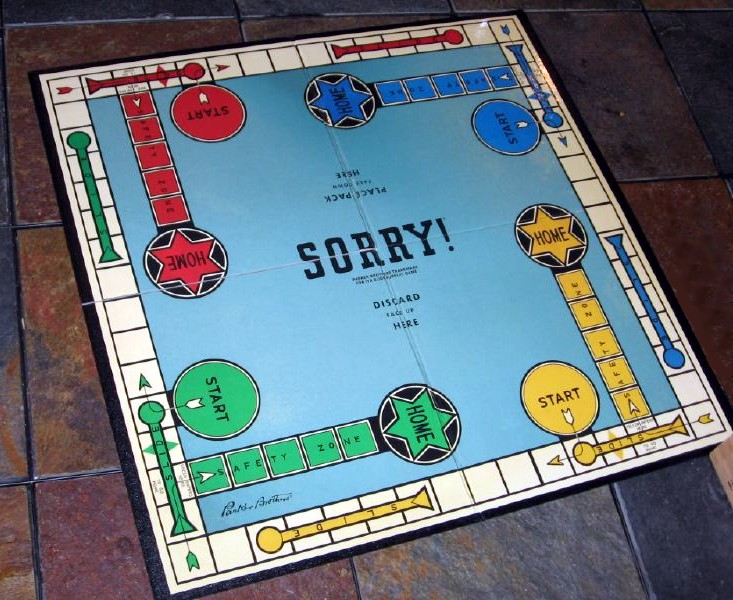
Sad to say, some adults have never learned how to lose. When I see them I think of my brother throwing the Sorry board across the room when he was five years old and losing to me. And I wish someone would hug them and let them know they will be all right. Losing doesn’t make us losers. That’s another truth I learned when young.

“Indivisible?”

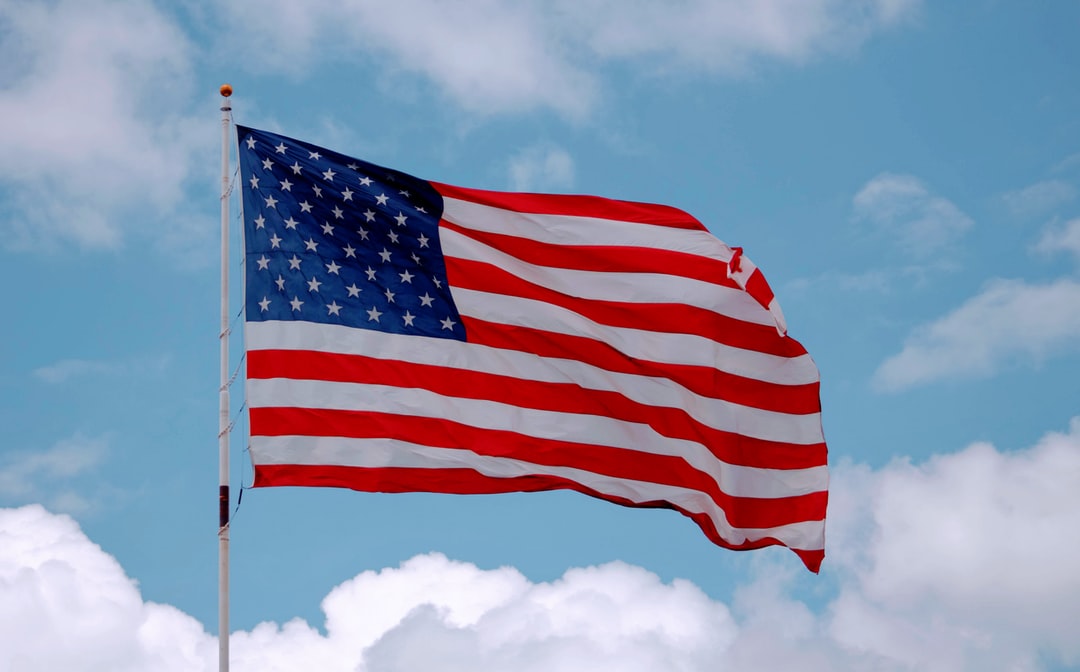
“I pledge allegiance to the flag of the United States of America, and to the republic for which it stands, one nation under God, indivisible, with liberty and justice for all.”

Growing up in the United States, I began every school morning by facing the American flag and repeating what is called the “Pledge of Allegiance.” When I was in third grade I had to adjust to the addition of the phrase “under God” which had just been inserted in light of a “Communist threat” said to be afoot. The “Pledge” was such a normal part of the day that I never gave it much thought until high school.

In high school, as I became more aware of racial injustice and the conflict now known as the Vietnam War, I found it difficult to recite the Pledge, and merely stood while it was repeated. And in recent years when flag salutes and the national anthem are regular parts of many events, I still struggle with the disparity between the ideals of my country and its reality.

This morning, as my nation reveals itself to be nearly evenly divided between two very different visions, I reflected back to one word in the Pledge–indivisible. Written in 1892, only thirty years after the Civil War, the Pledge stressed that we were one country, not two as had existed for the brief time of the Confederate States of America. The voting on November 4 starkly demonstrates that we are quite divisible. And as Abraham Lincoln said, echoing the New Testament, “a house divided against itself cannot stand.” While he was referring to slavery and freedom, the same truth prevails today.

Democracy on the grand scale of our country remains a fragile experiment. Unless we find our way forward together, I am afraid the experiment will come to an untimely end.

“Cognitive Dissonance”

I grew up listening to the activist folk singer Pete Seeger. One of my favorite albums in high school was from a 1963 concert in Carnegie Hall called We Shall Overcome. From it I learned many of the songs that were sung during the voter registration drives and arrests in the South during a civil rights movement. I also saw him in person several times, always in low key settings such as high school auditoriums. Tickets were inexpensive and the concerts were warm, inspiring and well attended.

Later Seeger devoted himself to efforts to make the Hudson River in New York State clean enough to swim in. When joined by hundreds of others, Seeger succeeded in his efforts to clean up “my dirty stream.” A lifelong union advocate Seeger always aligned himself with the working person, lived simply and stayed humble.

Imagine my shock when an ad for the Volvo automobile popped up on my tablet with a very familiar voice in the background singing “It’s hard times in the mill my love, hard times in the mill.” It sounded like Seeger, but that was impossible thought my naive brain. That was an labor organizing song about dreadful work conditions in New England textile mills. This was an ad for the upscale Volvo.

But unbelievably, that was Seeger(who died in 2008 and couldn’t object)singing that song paired with the apparently staggeringly difficult work of learning that an upscale Swedish couple was having twins. Needless to say, my brain has still not been able to adjust to something so past irony that it needs a new word. “Travesty” and “blasphemy” come to mind.

“Curses, Foiled Again”

I actually don’t mind feeding squirrels from the seed feeders I have in the yard. I buy seed by the 20 pound bag and the birds eat the majority of it. But the three varieties of woodpeckers we have near us love to eat suet cakes. These are costly and a squirrel can eat her way through one in no time. Starlings, an unwelcome invasive bird, love suet too. They will swoop in at once and clean out a couple of suet cakes in an afternoon.

After looking for a solution, and not finding one, I finally stopped putting suet cakes out. The expense was not justifiable since I was merely feeding squirrels and starlings. Even if a small woodpecker was eating, when a group of starlings landed they drove him away.

Then reading about squirrel proof feeders(an oxymoron by the way) I ran across this suet feeder. (I get no kickbacks from the company and there is no link to it.) A weight sensitive cage holds two suet cakes which are accessible from the front and the back. When a squirrel lands on the cage, it drops down covering the suet.

What about starlings? One starling doesn’t weigh enough to close the cage. But starlings never let one eat alone. Soon enough more fly over and the cage drops. They then begin to fight among themselves and no one gets to the suet.

To my great delight the woodpeckers are back and enjoying their well deserved fatty treat.