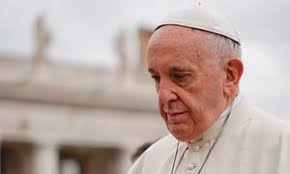
“Huh?”

2E40F4CB-95BF-4D63-9EF6-924DB518C8CA.jpeg

I often dog sit my granddogs, and they always give me this look of confusion. “Who are you anyway?” Are you here to help or are you a threat? They have to be reassured every time I drop by to care for them.

The Pope’s next line from the Peace Prayer says, “where there is ambiguity, let us bring clarity.” Reflecting on instances of ambiguity, I realized that many of them occur in normal life. When asked if I want to go somewhere, I may respond, “I guess so.” This message is not clear at all for the recipient. It is what we call a mixed message. My words are saying yes, but the phrase is implying reluctance or resentment, depending on the situation. I am asking the hearer to decide what I really want to do instead of being clear from the start. A clearer message might be:”I really do not want to go, but I realize that it is important to you and so I am agreeing to go and I will not act resentfully.” What are the chances that I will be that clear? Not high! But it would be a much fairer response on my part.

The Gospel of Matthew says “Let your yes be yes and your no be no.” Clearly people have been waffling for a long time when they answer one another! So this line of the prayer speaks to my tendency to be ambiguous instead of straightforward, handing responsibility to another to see what I really mean. A hard habit to break, but this line encourages me to try.
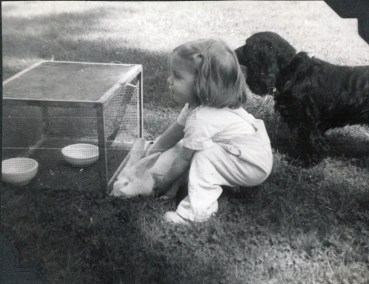
“Seeking Harmony”

1948-50s 056

The Pope’s prayer for peace continues “where there is confusion, let us inspire harmony.” This photo of me holding a rabbit in place while my dog stands quietly by could certainly be a picture of chaos, rather than harmony! But somehow, even though I am certain that an adult quickly rescued the rabbit, there is this lovely moment of all three creatures getting along.

Harmony doesn’t mean conforming to one note. Harmony, instead, comes from the blending of different notes. When different voices come together, they can either produce a pleasant sound or cacophony. Right now in the United States, the voices seem to be producing confusion. What might unite us, as different as we are one from another? How could harmony actually come out of the present confusion?

I am currently reading Robert Reich’s book The Common Good. In it he calls Americans back to an ideal, not yet fully realized, of a truly democratic society with equal opportunity for all. He speaks against the self-centered orientation of so much of today’s discourse. Reverend Martin Luther King spoke of this in similar words when he said, “We must learn to live together as brothers or perish together as fools.” Clearly I cast my vote on learning to live together.

“The Practice of Listening”

354DC68C-EE89-470D-AD1C-7AB98B9C4486.jpeg

Here my beloved Aunt Cary pays careful attention to some object I am explaining to her. Since I am just a little over one, she has to patiently wait for my first words to tumble out. The Pope asks us “where there is shouting, let us practice listening.” I read recently that silent is an anagram of listen, a good reminder of the correlation of the two words.

One of Shakespeare’s most quoted lines comes from MacBeth: “ Told by an idiot, full of sound and fury, signifying nothing.” We are surrounded by loud shouting and disagreements. We find people shouting over each other, believing that the loudest voice is the right one. But when I taught and my students were being loud, I got very quiet and waited. After a while, they noticed and quieted down themselves. Yelling for quiet would have been counterproductive.

Listening takes practice. It asks us to quiet our habit of preparing our response and actually hear what the other person is saying.  This morning, trying to connect with a woman at the gym, I asked her if she had begun a job since graduating from college. I was ready to hear the start of her career. Instead, she replied that she was tired of everyone asking her that since she hadn’t found a job. She clearly didn’t want to talk about job hunting. My first impulse was to give helpful suggestions. But by listening to her I was able to really hear what she was telling me. I was able to change the subject, much to her relief.

My brother didn’t speak until he was three. The family joke was that I hadn’t let him get a word in edgewise. Listening was not my strong suit in my youth. But as I have aged, I have learned that most people do not want to have to shout to be heard. They would rather just be given the quiet space to speak. We can take a cue from my Aunt Cary and wait for what they want to say.


“Words As Seeds”

99B458A5-65FE-4A99-9DF3-4AF1E13B2CFE

I seem to have good intentions here with my little watering can as I water Cinder. Perhaps I think if water makes seeds grow maybe water will help Cinder grow. Or maybe I just think she might be hot without a hat to keep her cool. The Pope continues, “may our words be seeds of goodness for the world.” But how can words act as seeds of goodness?

They can come in the form of reassurance to a scared child. They can be prayers for health to a friend who is ailing. They can be the comforting words of Scripture for those who believe. They can be calls for calm in tense situations.

Sometimes words plant the seeds of hope. Good intentions can be spoken, not just held inside. “I don’t know what it is like to be you, but I would like to hear about it.” How is it to be a Muslim in the United States today? How is it to fear deportation? How is it to be addicted to opioids? How did you come to leave Syria? What is it like to be living in our church family shelter? Any questions asked with a genuine interest in the other can act as seeds of goodness since they show a sincere desire to connect rather than separate.

I get overwhelmed when I think of all the troubles in the world. I can’t solve most of them. But I can guard my words and use them intentionally as seeds of goodness, not division. And I can hope for the same from those around me.

“Siblings”

EAF21D75-3C2B-492F-97A0-9024ADBFEFE0

The Pope goes on in his Peace Prayer to say “help us to speak about others as our brothers and sisters.” Here my late sister Patsy has a tender moment with our grandfather on his farm. He was one of seven kids, my grandmother and I one of four. Everything is not smooth sailing with siblings, but we rarely continue to call them names once we are grown. Instead we recognize that we have different opinions, outlooks, faiths even. We learn to negotiate these differences without demonizing each other.

In some churches I have attended, all refer to one another as Brother and Sister. In the Catholic Church, these words are set aside for people in religious orders. The churches where are all seen as siblings seems friendlier. There is an acknowledgement that we are in one family and need to respect one another.

Regardless of one’s religious affiliation or lack of one, we could all benefit by seeing one another as siblings under the same sun. Perhaps we would hesitate to call each other names. Perhaps we might remember our mother saying something like “we don’t talk like that to one another in this family!”

“With All Due Respect”

Security Council Holds Emergency Meeting After U.S. Airstrikes In Syria

The next line of the Pope’s prayer asks that we remove venom from our judgements. As I pondered these words, I thought about Nikki Haley, the United States Ambassador to the United Nations. In this capacity, she speaks to the world as a representative of the White House and its President Donald Trump. On Sunday, she announced that there would be new sanctions against Russia for their activity in Syria. She based this announcement on reliable sources in the federal government for which she was speaking.

On Monday, the White House announced that there were no new sanctions in the works. One of the President’s advisors said that Haley “must have been confused.” Since the confusion was clearly from the White House and not the U.N. Ambassador, Haley had an opportunity to respond in any way she felt necessary. She could have returned this slur on her character with venom. Instead, she replied with diplomatic aplomb. “With all due respect, I do not get confused.”

I take comfort from her approach to a personal attack and undermining of her position. She is telling her colleagues at the United Nations that she was speaking the policy that she had been given. She left unsaid, in a very gracious way, who exactly was causing the confusion.

“Building Communion”

1948-50s 294

Pope Francis in his reworked peace prayer(yesterday’s post) says that if communication does not  build communion we need to recognize the latent evil in it. In the picture above, my mother nurses my little sister Patsy as I look on in love. No words are needed. But imagine this scene in public with some offended stranger chastising my mother for nursing, as has happened with someone I knew. Rather than deal with their own discomfort about a natural way to feed a hungry baby, some people speak disdainfully about it.

So often in voicing our opinion or our discomfort, we do so by condemning another point of view. “How could anyone have voted for Trump?” “How could anyone have voted for Clinton?” “Can you believe…(insert your own opinion)? How could anyone be that stupid?” Unfortunately, the United States is in the middle of an attack mode, with all sorts of people attacking others. Democracies are founded on the ideal that different opinions are healthy and lead to creative solutions. Dictatorships thrive on a single acceptable opinion.

We probably wouldn’t be quick to label such communications as containing latent evil. But if we consider that evil separates and love unites, it is clear that the Pope has a valid point. Each condemnation tears down. Each attempt to listen builds up. I am attempting to submit my words to the test he puts forward. I am trying(sometimes without success) to recognize contempt in my words and to stop using them to destroy. No matter the discourse raging around me, I can try to use another approach.


“A New Peace Prayer”

e_00012a

In January, Pope Francis delivered a paraphrase of the Peace Prayer of St. Francis of Assisi. I have copied it below, and will be writing a series of blog posts in response to it over the next couple of weeks.

"Lord, make us instruments of your peace.
Help us to recognize the evil latent in a communication 
 that does not build communion.
Help us to remove venom from our judgements.
Help us to speak about others as our brothers and sisters.
You are faithful and trustworthy;
  may our words be seeds of goodness for the world:
  where there is shouting, let us practice listening;
  where there is confusion, let us inspire harmony;
  where there is ambiguity, let us bring clarity;
  where there is exclusion, let us offer solidarity;
  where there is sensationalism, let us use sobriety;
  where there is superficiality, let us raise real questions;
  where there is prejudice, let us awaken trust;
  where there is hostility, let us bring respect;
  where there is falsehood, let us bring truth.
Amen"


“Mea Culpa”

popeguilt

Pope Francis, the human head of the Roman Catholic Church, had been widely criticized for failing to take seriously the accusations that a Bishop in Chile had covered up pedophilia by a priest. This past week, he admitted his failure to do so in a clear, straightforward admission that he had been wrong. He did not attack the press who had reported the story. He did not attack fellow religious who had accused him of turning a blind eye toward the Bishop. He said he was wrong. He said he would do whatever was needed to atone for his mistakes.

We all know how difficult it is to admit we have made a mistake. As small children we learn early on to shift the blame to others. Or we learn to change the subject. Or we claim we didn’t know that what we were doing was wrong. Or we said that everyone else did it. Or we said it was no big deal. But those are indeed childish responses to being called out for a lapse in behavior, judgment or speech. Uncomfortable as it is, we learn to accept that we are in fact guilty. Then we seek to do repair work.

My church is lead by a man who takes seriously the truth that we all–including himself–make mistakes. My country is led by a man who believes that he is incapable of error. His ways of dealing with his own failings are those of a child. May he find the courage to act as an adult.

“I Know Where You’ve Been”

somebodys-watching-me

While there has been a lot in the news lately about the way Facebook has been making money selling its information about users, I have not been surprised. I never thought that any of the social media platforms were in it for their benevolence. How did people think the companies were valued so highly? Yes, one doesn’t have to pay to use the platforms, but one knows(or should know) that they are giving out their personal views for free. Clearly this is a treasure trove of data that many organizations want to access.

Still, occasionally I am amused by the rapid response to something I have searched for on the internet. Yesterday I needed an image to illustrate my post about the luxury credit card we had been offered. Anyone who read it would realize that I had less than no interest in acquiring one. Still, I had found the image using a Google search engine. Later in the day, I opened a newspaper web site. Sure enough, there on the right was an offer to apply for the same credit card.

No matter what you are looking for, someone is very interested in selling you something. You would think they were tracking my every move. Oh, yeah. They are.