“You Aren’t From Around Here!”

Pete’s comment about the correct pronunciation of Norwich when he looked up Rocky Neck State Part reminded me to return to a post I started before the chaos of war in the world. Because I cannot say any more than I already have on the subject of Ukraine and Russia, I return to the earlier writing.

One of the obvious marks of a new comer to an area is her way of saying a place name. In Oregon it was the word said as “or-ee-GONE’ instead of “or-ee-gun.” In a similar way, saying the “will-a-met River” ensures you weren’t raised near the “will-AM-it River.” A blogger in Cornwall made sure that I didn’t pronounce “Mousehole” the way it appears and wrote it is closer to “mowsel. But I don’t think anyone would think I was from Cornwall once they heard the ways I say ordinary words!

My favorite encounter with a completely unphonetic place name was the night my mother and I stayed in Kirkcudbright, Scotland. We had driven back from the Island of Skye on our return to London and needed a room for the night. After passing through Newton Stewart, we came to Kirkcudbright. In those days, before internet and cell phones, we just went into an inn to see if there was a room. We were fortunate to not only get a room but to also find ourselves in the middle of a wedding reception. My more proper mother thought we should stay away. My young adult self insisted we “crash” the party. We did and we were warmly welcomed to the fete.

It was at the party that we overheard the town name. It was so far removed from the phonetic rendering that we didn’t even realize at first what they were saying. But ever after when I see that name I remember that night, that wedding party and “cur-coo-bree.”

Sad to say in Connecticut they pronounce Norwich as “nor-witch” and have the poor sense to call the Thames River just the way the word looks, long “a” and all.

“The Long View”

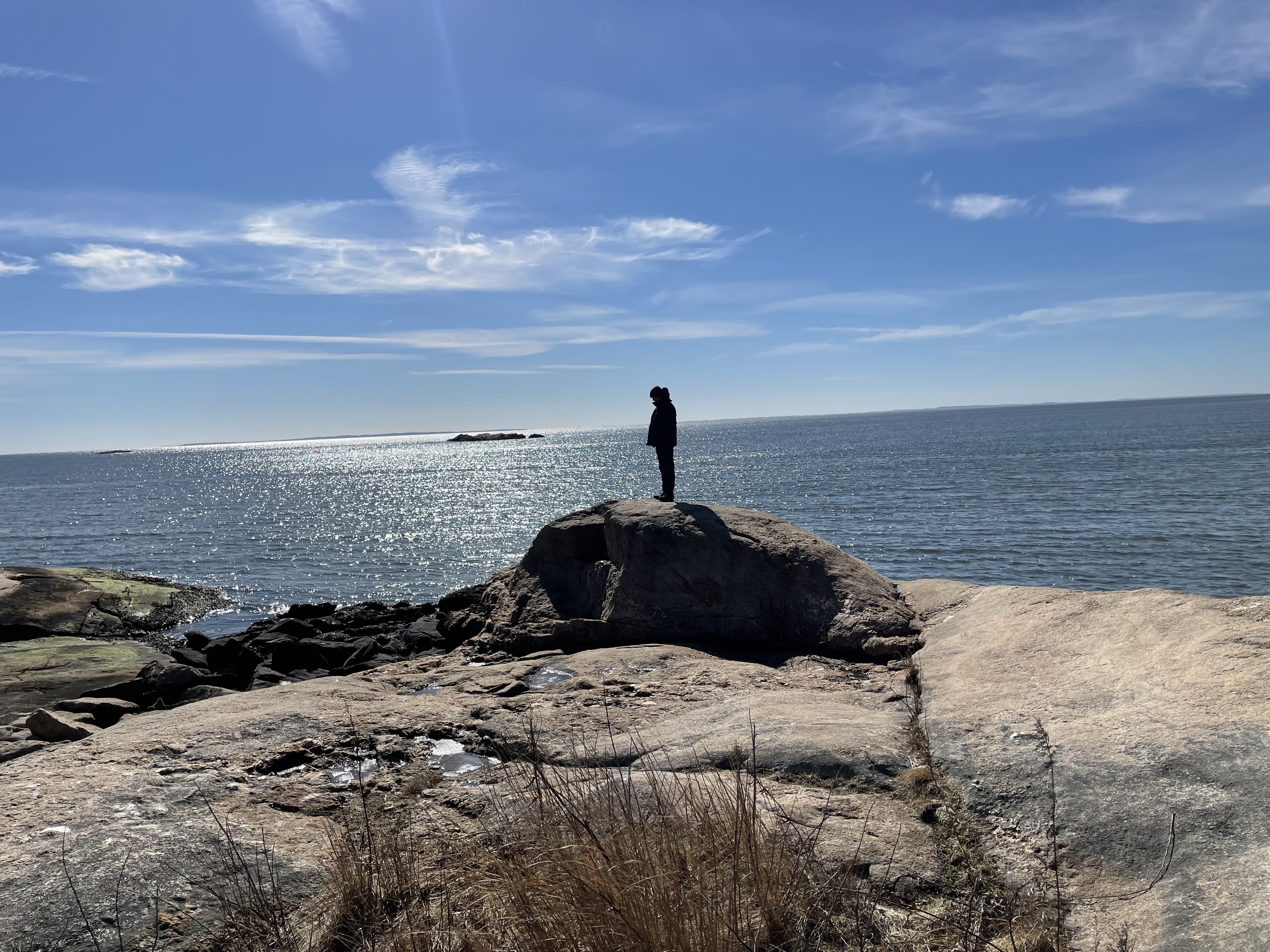
Last Monday, a national holiday, the weather was a balmy 45 degrees and Charlie and I went to Rocky Neck State Park along Long Island Sound. Although not open to the full Atlantic Ocean, the Sound has beaches, tidal activity and much sea life including clams, oysters and fish. That day a few dozen other people were enjoying the “warm” weather. Since then we had 67 degree weather on Wednesday, 27 degree weather Thursday and awoke this morning to several inches of ice encrusted snow. Nothing boring about weather here.

We are trying to absorb the news of the war began by Putin against Ukraine. All sorts of Americans, many of whom I suspect would be hard pressed to identify Ukraine on a world map, have all sorts of ideas about how the United States should be responding. From our former President praising Putin’s strength to those condemning Biden’s supposed weakness to the usual band of isolationists and over to war mongers, news 24/7 can hardly contain the chatter. But everyone seems suddenly to be an expert.

I am not one. I have no solutions. I cringe as I see grandmothers like me with small children huddling in subway tunnels to escape bombs. I fear what may come next. Because I am a woman of faith I pray. It is not nothing. It is in fact the best use of my time. I pray that those in power can use that power for good. And I pray that Americans disavow themselves of the notion that strength and brute force are the same thing.

“A Band of Squalls”

Yesterday our phones began blaring in unison with the message that a band of squalls was minutes away from our home. I had been reading a new history of the Middle Ages and I had trouble differentiating a band of squalls from a band of Huns, a band of Vandals, or a band of Goths. After a minute I realized that it was warning of upcoming blinding snow arriving without much warning(save the insistent phone alert.)

Realizing that I was sitting in my chair, reading a book, with no intention of going anywhere, I determined that they were not as drastic a threat as my pounding heart produced by the alert would indicate. It wasn’t going to be a big bad wolf threatening to “blow the house down.” I settled down and wondered what would actually happen.

As the image above explains, they did come on a fierce gust of wind with a myriad of flakes blowing virtually horizontally, quickly covering the ground. Cars seemed to be driving by with no trouble, however. No power interruptions. No objects flying through the air. Really just a blast of snow leaving nearly as fast as it came.

I intend to silence my phone again. I suffered more from the alert than from the squall!

“My World View Expands

The older I get the more I realize how much there is that I don’t know. My education was, like most American children of the 1950’s, focused on the United States with occasional reference to Europe. We had to memorize world maps, but didn’t spend time learning about countries other than our own. My knowledge about China never got much deeper as I grew and continued to focus on Western history and Western literature.

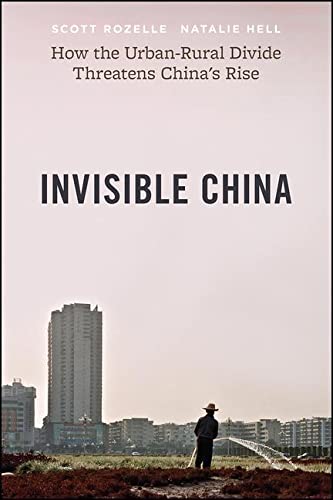
My husband reads The Economist each week and suggested I look at their list of interesting books published in 2021. I was confronted with the opportunity to learn about many issues and places I was fairly ignorant about. I chose to read Invisible China largely because of its subtitle How the Urban-Rural Divide Threatens China’s Rise. In my corner of the world China appears as a single thriving country threatening at any point to be the ascendant power in the world. I am stereotypically ignorant, I admit.

Written by a group of researchers who have studied rural China for decades, the book clearly describes serious problems there from poor education to poor health. They maintain that the vast, mainly rural, work force able to build infrastructure and man factories is unprepared for the work ahead as the structures are completed and factories move out of China to places such as Viet Nam. In addition the great disparity between men and women produces a challenge as large numbers of men become unemployed without purpose or family.

I knew so little about China that I didn’t realize that at birth a child is designated either rural or urban, a label that follows him throughout his life with serious implications for education. As urban kids are outpacing the world in science scores, rural kids are often suffering with health challenges, poorly educated teachers and low expectations. According to the book, 2/3 of the children in China are rural.

The book is fairly short, well documented and easy to read. If any of my readers are as clueless as I was about China I recommend it.

“I Jump On The Bandwagon”

I am rather hit and miss with fads. I bought a hula hoop as a kid and demanded a skort, but I never tried swallowing goldfish. In more recent years I have passed on Rubik’s cubes, Candy Crush and the Ice Bucket Challenge. However, in the last week, I have stumbled upon Wordle, the free daily on-line word puzzle.

In November 2021 the game had 90 users. Recently that number passed 3 million and the developer sold his game to The New York Times for a seven figure amount. What could account for such a meteoric rise in players? I had to find out, so I went to try it out for myself.

The game is blessedly simple. In six chances you try to figure out a five letter word. If the letter in your guess is incorrect it, and the corresponding spot on the keyboard, turn gray. If the letter is correct but in the wrong spot it turns yellow. If it is correct and in the right place it turns green. It took me about 10 minutes to learn it, most of the time spent not understanding I needed to press Enter after a guess.

What then is the appeal? Unlike many on-line games this one can’t suck you into an endless mindless playing rut. There is only one word a day. Once you solve it or don’t solve it you have a chance to return to your “regular” life. Solving a simple, free, concrete challenge is satisfying. Getting better as you remember which letters commonly combine takes you happily back to elementary school with its diphthongs and digraphs. (Don’t worry; they come pouring back.)

Free, fun and fast. What is not to like?

“Shifting Meanings”

hussy (n.)

1520s, “mistress of a household, housewife,” deformed contraction of Middle English husewif (see housewife). Evidence of the shortening of the two vowels is throughout Middle English. Traditionally pronounced “huzzy,” in 20c. the pronunciation shifted to match the spelling. The sense gradually broadened colloquially to mean “any woman or girl.” By 1650 the word was especially applied to “a woman or girl who shows casual or improper behavior” (short for pert hussy, etc.), and it had lost all but its derogatory sense by mid-18c. (www.etymonline.com)

When I was in graduate school my mother bought the two volume compact edition of the Oxford English Dictionary(O.E.D. to aficionados.)I was riveted by it and spent time reading it for fun. (I had read earlier dictionaries for fun too. You might say I was/am a word nerd.) I stumbled on my favorite new word “crinkle-crankle” and used it to describe our brook winding along at the edge of the property.

But the biggest gift of a resource such as the O.E.D. is its clarification of the way words change over time. I have highlighted “hussy” because it is such a dramatic example of both the denotation and the connotation of a word changing. I used this instance when I taught literature to help my students see that words do actually change in one or both of two ways. Of course it is fun in the present to help my grandchildren understand that the “gay 90’s” were not populated solely by people they now know as “gay.”

I try to keep this knowledge in mind when I see people outraged over language in earlier literature. At one point “colored” was considered thoughtful and “Black” offensive. “Homosexual” was a much more polite form of the more common “homo.” “Mongoloid” was a softening of the label “Mongoloid idiot,” long before we knew to call it “Down Syndrome.” We kid ourselves if we think future generations won’t be appalled at what we think of as “common speech.” After all, Chaucer wasn’t insulting a woman when he called her a “hussy.”

“Toasty Warm?”

Since covid Charlie has been working from home, using the dining room as his office. Two doors allow him to shut the room off to make the numerous phone calls and Zoom meetings his job entails. But recently as it has gotten very cold here the past few weeks I kept noticing that his “office” stayed pleasantly warm while the rest of the house was fairly cool.

Of course being the mature adult I profess to be it never occurred to me to envy him his warm den. And of course it never crossed my mind to resent that he was comfortable as I put on another sweater. Fortunately my ordinary grumpy self quieted for a bit yesterday. I remembered that the thermostat for the whole house is in the dining room. The thermostat, recognizing that the dining room is now our desired 68 degrees, promptly shuts down the furnace for a bit. The rest of the house gets cold quickly since it is open without the benefit of the warm air in the dining room.

Now the question remains. Would I rather be warm or listen to the tedious bureaucratic conversations my husband has to endure that allow us to pay the heating bill? Good thing I have a lot of sweaters.

“Apron Strings

Yesterday I tied Emmy’s leash around the leg of our butcher block kitchen island so I could cook in peace without worrying about spilling hot liquids on her. She enjoyed teething on a chew stick while watching me work.

This morning in the shower my mind drifted as my mind tends to do in the shower. I started thinking about the possible origin of the phrase “tied to her apron strings.” I am familiar with colonial life here, complete with its ongoing open fire for cooking and heat. Perhaps colonial mothers used a similar restraint to keep their toddlers away from the fire while they worked.

Sadly I have so far been unable to corroborate my idea. The phrase took on meaning long ago, not so different from our current use. Now and for a couple of hundred years it refers to a man who refuses to grow up. Since I believe that most popular phrases had an origin in actual practice, I find that origin unsatisfactory.

If there are any other sleuths out there curious about the phrase, I would appreciate knowing what you find.

Thanks.

“Sweet Girl”

Today is the birthday of my late sister Patsy. I love the picture above taken when she was 14 and my grandfather was 77 in 1967. They are outside of my grandparents’ farm in western New York. My grandfather, despite the summer weather, is dressed as always as if ready to chair his academic department. My sister is listening attentively to him as he lovingly rests his hand on her arm.

They shared a kind spirit. In that way my sister stood out among the four of us. She also had the only black hair and brown eyes; we other three had blue eyes and light brown hair. She was the tallest girl, too, passing me by at least four inches. Since we were six years apart I didn’t know her well as a child. Sadly we were assigned labels growing up, and I was “smart” and she was “pretty.” Only when I was an adult did I realize that she was brilliant and handled challenging job responsibilities at a large health organization as well as completing Master’s degree work in nursing and public health.

She hated hearing that she “fought” cancer three times. She liked to say that with God’s gracious help she lived for 12 years with the disease. She died at peace in her sleep. With her went a gentleness and kindness I can only hope to incorporate more fully into my ordinary life.

“Not The Old Drugs”

Published November 2021
Portland, Oregon 2021

I thought I was informed about the current drug scene until I read Sam Quinones book The Least of Us. His first book focused on the Sackler family and their horrendous marketing effort of Oxycontin and the addiction surge that followed across the United States. While this book continues relating the gymnastics the Sackler continued to perform even after their legal convictions, its main focus is on fentanyl and meth.

I was fairly informed about fentanyl since it has been turning up here for several years. Last week a 13 year old boy died from an exposure at his junior high school where 100 bags of the stuff were found. It is regularly involved in our overdose deaths because of it potency. When mistaken for heroin it is deadly, and many users don’t know what they are buying.

But the biggest surprise was his depiction of meth. I thought of it as “speed,” a drug which amped up energy and kept users awake for stretches of time. It turns out that was the “old meth” made from decongestants like Sudafed(which are no longer easily available.) The new is factory made from chemicals. But its effects are drastically different. As Quinones talks to doctors, outreach workers, police and addiction centers he shares with us the results of the “new meth.”

Rather than giving bursts of energy, the drug more often produces paranoia,hallucinations and behavior frequently mistaken for schizophrenia. He says that many of the tent occupying street people are meth addicts: paranoid, hoarding, ranting and acting irrationally, often violently without provocation. Not all of the homeless are on meth, but many are and old ways of helping them are no longer working.

There seems to be a tendency in cities filled with tent street “villages” to either have compassion for those who can’t afford a home or to see all as drug addicts and seek to remove them. And of course it isn’t one way or the other. Some people who can’t afford a home have spent all their money on drugs. Some have been kicked out of their own home for drug use. And then there are many who simply can’t afford a home because of low wages and high rent.

There is no one solution for the myriad of US citizens now living in tents on public sidewalks. But without a clear understanding of the “new meth,” many public officials will continue to operate with old answers. I hope many of them will take the time to read the book. And I recommend it for anyone who wants to understand what is going on around many of us right now.