“A Loaf of Bread and Blueberries?”

The grocery order came with two baguettes rather than the one I had ordered. We can only eat one in a day or so, and I had no idea what to do with the other. As it dried out I remembered bread pudding as an excellent use for stale bread. On the counter sat a large bowl of blueberries, freshly picked and not yet frozen. My husband’s blueberry garden has been particularly productive and we have had blueberries galore. Perhaps I could find a recipe for blueberry bread pudding.

I love my well worn cookbooks, but this search sent me to the internet. Here I found countless recipes, most of them requiring heavy cream, lots of butter and copious amounts of sugar. None sounded either appealing, simple or healthy. Then I ran across the “Kemptville Blueberry Bread Pudding” recipe. I planned to link it to the post, but found you would also get numerous ads. Suffice it to say it is easy to find using its title. This recipe actually asked for cubing a stale baguette! After adding skim milk,vanilla, two eggs, a cup of sugar, one and one half cups of blueberries and dotting the top with butter, I popped it in the oven.

I would have featured a photo of the product, but my husband got to it before my camera did. Best about this version is that the crunchy crust of the French bread gives the pudding a satisfying contrast between the milk soaked bread and the top. Next time you find yourself with an unexpected baguette, I recommend the treat.

“Return to Manderley”

D33AEBA1-469F-4B3D-A423-C8D04FC67F5E

When I was thirteen I read Daphne Du Maurier’s 1938 novel Rebecca. Although I didn’t remember the plot, I recalled my immersion in the reading and my understanding that I could now read “adult” novels.( Before I was thirteen I had to have a note from my mother to allow me entrance to the adult section of the library. Needless to say that encouraged my leap to more difficult reading.)

I suggested to my covid bound thirteen year old granddaughter, an avid reader, that she try Rebecca for herself. For the last three days she has reported the experience she is having reading it. We sit six feet apart and she regales me with the excitement, the reading challenge, and the plot of the book. I am genuinely curious about the plot since I don’t remember it, and any young reader loves to recount the story line to a receptive ear. I expect that at our evening’s get together tonight she will have finished the novel and I can find out what happened at Manderley after years of only remembering the famous opening line, Last night I dreamt I went to Manderley again.

I asked her if the book was challenging to read. She told me that she can understand the words but that the plot is complicated and sometimes difficult to follow. Most delightfully for me, a retired English professor, she said “they used more verbs then.” What a wonderful commentary on the rich language in ordinary popular fiction. I am glad she rose to the reading challenge and has been swept away as I was sixty years ago by good writing.

“Good Trouble”

344F37D9-C731-4F1B-BB18-1E76E2F66376

A local art space called Real Art Ways screens independent films on a weekly basis. Since the covid pandemic they have closed their auditorium. Fortunately last week they offered a new service, an ability to buy a $12 ticket and then stream a new documentary at home. Half of the money went to support Real Art Ways and the other half to the film makers and screening platform. Last Tuesday night we settled down and watched the film.

My husband, three years younger than I, had been living in Alabama in 1965, the year of the Selma, Alabama to Montgomery, Alabama peaceful march to demand equal voting rights. He was 15 and knew little of what was going on with civil rights in his region. I was 18, though, and living thousands of miles away in the North in Oregon I was deeply aware of the struggles going on in the deep South. So we brought very different experiences to the footage from that time. For me it was an instant return to watching television in 1965 and being grief stricken.  While the grief was the same for him, he had not experienced the images until years later and didn’t have that same shock of memory I had.

Both of us, however, had long been aware of John Lewis and his constant work for voting rights and were engrossed by the film. By the time the movie was released Lewis had been arrested 45 times but had also served for 33 years as a Congressional Representative from Georgia. He had constantly been involved in what he calls “good trouble.”

Whether you remember, as I did, the actual events in 1965 or came to learn of them later, the film supplies excellent context for the viewer. Millions were denied the right to vote and thousands worked to give them that right. As portions of the United States continue to try to find ways to disenfranchise qualified voters, it is a jarring reminder of how long people have had to fight for a democratic right. Watch it and strengthen your courage no matter the challenge where you live. Right now the world could use a little more “good trouble.”


“I Read the Book; I Skipped the Movie”

Last week my Zoom book club met and discussed “Our Souls At Night,” the 2015 last novel by Kent Haruf of eastern Colorado. While John Denver has made Colorado famous for its “rocky mountain high,” only the western half of the state has such peaks. The eastern half is part of the nation’s Great Plains, flat and agricultural. Here Haruf sets his five novels in the fictional town of Holt, Colorado.

Haruf uses a spare style, appropriate for the straight talking inhabitants of our central states. His characters have lived in or near Holt their entire lives and farm or supply the services such as teaching needed in such a place. They live without pretension and with a settled, though not resigned, sense of their lives. In each of his novels something unexpected happens to jar them into a new purpose or connection with their neighbors. In this case, a widow makes a proposition to a widower to meet and talk each night. In bed. Just to talk. Needless to say this causes great concern in the town and in each of their families. It just isn’t done. But they do it.

Unbelievably to me, a book about an ordinary elderly man and woman in a small farming town has been made into a film starring Robert Redford and Jane Fonda. I won’t watch it, not daring to ruin my own images of Addie and Louis formed as I read the novel. If you have managed to avoid the film, I highly recommend the book. If you have seen the film, I  suggest you take a good look around until you find spot two unassuming neighbors. Imagine it’s them instead!

“Missing J”

eq

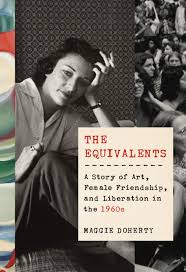
I just finished “The Equivalents” by Maggie Doherty which explores the beginnings of the Radcliffe Institute in the mid 1960’s. There the poets Anne Sexton and Maxine Kumin, the artists Barbara Swan and Marianna Pineda, and writer Tillie Olsen all met in this special atmosphere for a year. Each had a stipend and a place to work and they met with the other participants for weekly seminars where each shared their work. The artists were called “equivalents” since they didn’t fit the requirement of advanced scholarly work demanded of other members of the Institute.

I read the book a chapter a night, savoring it totally and loathe to finish it at all, much less quickly. But when I was done the only person I wanted to talk to about it was “J” my close college friend and fellow English major. We had attended the American poetry class together, talked poetry frequently and went to poet readings, including one given by Anne Sexton.

But “J” is in the euphemistically named “memory unit” in Cambridge, so called for those who have lost their memory. She inherited the early onset Alheimer’s that ran through her maternal line, with the first symptoms beginning in her 50’s. Twenty years later there is just her lovely form wandering the halls of the safe and caring atmosphere. She is not available to talk poetry.

The book allowed me to revisit our years at Radcliffe and Cambridge in the 1960’s. It explored the vast changes that took place in those years for many women. I could visualize our dorm rooms, our walks, our talks. Much joy came as I read. But in the end I was left just truly missing “J.”

“Rosamunde Pilcher Redux”

99851BFC-0D45-482D-9EFC-7A8E4441AD89

I rarely reread fiction, and when I do it is usually classics such as Jane Austen or Henry James. But recently I saw a reference to Rosamunde Pilcher and her Cornwall settings in a blog. Since I want to visit Cornwall, I follow several Cornwall blogs and thoroughly enjoy my correspondence with their authors. I decided to reread “The Shell Seekers,” a novel I last read in 1987 when it was published.

I hadn’t remembered much of the plot, read when I had just turned 40. It turns out to not matter at all. In the intervening years I had turned 73, and it was as if I was discovering the novel for the first time. Centering on a mother in her 60’s and her three adult children, the novel uses the mother’s reflections to explore her life and her children. Clearly I had paid no attention to the mother as I read it the first time, and had only focused on the adult sibling interactions, so reminiscent of my own.

I find it increasingly difficult to find contemporary fiction engaging. Ennui, broken marriages, gender confusion and fast paced urban life no longer interest me much. I similarly have no patience with dystopian writing, nor with authors trying to wow me with their “new” and “cutting edge” techniques. I assure you that cuts the selections down very rapidly.

In my reading experience, depictions of elders written by young adults often fail to capture the genuine complexity of old age . The nuances, bittersweet realities, mild regrets and loss of important companions which fill my life are perfect topics for fiction, but not for the young writer. Pilcher, who wrote “The Shell Seekers” in her 60’s brings a depth of experience both of life and of writing to the novel. I have felt known and described countless times in the book. I am grateful for the return to the novel. I look forward to finding other fiction I may have overlooked in the past. Recommendations are welcome.


“Covid Play List”

police

I was laughing in the shower this morning thinking it is time that we made a play list of songs that fit the pandemic. Maybe if they were played at the grocery store, some would remind people about appropriate behavior. First I thought of The Police with their song “Don’t Stand So” close to me.

Please add to the list. There are no rules beyond saying why you think the song would be a good addition. They don’t have to encourage good behavior, they just need to fit somehow with the times.

Thanks.

“Grand Opening!”


Finally everything is assembled, a place found for all the items, and a debut use this morning to try the “gym” out. Not visible are three important additions. New yesterday was a dehumidifier purchased after I experienced the working conditions in the basement. A large fan blows now comfortable air my direction. Most important is my Apple Home Pod which lets me tell it what music to play, stop, repeat, make louder or softer without my having to quit exercising. ( I get NO kickbacks for endorsing things. I just love the device.) For the curious, the large door shaped cardboard carton holds a large storm door slated to replace our current one. The little cupboard behind the weights hides our water meter.

A few things might need explanations for the visitors to my gym. The floor has a large padded mat, suitable for much core body work. The orange handle is a nifty invention that allows me to make a barbell into a kettle ball, thus saving me the expense of buying one. The large cylinders are foam rollers, a device unknown to me before the gym. Foam rolling loosens muscles and feels good too. The large white ball allows me to lean it against the wall and do wall squats. The flat black object is a step, using for ….stepping.

Of course the centerpiece is the incline bench. After failing to easily assemble it, I recruited Charlie’s help. After another hour, and after learning that of course one of the holes was slightly off center making attaching the seat a challenge, and after me getting frustrated and going upstairs, and after Charlie persevered, the bench was put together.

I would like to lie on the mat in the cool dry air and listen to music. Isn’t that why I built the gym?


“Some Assembly Required”

CC03013E-E170-4367-B6EE-BF7F44A5309E

The one thing I hadn’t figured into my timeline for gym construction was the assembly of the incline bench. I spent half an hour on it so far, then realized that I would need Charlie’s help to fasten one large piece to another. He is working at home, so he wasn’t immediately available.

Unlike many things I have put together, this one actually taped the various hardware to a piece of cardboard and labeled each piece. Sadly I misunderstood that the label referred  to the piece over, not under the label. I figured that out when a set of bolts was clearly too small to hold the pieces together. Fortunately I realized as I started to pull the tape off the parts that the labels were coming off also. So now I am just poking little holes to pull out the necessary items. The instructions are clear, just very lengthy.

I went back to read the description of the bench on the website. Frequently buyers touted the “ease of assembly.” Perhaps they were speaking comparatively. It is easier than IKEA projects, but that isn’t saying much! When the bench is ready, the weights await. Of course they came in a 50 pound package, and I had to carry the plates downstairs to the “gym” a few at a time.

At least I am getting a workout preparing a space to have a workout.

“Harry’s Room”

F3D075AA-5DCA-4B29-9208-633C875C183F

This morning I listened to the liturgical readings and heard about the prophet Elisha who stayed over at a couple’s house so often that they built him his own little house on their roof. It reminded me of “Harry’s Room,” a cherished place in my childhood home pictured above.

The house had been built in 1909 for a family of three, parents and one child, and  several servants. The parents had a suite, the child had a suite and the servants lived in two rooms on the third floor. There were front stairs and back stairs, a full pantry and a small room off the kitchen by the back stairs. We never determined the intended use for this room since by the time we moved in the house had been used as a group home. Perhaps it was a cloak room, perhaps the cook slept there. At any rate it was always called “Harry’s Room.” It held a twin bed, a lamp, a desk and a chair and had a pocket door installed for privacy.

Harry was the district attorney for a rural Oregon county and had to come into Portland regularly. He always stayed at our home. Even after he moved to a position in Washington, D.C., he still came West fairly regularly and stayed in “his” room.

I smiled this morning when I realized that giving him his own room connected me with ancient readings. Harry wasn’t a prophet, but we welcomed him all the same.