“Pent Up Demand”

barbershop

My mother spoke frequently about “pent up demand” which resulted from the war years’ scarcity of anything made of metal since it was being used for the military. I always imagined a line of moms waiting in line outside Sears, Roebuck to rush in and buy toasters. I guess in reality the pent up demand went far beyond toasters to include automobiles and houses. And then there is the resulting Baby Boom generation showing us that there was biological pent up demand!

So as the United States remains in virtual lock down, except for some individual states who still think they are exempt.(The governor of the state of Georgia, for instance, just realized TODAY that asymptomatic people can transit the coronavirus!) I have been contemplating what pent up demand will be revealed once this is over. (1% of my functioning brain believes that it will some day be over.)

I have decided that the rush will be to get first in line at the beauty salon and the barber shop. Already people who were due for a haircut at the beginning of the lock down(that would include me) are sporting “interesting” looks. My husband who gets his hair basically buzz cut every couple of weeks is now contemplating taking the dog clippers to himself. And while I have rarely wanted my nails done, now that they can’t be I am longing for a manicure.

What is the first thing you are going to rush out and do? Library? Bookstore? Favorite restaurant? Church? (I am only too aware that many are truly suffering. I am purposely trying to keep my writing light, but that in no way means I am cavalier about reality.)

 

“Dressing For Zoom Success”

F52E9A1F-7C3C-4786-89BD-075E83F64A15
@SneakersCorgi

My husband told me this morning that because of the proliferation of Zoom meetings sales of dress shirts were soaring without the usual accompanying purchase of trousers. He said this as he came upstairs to change his t-shirt into a button down dress shirt in time for his Zoom call. He left his Levis on. (As in he didn’t change them, not as if he might have gone without!)

I reflected on this phenomenon of what to wear when I was participating in my church’s Tuesday night Zoom Vespers service. The Friars, of course, could just don their usual brown robes with a rope waist tie. But we are not used to seeing people at home when we are at church. (As if that wasn’t self evident!) So I decided to change the shirt with remnants of lunch down the front in case my super Mac camera might share that stain with my parish. I remembered to brush my hair. Individual decisions about “dressing for church” were evident. One usually well groomed female singer sported a v-neck men’s white t-shirt. Another usually well groomed reader was just as polished as on any given Sunday.

Then there is the unintended Zoom photo bomb. At one point what looked like the rear end of a parishioner turned out to be a very, very close up of two of her fingers. Whew! Jennie had mentioned that Zoom was encountering some hacking, and I was relieved that this wasn’t an instance of that.

Since none of us are broadcasting from studios, few of us paid any attention to the decor behind us as we were Zoomed. My picture featured a brown recycling bag on the desk to my rear. Others never seemed to get the hang of things and kept showing their ceilings!

And, by the way. Does anyone else think that gallery view on Zoom is reminiscent of the old game show Hollywood Squares?

“Ration Books and Tripe”

1AFD53BC-28C7-4643-9CEA-0813A12E1D99

My mother spoke from time to time about living in New York City during World War II and using ration books to buy food for my father and her. She said that although they might have a ration for meat, it didn’t mean that meat was available. Often the only meat she could find was tripe–the stomach of a cow. Despite her creative approaches to cooking tripe, she never recovered from the experience. Throughout our childhood if any one of us complained about any dinner, she would say “at least you aren’t eating tripe!”

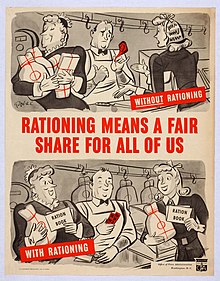
I appreciated the public service poster I have shown above because it shows that shoppers in the 1940’s were no more considerate than today’s toilet paper hoarders. Without the intervention of the federal government there not only would not have been food for the troops, but that at home might have been unfairly distributed. Price gouging also plagued the country at that time, so price control legislation was enacted.

I appreciate that so many are sharing positive stories at this time about people going out of their way to help each other. But the hoarding and price gouging are running rampant. Not only did citizens buy up needed supplies for hospital workers, but companies are happily gouging states, such as ours, trying to buy necessary equipment for health care. And no, except for the Surgeon General asking people not to buy their own masks, there has been no legal barrier to doing so. And no, there seems to be no penalty for bidding wars between states for supplies.

I never understood why rationing and price controls were put into place when my mother was a newlywed. I do now.

“Ligaments, Tendons and Joints –Oh My”

1948-50s-145

At five I gave no thoughts to my rotator cuffs as you can see from the above photo. I took my knees, elbows, hips, and shoulders completely for granted. I barely knew they were there as I stood on my head, did cartwheels, climbed our tree and hung from bars. So it came as a very rude shock to me when the first of these–one of my knees–voiced its displeasure when I was in my early 40’s. My first visit to the sports doctor(so named to lessen the shame of the baby boomer woman with hurting knees) said “yup.” What did he mean? He said after 40 these things happened. I should have listened to the plural of things, not thing as in my one knee. But I did the knee exercises until I felt fine and gave no further thought to my joints.

In my 50’s my shoulders began to speak to me and register their annoyance at my posture and my weak upper arms. Physical therapy helped and I forgot about them for a long time. By my late 60’s my tendons, ligaments and joints played an ensemble serenade of creaks and pops. It was either retire to my easy chair or face reality. I chose reality. I have been going to the gym and working with a trainer for four years. I am now familiar with all my bodily idiosyncrasies and address them regularly with movement.

Now that my gym has shut down I am working out at home. My mantra seems to be “a body at rest tends to remain at rest.” Without my gym pals and my trainer, my tendons, ligaments and joints lure me with the promise that I really can just stay in my reclining chair. They aren’t going anywhere, so why should I?

But they lie! Despite their intense resistance to movement, I am carrying on and exercising at home. Fortunately I talk to my trainer twice a week and do a custom exercise routine at least three times a week. Do I love it? Absolutely not. But at the moment my joints are quiet and I want to keep them that way.

“If I Only Had The Time…”

For years I harbored the fantasy that some day I would have enough time to do a whole variety of undone tasks. I would take the photos out of that picture killing 1970’s plastic and put them in archival albums. I would prune my cookbooks, giving away all that I would never use, despite my best intentions. “Cheese making from your goat’s milk,” for instance since I haven’t owned a goat since 1976. I would definitely get up into the attic and see what is still in one piece. The last time I climbed the ladder to get down the old cloth diapers, I found that the mice had found them first!

Then there are the unread books. If I only had the time I would finally get through all the unread nineteenth century English novels assigned in my 1968 course on the nineteenth century English novel. After all, I owned the books already. And War and Peace! Surely I would have a deeper understanding of it than when I read it as a lonely, love struck college freshman. Unbelievably, or neurotically enough, it still bothers me that I sped read Tolstoy instead of giving him the attention I am sure he deserved.

The wallpaper in the bathroom has been peeling for a few years. And I didn’t do a great job putting it up in the first place. (I didn’t have the time to do it carefully!) I even own new rolls to do the job. And what about that kit to make a solar powered miniature carousel for my granddaughter who is now much too old to enjoy it?

Well now that I am experiencing the double whammy of retirement combined with lockdown, the truth has been revealed. The real me is not the Energizer Bunny, just waiting for enough time to get things done. Sadly, the real me more closely resembles the Scottish sheep I encountered in the Highlands. After I waited for her and her friends to cross the road I was trying to navigate, she slowly walked over and flopped down on the edge. That was enough for her that day.

I know the feeling!

“Helmet Liners and Face Masks”

My mother started college in Ohio in 1939 at a coed liberal arts school. Two years later a majority of the male students were called up to fight in World War II. My mother told me that she and her classmates spent many hours knitting helmet liners. The image on the right is from a pattern distributed at that time.

Here hospitals face a shortage of face masks to protect workers from the coronavirus. (I am not going to go off on my rant about how insane that is. You can imagine my rant for yourself.) At any rate, women across the country are sharing patterns for making face masks such as shown on the left. Using leftover material women are sewing cotton, cotton flannel and elastic to make these masks. While they are not as protective as the ones hospitals use, they are far better than total exposure. They can be washed and bleached to be reused. Usually face masks are discarded, not reused, but again these are better than no protection.

Here also our governor, having despaired of getting any federal help, has sought protective equipment from any businesses which have it on hand. Sources as varied as college chemistry labs, factories and paint stores have come through with what they have.

I would like this to be a feel good post. It isn’t. It is just a reminder that in desperate situations each of us can use the skills we have in the same way all those knitting coeds passed the time. Please let me know if you have found a way to contribute to the “war effort” as it might as well be called.

“Comforting Food”

dutchbaby2

As I read Pete’s comment about cooking a chicken dinner instead of writing, I responded that I was about to cook pancakes. My mother often cooked pancakes for supper if my father wasn’t home for the evening. We always loved the chance to cover them with ample syrup.

The New York Times, in their special Sunday edition all about coronavirus, included several recipes entitled “I’m Stuck at Home. What Can I Cook?” Here was a simple formula for making a Dutch Baby pancake, one I hadn’t made in many years. I had the ingredients on hand, still frequently use the cast iron skillet from my grandmother, so I was ready to go.

 You need 3 eggs, 1/2 cup of flour, 1/2 cup of milk, 1 tablespoon of sugar, a pinch of nutmeg and 4 tablespoons of butter. Heat the oven to 425 degrees. Combine the eggs, flour, milk, sugar and nutmeg(I did this by hand or you could use a blender.)

Put the butter in the 10 inch skillet or dish and  put it in the oven and watch it carefully until it is melted. Remove the pan.

Pour in the batter. Return the pan to the oven for 20 minutes. Lower the oven to 300 degrees for 5 minutes. Eat immediately with syrup or jam or powdered sugar(or all three!!)

In theory this makes three to four servings. I have no idea which three or four people she had in mind. We split it down the middle and dug in. Since I live in New England, I used real maple syrup. Since my husband prefers Mrs. Butterworth’s, he used that.

We were comforted. We were carb loaded. We fell deeply asleep for the night.

“Zoom, Zoom!”

C29C6BB2-CA4D-48D2-AD70-C4EA6031947C

One of the recommendations for this time at home during the virus pandemic is to learn a new skill. While I would have preferred to master one I chose, I had instead to learn how to use Zoom. Not to be confused with Zumba, the dance exercise, Zoom is an application for computers, phones or tablets that allows people to “meet” in “virtual rooms.” In the photo above, some of the employees of Zoom are pictured having one such get together.

Because regular meetings of people are prohibited, many of us have had to find ways to connect face to face, or at least image to image, with one another. Zoom uses the camera and microphone on a given device to send a person’s image and voice to others. Much more capable than Facetime, the Apple application which allows us to talk to one another, Zoom has the capacity to host large meetings, to allow breakout sessions during them, to allow people to take turns when facilitated by the host, and other things I have yet to discover. Since I really don’t want to spend my whole time at home learning Zoom, that is as much as I am likely to know.

The Friars from our church set up separate Zoom sessions for each of the Mass times yesterday. Since we go to the 11:45 Mass, for instance, we logged onto Zoom at 11:30, giving us a chance to virtually meet and greet one another. One positive addition to this way of meeting was that each person’s name was displayed under the picture like a name tag. We often only know each other by sight, so now we had names. We also had a chance to see people’s living rooms, their uncombed hair, and their pets.

Most fun was the majority’s inability to use the application smoothly. If I had ever wondered how families interacted before they entered church, I now had my answer. “No not that button.” “Get that image off the screen.” “You are only showing your pants leg.” “Let me work this myself!” While the majority of microphones were on mute, per the Friar’s instructions, each new person entered noisily and clumsily, interrupting the already semi-chaotic gathering. I guess people who come late to Mass also come late to Zoom!

I would love to know if anyone else has attempted to master a new skill.  Please share. One at a time. Just like on Zoom. (Don’t worry. I can’t see or hear you.)


“Just For Today”

57368A22-ACA2-426C-BA8E-BC1AF0B8850D

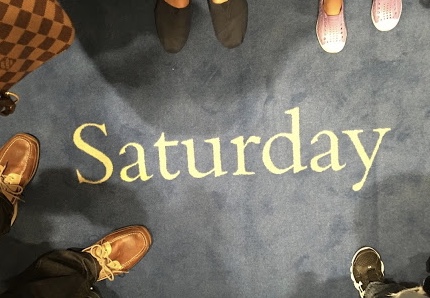
Years ago when we took a family trip on a cruise line every time we stepped into an elevator we were greeted with a rug embroidered with the day of the week. I echo my blog friend Maggie about having trouble knowing what day it is at the moment. I could use a set of those rugs to use in my house!

While the world is doing a reboot, to use computer terms, we are in that time illustrated on the Mac by a little whirling circle. Wait. Wait. Wait. And there isn’t even a helpful indicator that the reboot is 78% or whatever done. Nor is there a note that the process will be over in 4 hours and 6 minutes as my computer lets me know.

We are all in a period of unknowing. It did finally sink in to my psyche that there won’t be a quick return to normal. When I know how long updating my computer takes, I can schedule it accordingly. This virus gives us no such option. It’s here. We’re here. We get to deal with it.

Years ago I spent many hours in “these rooms,” the code phrase for recovery groups. They are big on slogans, most of which used to drive me nuts. “I am too sophisticated for such cliches” seemed to be my orientation. Mea culpa! The phrases that sustain me the most at the moment come from those meetings. “Just for today.” “One day at a time.” “This too shall pass.”

And as for attacks on our leader, I understand them. I voted for a different leader too. But to quote the old line, “you gotta dance with the one that brung you.” He’s who we have. May we at least stop looking to him for leadership. Harry Truman, President after Roosevelt, had a sign on his desk “The Buck Stops Here.” That sign is nowhere in sight at the moment, but seemingly is being  passing around as if we were all playing “Hot Potato.” We aren’t. This isn’t a blame game. We really are all in this together. One day at a time.


“Sustaining Family Stories”

042CA380-A977-4CA2-887E-9B356B1AC6DF

While it is true that people over the age of 60, particularly over the age of 70 and even more so over 80 are especially prone to fatalities from the coronavirus, we also have a great deal of wisdom that we need to share with those around us who are much younger. I grew up with several important family stories which taught me from an early age that life is unpredictable, that events far away can have a huge impact on our lives, and that the stock market doesn’t guarantee financial security. I believe that while I am greatly distressed by the present pandemic, I don’t experience it as something no generation before me has had to endure.

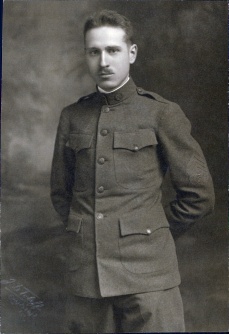
Above is my grandfather who was called into service in World War 1 for a conflict which took place across the Atlantic Ocean. He had no fervent desire to go fight, but he had no choice. The government drafted him. My generation knows that the government can draft its citizens. Many of my generation had to go across the Pacific Ocean to fight in a war that they opposed. They went.

When he returned home, my grandfather contracted the Spanish Flu. He nearly died, but my grandmother nursed him through it. Despite our cavalier approach to that flu–“we know so much more now”–we are actually in the same situation they were. The flu killed left and right. It wasn’t fair. It didn’t discriminate. But as the older generations repeatedly told us “life isn’t fair.”

My father’s mother invested the life insurance money from her husband’s death in the stock market and lost it all. My father never trusted financial predictions of endless prosperity. “What goes up always comes down” could have been his motto.

My mother was in high school when her family tuned into the radio to hear that Hitler had just invaded Poland. She told us about that moment from time to time. “Our whole world changed in a minute.” The world is like that.

When I think about helicopter parents who have steadfastly tried to shield their children from challenges, I reflect on my own upbringing. I learned that my family had known hard times. It makes me realize I can deal with them too.