“Three Little Birds”

0C16BA7F-1FD5-43DF-85BB-2FC17D0CADE4

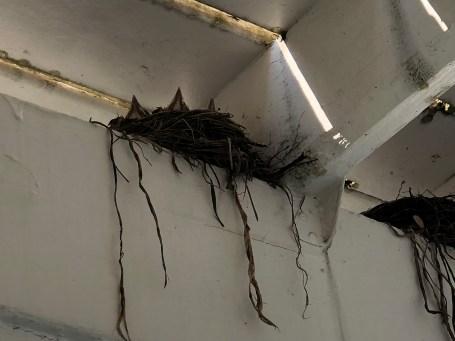
Woke up this morning, saw this robin’s nest under our upper deck and immediately began singing along with Bob Marley “Three Little Birds.” Its message is very clear. “Don’t worry about a thing, Cause every little thing is going to be all right.” I have always loved that old song, and was especially glad to be humming it as the head of my country went overseas and seems to have solved Brexit all by himself! Oh and his son-in-law has found a way for lasting peace for the Palestinians and the Israelis! And a tax on imports from Mexico will solve the humanitarian crisis at our Southern border! As you know, I have rarely commented on the political insanity of the United States, but the series of news items risked putting me over the edge.

Thank goodness the robins are oblivious and decided, for the first time, to nest in a spot I see as I walk out the back door. The nest to the right is empty, but the one on the left has three thriving and always hungry babies. They are watched over by a fierce robin, a phrase I would have called an oxymoron before witnessing this adult. The bird has even dive bombed my grandson who got too close to the nest trying to talk to the babies. So no matter how misguided my president is at the moment, one robin knows exactly how to take care of those under her. I wish my Commander in Chief knew as much!

“Unexpected Generosity”

21D2FAE9-3D7E-495F-90CA-3511E3CADC40

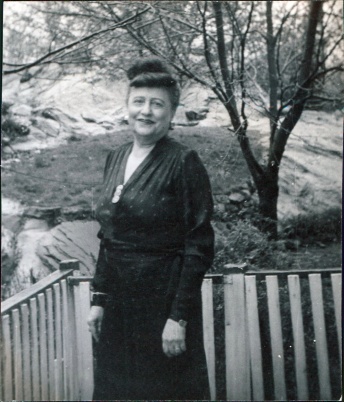
A favorite singer songwriter of mine, John Gorka,  has great lyrics “I’m from New Jersey, I don’t expect too much. If the world ended, I would adjust.” Though I am not from New Jersey, the rest definitely applies to me. Moments of generosity were sorely lacking in my upbringing. One such moment shown above is the love given me by my then sixteen year old Aunt Cary after I had been left with her and my grandparents for several months as a toddler.

So when I received two mentions from two different bloggers yesterday, I was totally delighted. I have been stunned by the generosity not only of those two, but also from the blogging community in general. This blog was my first foray into social media, after avoiding Facebook, Instagram, and Twitter. I had no idea what to expect when I began posting. I only knew the venomous comments that often appear on-line about news articles or editorials. Whether I have stumbled onto a particularly kind part of the blogging world, or whether it is kinder in general I don’t know. What I do know is that responses to my writing have been generous and thoughtful.

I have tried to reciprocate this generosity by taking the time to consider others’ writing and then to comment about it. I have also tried to respond to each comment I receive. This give and take keeps me keeps me generating new ideas to write about. I also want to repeat an offer I made some time ago to edit anyone’s writings that would like the help. I recently edited three research essays for a nurse in London for whom English is a second language. I learned a lot about critical care nursing along the way. I want to repeat that this is free of charge, just a way to use my skills from years of teaching.

So thanks to you all. Your reading makes my writing very rewarding.


“Curiouser and Curiouser”

DD384B64-5000-4B19-B899-8F778460345D.jpeg

The best learning proceeds from genuine curiosity.  Here I am examining a trout just caught by my father on our camping trip. I will soon learn what the insides of a fish look like and how it turns into something we will eat. My curiosity continues to guide my life, from the books I read to the friends I make. I genuinely want to know and understand things, and I have been able to keep this trait alive.

When I taught literature to college students, I made it a point to always reread each poem, play or short story we were to discuss before the class met. I did this even if I had read it fifty times before and could have easily “coasted” through the class. When I was encountering a piece “again for the first time” I could more easily appreciate students’ struggles with the readings and could engage their curiosity. I might ask “why do you think this poem is so confusing?” Or “where were you in the story when your mind drifted off?”

Sadly I frequently had to confront the effects of earlier teachers. Questions that I was sincerely asking were sometimes received as one more “guess how the teacher is going to answer her own question.” Needless to say that kind of teaching to the teacher doesn’t engage anyone’s curiosity. But after a while they realized that I didn’t have an answer to the question I had just posed. I really wanted to know what they thought.

I hope that all of us can keep our minds open to new possibilities and continue to find the world as Alice in Wonderland found it “curiouser and curiouser.”

“Learning to Swim”

9928D4F5-164F-42D1-89BA-C668071FC327

I learned to swim at a very long very cold indoor swimming pool at my parents’ athletic facility, the Multnomah Athletic Club. I was a very short very skinny little girl, and even in the shallow end I couldn’t touch the bottom. I was equipped with water wings very similar to the photo above and told to jump in. I detested every minute of the experience, but I did learn to swim. I certainly never would have put fun and swimming in the same sentence.

Fortunately, each summer I went to Camp Fire Girls camp which also had a very big very cold outdoor pool, but it came with very kind, loving counselors. Each summer a different Red Cross swimming award was the goal of the week. The steps were very clear such as tread water for one minute and float on your back for one minute. Even the challenges when I was older were fun. One involved jumping in the pool fully clothed and removing my shoes before swimming to the edge. I even learned to dive from the side of the pool though I never mastered a dive off a board.

In the summers after I learned to swim I often went swimming with a friend at a neighbor’s pool, in the lake in the adjacent town,  or in the creek at my grandparents’ summer home. I never had any supervision in those places. I think parents generally assumed that kids could swim and left them alone. Even at the beach there were never any lifeguards. I was startled to find lifeguards all over the East coast beaches and large warnings if one wasn’t present.

Why were all those swimming pools so cold? Apparently the idea of heating a pool hadn’t caught on during my childhood. I never got into a heating pool until I joined the YWCA as an adult!


“Hic, Haec, Hoc”

B480C3BA-A164-42C9-B425-B77F4DB48D4F

As I was reflecting about my Latin class I remembered something I mentioned in passing a couple of years ago. My Latin teacher was, I now believe, an alcoholic. We had Latin class after lunch, and she was in rare form. She got up on the desk and did a declension of the Latin “Hic, Haec, Hoc” as she kicked in a mini Can Can routine.

Teachers were absolute authorities when I was in high school, and what they said went. We never disagreed about their assessments of us, and we wouldn’t have dreamed of having our parents talk to any teacher about a disagreement. The teacher was always right. And this included their idiosyncrasies, such as dancing on the desk. I am sure none of us ever spoke about it out of class.

Our very strange English teacher used to put his feet up on his desk, put his hands down the front of his trousers and talk about the day’s readings. We found it “icky,” but that was as far as it went. Our response to that behavior makes it easier to understand how children tolerated aberrant behavior from adults such as priests in those days.

One excellent English teacher always wore what I thought was the same dress every day for the entire school year. I learned much later that she actually had five of the same dresses made for her which she was rotating. I guess she didn’t want to have to think about what to wear on any given day.

I even had one intriguing English professor in graduate school. He had terrible stage fright about lecturing to the class. To solve this, he would start the lecture as he walked down the corridor outside the class door. Then he would enter, mid sentence, and continue on. It was confusing at first since we missed the beginning of the first sentence, but we became used to it.

I shudder to think what idiosyncrasies my former students might report about me!

“Parlez-vous Français?”

F7560F11-3AE7-4FC0-9C20-86B97E68F3DB

My paternal grandmother was French, but that is not why I took French as my elective in high school. We had the choice of Spanish, German, Russian, Latin or French. Spanish was not considered useful. (How little we knew.) Russian seemed impractical since I didn’t intend to be a diplomat. I still associated German with Hitler, so it held no appeal. But French supposedly was the language of the intelligentsia. Not that I knew who they were, just that I was supposed to learn French.

I never mastered either speaking or listening to French. In fact when a clerk spoke to me in Paris, I fled. It took me some time to realize she had said,”May I help you?” But I did learn to read French, enough so that I passed a written exam in it for my Master’s degree. It has also been very useful to read the genealogical records in France for my grandmother’s ancestors.

And what I have learned! My very unpleasant grandmother hid an interesting truth from us as she presented herself as the epitome of grace. She had never married my grandfather and was in fact still married and the mother of four small children when she ran off with my grandfather to Canada at the end of World War I. And intriguingly, her mother had been born in San Francisco when her family went there to supply goods to the gold miners. And her family was Jewish. A complete surprise, but all there in the French newspapers and cemetery records.

So while I can only read French, it has saved me from parking tickets in Quebec and has allowed me to learn much more about my family background. Things my grandmother was determined to keep to herself. C’est la vie!

“Changing Tastes”

2hopewell

A few times a year my husband and I like to go out for a fancy dinner, and last night it was celebrate(belated)my birthday. We chose a quiet small place where we have frequently enjoyed a superb meal with excellent but not intrusive service. The noise usually is a solid low murmur of other diners who, as you can see from the photo of the interior, are quite near by.

Sadly, while I was looking forward to chatting with my husband, I learned the following: “I don’t like people my age. I’m old for 29.” “I always need to sit with my back to the door.” “We are in a book club with older women in their 50’s.” And on and on and on. Yes this too old for 29 young woman trying, perhaps with success, to impress her partner’s parents talked loudly enough for all of us to hear her life story. And it wasn’t even, as I confided to my husband, an interesting life story! She was completely oblivious, failing to read the room and adjust herself accordingly.

After spending upward of $100 for a meal, we left disheartened as well as broke. We agreed that we would have had a much nicer time with a meal I cooked sitting alone at our own table. We show every sign of being well on our way to curmudgeonry!

“Electives?”

These photos from my high school yearbook of 1963 show that while I was enrolled in Latin, French, Biology, English, Social Studies and Algebra, other students were taking Home Economics(the girls) and Shop(the boys.) No one I knew took either class. What was going on? While theoretically I could have chosen Home Economics instead of Latin as my elective, I was never given a choice by either my parents or school counselors.   Sadly, we judged the girls who did take Home Ec as inferior to us. The boys had the same attitude towards Shop and I knew no one who took it. Eventually these two courses, probably some of the most useful classes for regular life, disappeared from many schools altogether.

I still don’t understand this condescending attitude to these classes that prevailed in my high school. We girls were definitely expected to be able to run households when we were grown. The boys were definitely expected to be able to fix things when they were grown. But apparently learning these skills in well equipped classrooms with master teachers was considered “below us.”

I cook every day. I never use Latin. Which elective would have been a better use of my time?

“Required Reading”

juliuscaesar

I have wandered back around to my focus of earlier this month, education. I began thinking about required reading in high school English classes after Pete(beetleypete)commented that Whitman wasn’t read much in England. I wonder what any of my readers were assigned in their English classes.

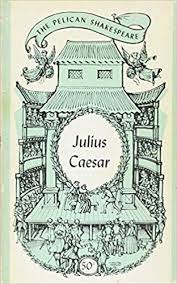
We read one Shakespeare play each year. Julius Caesar, Macbeth, Hamlet and King Lear in that order. I assume that they thought each play was a little harder than the one the year before. No one ever connected them with each other. We got no background for the plays and stumbled through them wondering why we were reading them. But they were required.

When I got to college I realized that my high school had made no distinction between American and English authors, referring to them all as English. This was a little embarrassing to find out when sitting in an English survey and understanding I really wanted the American survey. That basic distinction would have been useful information in high school, but it was never made.

Other required reading that I remember included The Scarlet Letter, The Mayor of Casterbridge, and  The Rime of the Ancient Mariner. I still have no idea why these particular works were considered essential in the early 1960’s. Thrown into each with no context, we plowed ahead because they were required.

Please share any books you were made to read in high school. I am very curious about the variety–that is if there was any.