“Who Knew?”

The theme for my 70’s seems to be continuing to find out that I don’t know many things that I thought I knew. I guess I am old enough that I no longer feel the need of my younger years to know everything. Humility comes with age for sure (well, with some prominent political figures excepted.)

Collective Illusions: Conformity, Complicity and the Science of Why We Make Bad Decisions by Todd Rose, 2022, recently made me reconsider much of what I thought I knew about other peoples’ views. While the book and its research base are centered in the United States, the general principles he explores would likely apply in other countries.

His nonprofit research arm Populace (https://populace.org) details in length his process and its results. In essence he is interested in the discrepancy between what people believe and what they think other people believe. He poses two questions to each interviewee about current issues. For instance he would first ask if the person in concerned with climate change. Then he would ask how many other people the person thinks care about climate change. He finds that people vastly underestimate how many others share their viewpoints. He finds much more consensus around the United States on major issues than it appears, particularly in social media.

He stresses that the loudest voices on line on any issues are generally the far outliers on each end of the spectrum. Because they make the most noise it is easy to assume they are the majority. And of course the trolls, bots and menacing people on line work to silence opposing voices. Most of our voices are stilled as it turns out.

Both the web site and the book are worth an in depth look. While I still hesitate to post my political opinions, I am trying to be braver at least articulating them when I have the chance. I, like too many, have ceded the floor to the loudest. Surrendering to bullies is a poor life strategy that many of us have adopted. I hope for a clear way forward, now knowing so many of my preconceptions of other Americans are wrong.
“The Best Laid Plans”

I think that one of the universal truths about writing a blog is that every time a blogger says they are back writing, life interferes! In my case my husband got rebound Covid. Another car pool driver got Covid. High school started and required the last person(me) standing to drive. The plumbing had a glitch. Crickets invaded the house (one lucky, multitudes not.) The painters started painting the outside of our old home. This meant that at any moment a face was peering into the one window I thought I could freely walk in front of unclad. None of this supported the calm frame of mind I use to write.

Anyway I hesitate to say that I am back. I will say with confidence that I am posting today. I think I won’t tempt fate by predicting anything about tomorrow.

Hopefully yours…

“My American History:1962 version”

I have been reflecting on how history was taught to me. Writing about that will clarify further my responses to my recent history readings.

In 1962 I sat in assigned seats with about 25 other high school sophomores, a text similar to the one above in front of me before Mrs. L. with the same text open before her. We would have read several pages for our daily 55 minute class. She would talk over the same material. She didn’t expand on it, question it, or lead any discussion about it. She simply paraphrased the text. Every so often she would test us on our readings. The tests were usually multiple choice(The Missouri Compromise was about a. oxen, b. marriage,c. admitting new states to the Union,d. water rights.) I flew through the course, earning an “easy A” and assuming that I now knew American history.

EXCEPT–events that would prove to be seen as historic were taking place all around me. A Catholic had been elected President(he wasn’t killed until the following winter.) The Supreme Court had ordered that schools be racially integrated. Several years earlier troops had been brought into one state to enable “Negro” children to enter a high school. In May of the previous year our “advisors” to Viet Nam had increased. I learned all this from the Evening News with Walter Cronkite. I talked about these things with my friends.

But at Lincoln High’s American History class none of it was ever mentioned. In fact we only made it as far as the Great Depression before our school year ended. Mrs. L. bemoaned that “once again she hadn’t taught us about World War II.” Of course many of our fathers had already experienced it. But they weren’t talking either.

“Questioning What I Know”

It has seemed impossible to avoid confronting rampant ignorance about the United States constantly being spouted on-line by whoever is taking the time to post. I have often felt smugly comfortable that I knew U.S. history fairly well. But some time ago, I began to question what I actually did know. I picked up the book above, The Accidental President by A.J. Baime, and began to read about the first four months of President Harry Truman’s presidency from April through August 1945.

But first a clarifying point that might help you know me a little better. In high school, “English” class freely mixed authors from various places. In other words I read American writers in “English” class. When I arrived a totally clueless college freshman in 1960, I enrolled in English 10, the introductory course at Harvard at the time. An astute reader can predict what happened. I read Chaucer to Eliot(remember Eliot was still fairly “modern” in 1960.) Not an American author anywhere. To read them I would have had to take English 70. And I hadn’t. Accordingly I had to learn a great deal of English, not American, history.

My English major continued apace, as I read the War Poets, 19th Century English novels and so on. My reading of English history went along with the literature. I learned about monarchs, laws, enclosures, Prime Ministers, struggles with Ireland, political parties and so on. The same astute reader will now understand a problem about my knowledge of United States history.

The only time I formally studied American history was in 1962/1963 when I was 15. Keep that in mind as I begin to share my readings in the next several posts.

“Three Men in a Boat”

After I finished reading Emma Donoghue’s new novel Haven(August 23, 2022) I made the mistake of reading reviews of the book. That helped me know that I should recommend it to my readers with all due diligence. No it does not have a riveting plot. Yes it is about three monks in the 7th century, not a very elaborately costumed time for the men. No it is not simply an indictment of the Catholic Church, nor can it be reduced so tidily to any set meaning. No it is not a primer on “getting back to nature.”

Haven is a meditation on vision, authority, discernment, obedience, and community. I am still thinking about it some days later. Three men set out to establish a monastery on an empty rock off the coast of Ireland. The rock is the setting. The monks are the characters. Any contemplation is the reader’s job. I take to contemplation easily, so the book found in me an ideal reader. Most reviewers didn’t take to it.

You know yourself best. Let me know if you do read it and what you think about it. Thanks.

“Stepping Back In”

Running In Canon Beach 1950

It has been a difficult month and I am enormously grateful for the outpouring of support I received from so many of my readers after our dog Emmy was killed. We have never been without a dog or in anticipation of a dog during our long marriage. I have always had a dog. We are amazed at how much structure a dog provides our life, from feeding to exercising to bringing in at night to getting up in the morning. We intend to get another dog, but not until next spring.

August also commemorates the death of my beloved sister Patsy. I quietly thought of her this time instead of writing a post. Then a week ago my husband contracted Covid. He has been ultra careful, always masked, vaxed and double boosted. It has knocked him out though it was tempered some what by the anti-viral available to people our age. We have to be apart for a total of 10 days, him in now finished five days of isolation followed by forthcoming five days of masking at home. Our doctor says he remains contagious for these days and we are hopeful of preventing me getting the virus too. Since no one is keeping track any more of cases, I can only go on personal experience. In the last 10 days eight careful people I know have gotten Covid. Astonishingly contagious variant.

Most of August has found me reading a great deal. In future writing I will share some of what I have learned from it.

Peace as fall comes to New England this September.

“Gone Much Too Soon”

We lost our beloved 11 month old puppy Emmy to a tragic accident this week. It was nobody’s fault and there is no one to blame.(I don’t know why I think that would ease the pain since it wouldn’t.) I will be away for a time to absorb the deep loss with my family.

Thanks.

“Slipping Into Place”

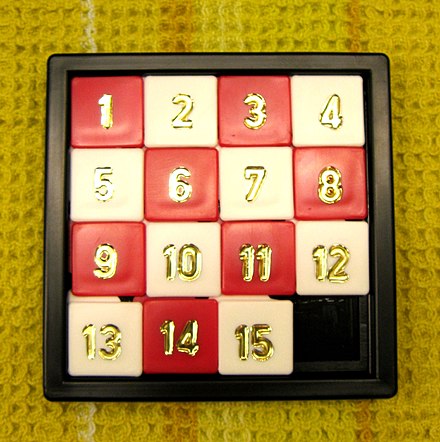
While my image is of a more recent version, the “slide numbers into order” puzzle was one of my favorite toys. The aim is to scramble the tiles all around and then manipulate them into the numerical array shown above. It actually turns out to be a lot harder than it seems it would be.

Working this puzzle taught me something new that has been useful in life. It didn’t pay to overthink the actions. Since I have an advanced degree in overthinking according to those who know and love me, this was a challenge. When I really focused on the movements the sequence got worse. When I relaxed and just casually slid them hither and yon I was able to solve the game. (Speaking of hither and yon, I once had an art student who made crocheted objects spaced some distance apart in the room and called them “hither and yon.” Now you have another clue to why I loved working at the college.)

Paying less attention to things and letting them fall into place will probably never be my strong suit. But I clearly remember the joy I experienced each time I picked up the puzzle, scrambled the numbers and moved them back where they belonged. Without trying.

“The Waiting Room”

As one of four children, I spent a lot of time in the pediatrician’s waiting room. One or another of us was always catching something or needing a shot or breaking something or needing stitches. Those of us unscathed waited with nothing but a large fish aquarium and many issues of Highlights Magazine. Here I encountered two of my favorite early puzzles, “Hidden Pictures” and “Spot the DIfferences.”

I expect that both puzzles ended up preparing me for adult life. Certainly as a mother I was constantly trying to find “hidden” objects ranging from the other shoe to permission slips to the “I must have my blue shirt for chorus.” As a college English professor I spent too many hours pointing out the differences between its and it’s, commas and semi-colons, active and passive voice, and fragments and complete sentences.

I seem to have confused some of my readers in my last post. I won’t usually put up actual puzzles to solve. Rather, I am going to meander through my life’s experiences with puzzles. Where possible I will try to include links to pages of similar puzzles.

”Mind Games”

I just finished reading the The Puzzler by A.J. Jacobs. (His previous book was The Know-It-All, a phrase more than occasionally applied to me, much to my dismay.) In it Jacobs explores a variety of puzzles and games, giving examples of each. As he meanders along he also relays his personal experiences with the challenge. Because I realized I had spent most of my life trying to solve all kinds of puzzles I have decided to use Jacobs’ format for the next series of posts . I am going to ignore any deep metaphorical reason for this and am just going with the claim that they are all a lot of fun.(That and they allow me to continue to deserve my aforementioned sobriquet.) The first post appears tomorrow.