“Are We There Yet?”

scotlanda014

In June 1963, my mother drove the four of us, now 16, 13, 10 and 8 across the United States from Portland to Buffalo, New York. She was the only one old enough to drive(I didn’t get my license for two more years) and did all the driving herself. We drove in a Ford station wagon with a luggage rack on the top. The car had a bench front seat, a bench middle seat and a flat “way-back” covered with pillows and sleeping bags. Each seat had its advantages and disadvantages. It won’t surprise any of my readers to know that we almost always wanted to be in the part of the car that we weren’t currently in.

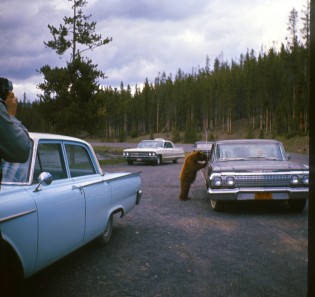
The picture above was taken from the “way back” of the car when we were driving through Yellowstone National Park. My mother tried to hit interesting spots on the way, though her idea of interesting and ours rarely coincided. We did all enjoy Yellowstone, however. “Craters of the Moon,” a must stop for her was tolerated only if she agreed to stop at the endlessly advertised Wall Drug Store.

The drive covered over 2600 miles and took us six days to cross the country. To say that we were bored and often cranky is putting a kind face on things. But we did end up playing several car games as we went. One favorite was the license plate hunt. Each of us tried to be the first to spot a license plate from another state. Wall Drug Store parking lot actually was a gold mine of various plates. With the exception of Hawaii and Alaska, by the time our trip was over, we had seen plates from every state, keeping track on a piece of paper.

The other game was the Alphabet Hunt. Here we each looked for the letters of the alphabet in order from a to z. Each of us kept our own tally and could not count a letter found by a sibling. Billboards were abundant in those days, but it still took many hours to find the complete set. It was frustrating to spot a “q” when I was only up to “e” in the search. But we actually kept to our rules and out of trouble for a while.

My mother played her own game. She would announce a mileage on the odometer and state that no one was to speak until that mileage was reached. Never have numbers turned over more slowly than those times. I am sure she wondered countless times why we hadn’t just gone by train as in previous visits East!




“Bored Silly”

840dcaba-a621-4b3e-b032-a90cc33c3e06

In late summer when everything we could think of to do we had done, my brother and I were always up for an invented game, Counting Cars. Our house lay below a main road and a fence marked the division between our driveway entrance and the highway. Here my brother and I would plunk ourselves down and begin our game. First we each chose a color of car and then we proceeded to count the number of cars of that color that went by. We were often torn between picking a color we liked(blue in my case) or a color that was more typical(green in most years.) Sometimes we went with the one we liked even as we suspected we might lose. Sometimes we argued over whether a car was our chosen color or not. (Anyone who grew up with siblings knows that a lot of time is taken up squabbling over such trivia!) Eventually we would tire of the game and hope dinner was ready.

I taught this game to my grandchildren one hot summer evening. Although the road in front of our house has enough cars to count, they come by less often than on my childhood highway. My grandson immediately came up with a variant on my rules. Since we live near a corner, he decided we needed to guess what color of car would round the corner. He usually chose black, and he was usually right. We ended up laughing and literally rolling around on the front lawn together.

Who says kids died of boredom? We never did, since we were always ready to invent yet another way to pass the time. It certainly beat letting our mother–always ready with a needed household chore-know we were at loose ends!


“Off Balance”

b59c9e0e-3372-4389-b49a-269d2416dde0

As I aged, I have noticed a decline in my ability to balance. Apparently this is a natural occurrence leading  to many falls in older people. So working to improve my balance requires effort. Lately I have incorporated a tip I learned from the New York Times 30 Day Wellness Challenge which has been running this month. It suggests standing on one foot for half of the time while brushing my teeth, then standing on the other foot for the other half. I use an electric toothbrush which beeps in 30 second intervals, so it is easy to measure my time on each foot. The thing beeps four times, allowing me one full minute of balancing on each foot. In a short time my balance has markedly improved. But partly it is because I remembered a tip I learned as a kid.

A train track belonging to a spur line of the railroad ran below our property. Because the train ran only twice a day, the tracks were empty most of the time. My brother and I spent time trying to see who could stay balanced walking on the rails the longest. Our distances improved after our father came along and taught us his method. “Never look at your feet. Always look at a point down the track and trust that your feet will move along the rail.” As I brush my teeth, I look across into the next room and balance for a longer time than if I look down.

But although the tip applied to balancing on the rail, it seems a good thing to remember in lots of situations. I think it would be helpful advice for cellphone users who are always bumping into me while they are looking down!

“Sticks and Stones”

The old line goes “sticks and stones can break my bones but names will never hurt me.” Of course that isn’t true, but is useful as a playground response to bullying. But the sticks and stones in this post are the common variety found on the ground by kids everywhere. These basis of these two comes naturally, I think, since I have never known a child to pass by a stick or stone without wanting to do something with it.

The first is named “Pooh Sticks,” after an activity in the “Winnie the Pooh” books. It requires a bridge, two or more kids, and a stick each. At the word go, each person drops her stick in the stream and runs to the other side of the bridge.(Clearly this should be played on footbridges, not ones with traffic!) The first stick to emerge is the winner. We played this endlessly for reasons I cannot now fathom.

The other game was skipping stones. I think that I was better at this when I was much shorter and closer to the water. In essence, you find a fairly flat, fairly round stone, throw it low to the ground and hope it skips across the water. The picture shows an excellent example of a successful stone being skipped. The winner is the kid with the most skips. I sometimes can still get one skip. But when I was a child I would fill my pockets with perfect stones and try and try to get a series of skips. Kids learn the idea very quickly, and my grandson tries his skill any time we are near water.

Both activities are free outdoor fun. I think each has definitely stood the test of time. And throwing rocks and sticks into water is definitely more parent approved than the other uses my siblings and I found for them!(The phrase “someone is going to get their eye poked out” comes immediately to mind.)

“Manual Dexterity”

I confess that my fine motor skills left much to be desired. I never perfected penmanship, for instance, and continually received “needs improvement” on my report cards in that category. Three of the games we liked to play indoors, pictured above, were jacks, pick up sticks and tiddlywinks. I have written a little about the first two a while back, but include them again remembering the challenges they presented to my lack of manual dexterity.

Jacks seemed simple enough. We made a circle on the hardwood floor with a piece of string marking the boundary for the game. Then taking turns, we bounced the ball and took in sequence one jack, then two jacks, and so forth until we could scoop up all the jacks on one bounce. Simple, right? Well there were four of us siblings and we never missed an opportunity for mayhem. The ball would bounce into someone. That someone would start yelling or worse still crying. Jacks would go flying. One or more of us would stomp off, ending the game. I never completed a game of jacks at home, only with a friend at school.

Pick up sticks was also simple to play in theory. Players could remove sticks without any of the others moving. Their turn ended when a stick moved while moving the target stick. What could go wrong? Well, our father was an attorney, so we were well schooled in argument. Needless to say no one could agree whether a stick had moved or not. The player insisted she had removed a stick without a problem. Some other kid would insist “I saw that one move!!!” Also the sticks had pointed ends, supposedly to allow intricate maneuvers. Unfortunately, the sticks had pointed ends. Enough said.

Tiddlywinks required the player to use one large plastic disc to snap little ones into a cup. While some versions of this game had a box with various scores on it, we played with just the cup. If we had owned the fancier version, it must have been destroyed early on. All four of us were hopeless at this game. Our success matched that of rigged carnival games. Discs flew willy-nilly around the room. We dissolved in gales of laughter. Even today, saying the word “tiddlywinks,” I smile thinking of those rainy afternoons indoors.

“ Oh, For a Sidewalk!”

23029b89-765e-46fd-8112-91b081adebf7

I grew up in a “privileged” neighborhood which forbid both stores and sidewalks. I guess they were considered déclassé at the time. I was enchanted with the possibilities of sidewalks when I visited my grandparents in Buffalo, New York. I could go down one to the main street and buy penny candy at a store. I could roller skate. But, best of all, I could take a stick of chalk, draw a hopscotch pattern and play with other kids using just a rock and the sidewalk.

I determined at age eleven that when I was grown I would either live completely in the country surrounded by animals or I would live somewhere with sidewalks. Since I was thirty, I have always lived in houses with sidewalks. I think the real estate broker thought I was a little odd when I insisted at only looking at such houses. She had other priorities, but we wanted walk-ability above all else.

I am amused to see that in the neighboring “privileged” town they are methodically building sidewalks where none existed. Apparently they have begun to value a safer place to walk than on the side of the road. Interestingly, they built bike lanes before they thought of pedestrian traffic. Because they are being developed in a patchwork way, they really don’t function very well yet. But perhaps some time in the future some kid will take a piece of chalk outside, draw a hopscotch pattern, toss a rock, and start hopping. I certainly hope so.


“Up, Up and Away!”

We spent much time on the northern Oregon coast, and one constant there was the wind. Clearly wind exists to amuse kids, and we took full advantage of it. We flew paper kites, such as the one on the left. We assembled and flew balsa gliders such as the one on the right. Each was inexpensive. I remember that the planes cost 10 cents. The kites were not much more money. Fortunately they were not a great expense because neither one lasted very long. The kites ripped or the wooden support struts snapped. The balsa fared little better, as bits of the wings and tail broke off after a couple of flights.

In kite shops today these inexpensive paper kites have been replaced by spendy nylon ones, each trying to outshine the next. Some even require two lines to keep them soaring and dipping. I never had very elaborate acrobatics with my paper kites. Mainly they went way up and then crashed to the ground, hence the rips and snaps. But the joy of running full speed against the wind and then watching the kite take off continually thrilled me.

In the park near us, in the neighboring wealthy town, children fly remote controlled planes. Clearly they cost most than 10 cents! They don’t require any running, nor do they need a strong thrust to have them take flight. They also make an annoying humming noise. I suppose our little balsa gliders would seem BORING. But we loved them, and often used our weekly allowance to replace the one broken the week before.

As I continue to write about childhood games, I am struck by how much physical activity we got every day. We didn’t need Fitbits or pedometers to encourage us. We were expected to regularly “burn off our energy.” And we did.

“Jumping for Joy”

pogostick

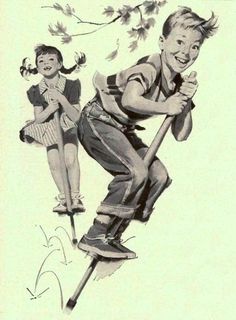
We didn’t own a pogo stick since we had a gravel driveway which didn’t have a good surface for using one. My good friend Penny, however, owned one and I used it at her house. This picture accurately portrays the outfit I would have been wearing to jump. However, there the similarity ends. This little girl and boy seem to defy gravity, making a deft series of hops, all the while staying upright and smiling. Me–not so much!

Even getting on a pogo stick required a certain grace. Somehow while keeping the pole upright, you had to put both feet on the little step which was about 12 inches off the ground. As soon as you were on the thing, you needed to begin hopping in order to stay on it. I spent most of my time trying to get on the stick and picking myself off the ground after I fell off the stick. Penny and I quickly found something else to do.

stilts

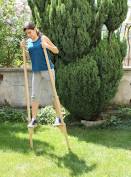
Fortunately, her father had built her a set of wooden stilts. While these required some of the same agility as the pogo stick, at least once you were on them you could step, not hop, across the yard. I enjoyed the stilts more than Penny. I was always one of the shortest girls in my class. For a short while, I could tower over my playmates!

“Flying High”

1948-50s 057

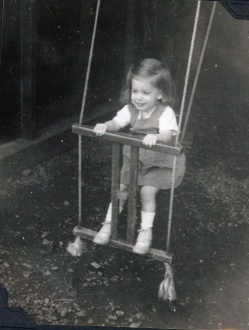
What kid doesn’t like a swing? Here I am at two on a wonderful contraption hung from a tree. By the time I was three I had an actual swing set with two metal swings. Later we acquired a set with two swings and a glider. The school had swings, parks had swings, friends had swings. When I was a kid the seats on swings were either wood or metal, but the seat was always flat. This allowed two wonderful and often parental discouraged activities. One was standing up on the swing seat. The other was getting high in the air and jumping off the seat.

Getting a swing going by oneself requires the skill of “pumping” one’s legs. It takes kids quite a while to master that. Until then every child continually yells “Push me. Push me.” As the oldest child, I often obliged by pushing my younger siblings until I was tired. The seats were hard edged and it was imperative for me to get out of the way before I was hit in the face by the swing. I remember many adults yelling at kids in the park to “Get away from the swings. You’re going to get hit.”

Sadly some safety conscious people decided to redesign swing seats. They replaced those platform seats with curved rubber.  The first time I encountered one I was angry. It was impossible to stand up on that rubber seat. Besides, they pinched the sides of my legs making it impossible to make the death defying leaps out of the swing.

My husband hung a tire swing from my grandchildren’s tree. The kids swing high and dangerously I suppose, standing and leaping to their hearts’ content. Thankfully no one has discovered how to take the fun out of a tire!

“Send Betsy Right Over”

redrover

A favorite game for us girls was “Red Rover.” In this game two lines of girls face off against each other forming chains by holding hands. One team chants “red rover, red rover, send _____right over.” The girl who is named then runs at full speed into the opposing line, trying to break through between two girls. If she is successful at breaking the chain, she can take one girl back with her to join her team. If she can’t get through, she has to join the opposing team. Theoretically it is played until only one player is left on one team. We never made it that far. In our case, it ended when  everyone was thoroughly sore from being run into.

I was one of the two smallest girls in my group. I was a poor candidate to be called to come “right over,” since I would rarely get through the line. I was also not an ideal member of the chain and probably suffered more arm collisions than most as stronger girls broke past me.

Teams were chosen by two team captains, usually the same two biggest girls. They would take turns choosing members. No matter the game, I was usually one of the last girls chosen. While contemporary theory suggests this is a dreadful thing to do to children, I accepted the logic of it. I was, after all, short and not very strong. I am grateful that no adult intervened in the hope of making things more “fair.” Kids gain resiliency in many ways, including recognizing reality about their abilities. I excelled in the classroom, so I figured it all balanced out.