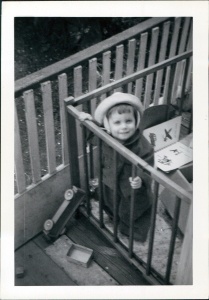
“There Is A Great Future In Plastics”

006D0AB4-61AC-41A9-A00B-97A436EAAC92.jpeg

(The post title comes from the movie “The Graduate” and conveys the attitude towards going into business for young people in the 1960’s)

Plastic was rare when I was a kid in the 1950’s. In fact, we associated plastic with cheap, flimsy and ugly. Nearly every item was made of wood, metal, glass or cardboard. Most liquids came in glass bottles, including bleach, shampoo, oils, juices and syrups. Toys were made mainly of wood or metal. My blocks were wood cubes. My doll furniture was wood, with a smattering of “cheap plastic.” Our Ferris wheel toy was made of sheet metal, as was our toy train. As I mentioned yesterday, my lunch box was metal. Most food came in cardboard boxes, as much of it does today. However, the boxes were never covered in plastic, nor did they have their contents wrapped in plastic inside the box.

Glass is of course breakable, and there were endless clean up jobs when one of us kids dropped something in the house. Metal edges can cut, and more than one toy wounded one of us. Cardboard doesn’t protect crackers from getting stale. On the other hand, crackers didn’t have a chance to go stale in our house with six people eating them!

So is the proliferation of plastic more beneficial or harmful?  We can see islands of plastic debris in the oceans, clearly a negative. We are beginning to examine the effects of plastic on the disruption of hormones in humans. There is some research about decreasing sperm count, for instance, in relation to the chemicals used to make plastic.

I realize that we are unlikely to return to the simple packaging of my childhood. However, it was a time of much less waste and much less negative effect on the world around us. All for the sake of “convenience.”



“Waxing Poetic”

waxpaper

My grade school lacked a cafeteria, so we all packed our lunches. We all owned little metal lunchboxes which, no matter how well you cleaned them, always held onto an odor of overripe banana. The only thing provided by the school was a little carton of milk, costing a penny.

I made my own sandwiches and rotated among peanut butter and honey, bologna and liverwurst.(I loved liverwurst. Since no one else did, I usually could make a sandwich when I wanted it.) Sometimes when peanut butter and bologna were both gone, I made honey sandwiches. One dreadful morning when my mother hadn’t been able to get to the grocery store on Saturday, I had a margarine sandwich.

But this post highlights that trusty product, waxed paper. I never had heard of Saran Wrap in those days. No one I knew had either. Nor had they invented little plastic “sandwich” bags. Only waxed paper was going to keep my sandwich intact until lunch. Waxed paper doesn’t “cling” like plastic wrap. It folds and then unfolds, allowing said sandwich to slide into the banana or the bottom of the less than ideal lunchbox.

The solution? Basic origami was required to get a sandwich to stay put. I was not particularly dexterous, and often couldn’t remember how to fold the paper in any orderly manner. I was in awe of classmates whose sandwiches were wrapped in a way that they stayed intact.

I guess waxed paper is still around. I use it to line cake pans occasionally. I think my roll is ten years old. I don’t miss it. For me it still conjures up that stale lunchbox smell.

“A Dime In My Shoe”

CB157DE6-E8F3-4D77-920A-F50B59A581249A8E59A2-347F-4300-BCF0-856C9BC28218

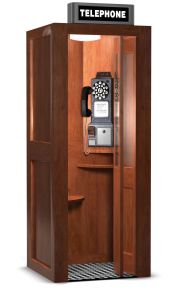
When I was in high school in the early 1960’s, every girl I knew was advised to have a dime in her shoe. This was to be used to call home in the event of some occasion–never directly named, but assumed to be related to boys’ behavior. The dime was to put in a pay phone of the kind pictured above.

Pay phones were everywhere. The one above was typical and had a couple of features alien to today’s high school girl. The dial is a rotary, not push button, and was pulled clockwise to each number in the sequence, then released to allow  each subsequent number to be dialed. The three slots on the top of the box were for nickels, dimes and quarters. A call cost one dime. However, it was also possible to place long distance calls by dialing 0 for operator. You would say what number was needed, and the operator would tell you to put the required change for three minutes into the phone. As the three minutes neared its end, the operator would warn you to either hang up or add more money. With no added money, the call would be disconnected.

The bottom of the phone had a little coin return opening. If the number was not answered, the money would be returned. My little brother always entered every phone booth we passed to check for unclaimed coins in the coin return. Once every twenty booths or so, he would find a dime. The unpredictability of this find delighted him and kept him checking.

Originally phone booths were opaque, not transparent as pictured above. This allowed Clark Kent to change into Superman without revealing the switch!

(I added a picture of the opaque one to illustrate this.)


“Staying Alive”

blackdeath

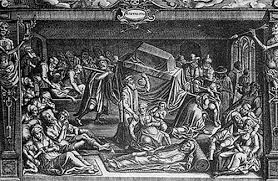
Sunday night having a great feast of Chinese food with family and friend, my eight year old grandson announced he was glad he wasn’t alive in the Middle Ages. Where this thought came from is one of the ongoing mysteries of life. With the kids around, I go from hearing about making slime to dog clothing to living in the Middle Ages. His mother told him he would have not survived, probably dying form the bubonic plague. He immediately snapped back,”I would have died from no internet.”

I had been considering a new series of posts, and this comment cemented my decision. For a while now, I will be writing about common objects and activities from my childhood and young adult life that seem totally foreign to my grandchildren. I am thinking of things such as nylon stockings, phone booths, long distance operators, the time lady and other ordinary parts of life. Whenever someone of my era thinks of another common object or experience now gone, please feel to note it in any of my comment sections.

Till tomorrow then.

“Truth”


Scrapbook 50s_00033A

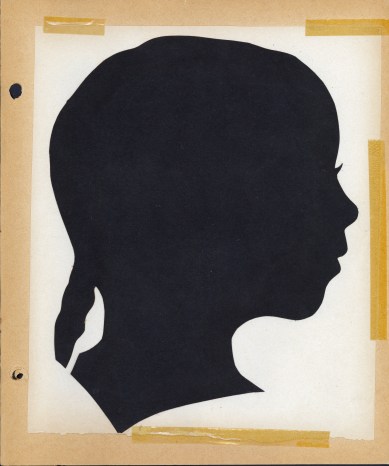
This silhouette cut-out of me from first grade reminds me that some things are actually black and white. When it comes to speaking, the Pope ends his prayer with the words, “Where there is falsehood, let us bring truth.” George Orwell, in his famous essay, “Politics and the English Language” written in 1946, carefully elucidates the way language can be used to obfuscate and confuse.

In the United States, at the moment, the president has taken to calling any reports with which he disagrees, “fake news.” In essence, he is accusing most of the press of lying. Language can also be used to disguise the truth. Torture can be renamed “enhanced interrogation. Lying can be called “spin.” Truth can be reshaped as “my truth, ” as though we somehow can make anything true by stating it.

Real truth is pretty straightforward. It is an accurate description of actual events. The climate is changing. One can argue about the cause of the change, but one cannot say that climate change is a hoax and be truthful. Assault weapons were designed to kill people in wars. Saying that regular citizens need to own them is a lie.

May we have the courage to challenge falsehood when we encounter it. May we have the courage to speak truth to power.

“Returning to the Blogosphere”

ogunquit
Ogunquit, Maine

I have been away for a few days visiting with a dear friend from Oregon. She flew to Boston, and took a shuttle to a motel where I met her. After a couple of hours of catching up, a huge Mexican dinner, and a good night’s sleep we went up to Maine.

We spent a while at the Kittery Factory Outlets. Unlike many of these outlet places, this one actually had terrific bargains. She picked up a new pair of shoes for $16 and I found a frying pan for my husband’s upcoming birthday at half price. Then on to Ogunquit, a medium sized resort town a few miles north.

In high summer, this town is packed, with a trolley running just to prevent nonstop gridlock of cars. In early May, however, crowds were minimal, yet shops and restaurants were open for the season. And astonishingly, spring decided it was high time it arrived. We had temperatures in the mid 70’s and lots of blue sky. The trees hadn’t yet decided if it was safe to leaf, so they were still bare. A few daffodils had ventured out for a look around.

Now that I am back home I am faced with a blogger’s dilemma. Do I catch up on reading and commenting on all the people I follow, or do I just start with today’s posts? I am catching up on comments left for me, so they should appear soon. Had a great time. Glad to be back in touch.

“R-E-S-P-E-C-T”

1CDB0DB1-AAAF-441B-A6BB-32D766AF7B5A

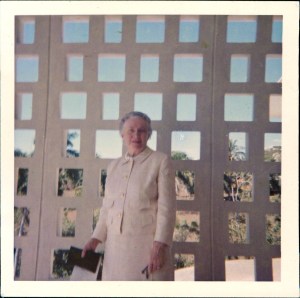
The Pope’s Peace Prayer asks for respect where there has been hostility. I first think of the Aretha Franklin hit “Respect” as she sings “all I’m asking for is a little respect.” So are we all. My maternal grandmother, pictured above in her mid 80’s was a model of propriety. She didn’t have to ask for respect. Somehow in her presence we understood what was required of us.

But at the moment there are torrents of hostility in the United States.  We seem to have lost the ability to respect one another. Drive on the highway and someone will be sure to honk or yell or drive too close to make sure you understand that somehow you have offended the driver. People push in lines, hoping you will check out faster. It’s as if we all need to go back to kindergarten and learn basic behavior.

it is challenging to be living in a country presided over by a hostile man who lacks basic respect and feels free to call other adults names more fitting for the school yard. I find it difficult to respond with anything other than more hostility. Still, I will attempt to at least not add fuel to the fire. I will think of my grandmother and her calm, civilized demeanor and try to emulate her.

“Awakening Trust”

IMG_0373

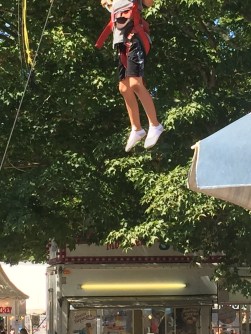
My grandson joyfully put on this harness and jumped high into the air attached to a bungee cord. He had complete trust(more than his grandmother!) that it was safe. The Pope’s Peace Prayer continues, “where there is prejudice, let us awaken trust.”

I was challenged by this phrase and took a while to understand what I believe he is getting at. I think that he is suggesting that our preset ideas prevent something positive from happening between people. If I am prejudging all Southerners as racist, I am unlikely to actually interact with one. I will be suspicious and keep my distance.

In my case, this would have been a great loss, since I married a man from Alabama, one of our Southern states, who isn’t a racist. I might never have had the chance to have 30 years of a solid marriage if I had dismissed him outright.

I appreciate that the Pope says to “awaken trust.” This certainly suggests that for many of us “trust” is either asleep or in a coma. There are excellent reasons for suspicion and lack of trust. But when we generalize from our experiences, we miss the chance to reawaken trust. May we have an awakened trust, not foolhardy, but open to new possibility.

“DO I HAVE YOUR ATTENTION?”

8AA0C97F-BBF0-46BC-834B-705EE6906AA5

I am demonstrating a favorite trick in the photo above, tossing my toys out of the play pen so that someone will have to walk over and put them back. I am seeking attention however I might get it. The Pope’s Peace Prayer’s next line is “where there is sensationalism, let us use sobriety.”

Everyone seems to be screaming for our attention. The news runs seven days a week, twenty-four hours a day. There really isn’t any more news than there ever was, so broadcasters have to come up with sensationalism to get and keep our attention. “Breaking News!” “We interrupt this program for an important announcement.” “Stay tuned for our big story!” Many of the television commentators are so breathless you would think they just ran to the camera holding this exciting story.

Unfortunately, we don’t have a chance to soberly consider what is really important and what is just sensationalism. In the United States there are already long discussions about who will win the elections that are six months away. Of course, no one knows, but that hasn’t stopped the excited predictions. If you watch television, you would also think we have gone from the brink of war with North Korea to Donald Trump deserving the Nobel Peace Prize. What?

I hope we can all unplug from the hysteria called news and quietly go about our lives. They may not be very sensational, but they are solid and meaningful.

“Include Me”

1948-50s 328

On our way to a birthday party to which we both had been invited. The Pope’s Peace Prayer adds, “where there is exclusion, let us offer solidarity.” In this instance, we were both included as guests.

Many times in grade school, party invitations were handed out in class. There were none of the more modern rules about including everyone if invitations were to be distributed at school. It was very disheartening to be left out of the party. On Valentine’s Day, each student had a little decorated box on their desk. Pupils put valentine cards into boxes of their choice. At the end, we would all count how many we had received. It was very sad to be the recipient of few cards compared to other kids.

It is no less painful to be ignored as an adult. Who is being overlooked by others? How might hospitality be extended so that more people feel welcome? Who is saying “include me” today?