“Whose Phone is That?”

cell phones

Once upon a time, in the dark ages known as most of my life, there was only one sound that a phone made. Everyone recognized the sound and knew to answer the phone. Of course, the phone was either at home, at work or in a phone booth. You didn’t hear phones of all the people around you wherever you went. Those peoples’ phones were safe at home ringing away.

Now, unfortunately, most people carry around a portable phone with its own ring tone. If you are fairly inept, you probably still have the tone the phone came with. For instance, all T-Mobile phones sing with the same tone. However, if you have very clever grandchildren, your phone may have been reprogrammed to call out choice noises they have put on your phone while you are otherwise occupied. (This is a general statement. In no way does this even vaguely point to any particular grandchildren I might know.) Then you might be suddenly startled when your purse begins to sing out the signal to start a horse race.

Even more distracting are the random tunes that play loudly in the middle of a church service, even though the cantor has made the standard request to “silence your cell phone before the service begins.” For some reason, the phone owning culprit usually fails to realize that it is her phone ringing away. Suddenly many parishioners are checking their pockets to make sure they aren’t disrupting things. Of course this mass rummaging makes its own interruption.

As for me, I have just turned off the ringer. I think. Unless some unnamed grandchild has turned it back on just before church!

“Sound Effects”

washingdone
Washing done

I have been intrigued lately by the various sounds that my appliances and gadgets make. My dryer makes a dreadful blaring noise when it is done. My new washer(yeah, I know, I am presently washer obsessed)plays a jaunty tune which you can hear for yourself by pressing the caption under the photo above. Needless to say, this is a much more pleasant sound to get my attention. The dryer seems to be saying “what’s taking you so long?” The washer, on the other hand, seems to be pleased with itself for having finished another task for me.

My rice cooker plays “Twinkle, Twinkle Little Star” when the rice is cooked. This is a Japanese rice cooker, and I don’t know if the version sold in Japan plays the same tune.  My stove, on the other hand, does that same annoying blare when time is up. Is there something American about unpleasant noise?(Anyone who has to watch U.S. news would certainly say that there is.) Why do the South Koreans and Japanese opt for pleasant sounds?

More thoughts on sounds tomorrow, including cell phones. Please feel free to comment at any point about your interactions with electronic sounds.

“Just In Time”

lg

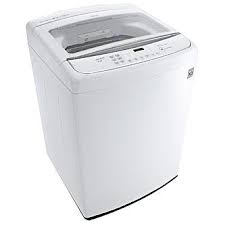
I had replaced the timing mechanism in my Whirlpool washer once, but when it went out again, I adjusted to its idiosyncrasies. The main problem was that it insisted on rinsing everything twice, no matter if I wanted it to or not. I had been putting up with this for over a year, wasting water, wasting time. My husband noticed my frustration and suggested we buy a new machine. The old one had done great work, but he was right. So I bought a new machine, this time by LG, a South Korean manufacturer. It was priced about the same as the others, but had some appealing features.

Who knew how much progress had been made in 10 years? This little machine weighs the load and shortens the cycle accordingly. What was taking me 90 minutes now takes 36. It also spins much more water out of the clothes, shortening the drying time. Its only drawback is the depth of its tub. Even standing on my toes, I have trouble reaching the stray sock at the bottom of the tub. I need one of those grabbers.

Why was this post called “just in time?” Last week our president announced a large tariff on South Korean washing machines. Not other appliances, just washing machines. This was to protect Whirlpool, the maker of my faulty machine. So I had bought my wonderful machine at a propitious moment in American trade policy. I don’t understand the policy, but I am glad I saved the likely 50% surcharge coming soon to an appliance store near me.


“No Venting”

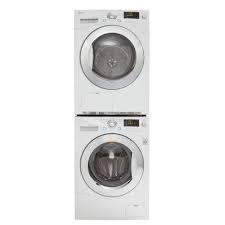
stackingWhen I lived in a duplex with my daughter, the landlord installed an actual stacking washer and dryer in the kitchen. This allowed sufficient water pressure and electrical power to run a full sized washer and dryer, thus allowing the machines to run efficiently, unlike my previous all-in-one or portable models. However, since it was on a inside wall of the duplex, the dryer couldn’t vent to the outside.

If you ever read that a dryer can operate vented or ventless, beware. Ventless really just means that all the damp air is vented into the room where the dryer sits. In the small apartment we occupied, this meant into all the rooms. I imagine that in a very arid place such as Arizona, it might be beneficial to have all that humid air circulating. However, this was Portland and we didn’t need a drop more of humidity.

So for the several years we lived there, the apartment had a lingering odor of moisture, approaching mildew. If we had wanted to grow mushrooms, we had the right environment. Unfortunately, it always felt like we were never quite dry. Thanks, ironically enough, to the dryer.

“I Go Portable”

91B43894-BAE6-4B77-AFF9-AE30F3032349

We moved onto the land when our daughter was just thinking about crawling around the houseboat. That would lead to her walking around the houseboat and one day walking off the houseboat into the river if we weren’t hypervigilant. So we bought an old house on 5 acres and moved in. We were totally clueless buyers, going only for the price, and overlooked some major problems. Such as our water supply.

The house was supplied by a spring attached to a pipe attached to our house. This meant that our water pressure was very low. We also had no plumbing for a washing machine. I bought a portable machine, similar to the more modern one pictured above. It rolled over to the sink where I used a hose from the faucet to s-l-o-w-l-y fill the little tank on the left side. The machine sloshed the clothing around as long as you wanted it to( no timers), then I put the hose back and pumped the water back into the sink. The right hand side of the machine was a tiny spin cylinder which again operated as long as you let it. Then, of course, the clothes had to be hung out to dry. Or, hung in on our folding wood rack when it was raining.(It was Oregon. We used the wood rack most of the time.)

While I realized that this would have been a step up from hand washing, it was definitely a step down from the all-in-one machine from the houseboat. It also had the capacity of a thimble, and I again was endlessly washing diapers and our clothes. When I moved back into the city to an apartment with coin operated washers and dryers, I gave the little machine to a student. She had been hand washing, so she considered this a great gift. It’s all in the comparison, I guess, but it proved I was a poor candidate for “going off the grid.”

“All-In-One”

washerdryer

When I was married and living in the houseboat, we had a stacked washer dryer which was really just one unit. Each had a very small capacity, but it fit in our houseboat which was the main criterion. The dryer used 120volts, which if you know anything about dryers is half the voltage of standard electric dryers. At half the power, the dryer took twice the time.

I suppose that this unit was designed for a household of one or two that did little laundry. However, my husband was a construction worker and we had a new baby. Thus we had lots of laundry, including very dirty work clothes and many many diapers. Now it was certainly better to be able to do the laundry at home than having to drive a with a new baby to a laundromat, but it meant that the washer/dryer was running most of the time. Since I was home with a new baby, this meant I was able to do wash all day, which is what it seemed like at the time.

If I had known what awaited me in our first home on the land, I would have treasured even this all-in-one. At least this machine filled and drained itself, had a rinse cycle and dried clothes.

“Washing Together”

laundromat

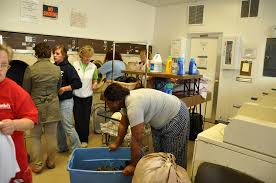
Americans have a few places where many different people come together and have to work out sharing. The highway, of course, is a prime example. But there is a specialized set of skills required to navigate the communal space of the laundromat. When I was younger, I frequently used a laundromat since I didn’t own a washer. In more recent years, I still use them to launder items too large to wash in my home machine such as throw rugs and comforters. On those infrequent occasions, I have been able spend my time observing and contemplating. It is too noisy to read and the television usually blares something obnoxious. I did once try to write a poem in the place, but failed.

Timing is everything in the laundromat. It is important to empty the washer as soon as the cycle is finished. Otherwise you risk having someone unceremoniously dump your wet load somewhere. Similarly, apparently you are to leap up when the dryer load is done. Again, you risk having your clothes dumped out on any available surface. While it is rude to stare at another person’s load waiting for it to be done(lest you be suspected of clothing theft) there is often just an instant between their conclusion and your opportunity to nab a machine. I would advise going when the place is empty, but I have never found a time when that is true.

You will encounter a variety of people from the elderly wheeling their carts down the sidewalk to large families with very bored toddlers. The conversation seems to be limited to “are you waiting for that machine” and “are these yours?”(asked in that 30 seconds you have failed to empty a machine.) The main characteristic seems to be territoriality, with people favoring certain dryers. Apparently some run longer on the same dime. If you know that, I think you have probably been hanging out there too often!

The main thing I have acquired in laundromats is deep compassion for people who don’t have washing machines. No one ever looks happy to be having to do their wash with others. Everyone would clearly rather be at home.


“Apartment Includes Washer”

wringerwasher

I return to my saga of laundry with a look back at my first place of my own after college. I found the washing machine in the basement and quickly mastered rolling it over to the sink, filling the tub with water, draining the tub, filling the rub with rinse water, draining the tub and then hand feeding the garments through the wringer. The only electrified parts of the machine were the agitator and the pump for draining. The wringer was hand run. This required a certain degree of coordination, using one hand to turn the wringer, another to feed the garment, and another to make sure the clothing didn’t fall on the floor. I knew it felt as if I needed three hands!

The basement also had clothes lines as did the back yard. The whole process was tedious, not fitting my idea of myself as a successful working woman. I occasionally took a load of washing to my parents when I visited and did it while we talked. I also discovered the laundromat.  As anyone who has used a laundromat knows, this has its own lengthy requirements from finding quarters, getting soap(unless you’re willing to pay an arm and a leg for the laundromat’s own little packets of soap), and transporting the clothes to the laundromat. Then the social interactions. Of which, more tomorrow.

“January 26, 1953”

I lost my little sister, Patsy, last August. Her birthday was today and I am pausing to share a little about that day. My mother was due on January 12, and so we were all waiting to see when this baby would actually arrive. In those days, of course, we had no idea of whether the baby would be a girl or a boy. I wanted a girl; my brother wanted a boy.

Tired of waiting for the baby, my parents went out for dinner, leaving us with a sitter. My mother had one martini and dinner. At the restaurant she went into labor and they went straight to the hospital. At the hospital, the doctor asked her if she had had anything to drink. When told about the martini, he quipped, “That’s all the pain relief you will get.” But my sister arrived after only 45 minutes, making her entrance quickly to compensate for her late start!

A girl was to be named Jean, after Jeannie with the light brown hair, a favorite song in our family. Patsy, nearly ten pounds, had a full head of black hair. Clearly this was no dreamlike Jeannie. It took at least two weeks before this baby had a name, but they finally thought of Patricia. They skipped a middle name.

She was a happy baby, a cheerful little girl and a life loving grown woman. She fought breast cancer through three different sieges, finally succumbing after all that could be done had been done. She died peacefully in her sleep, as she had wished. I know the angels blessed her coming in and her going out. Love you, kid.


“Pressing Concerns”

In the museum of the Hancock, Massachusetts Shaker community, one can visit the communal ironing room. Pictured above is the ironing room itself and the stove that heated all the irons. While it is hard to see in the left hand picture, each little door could be opened to see the group of irons being reheated on the stove. While you can find irons like this today, they are usually used as doorstops.

When I was a kid, there were two fabrics in clothing: cotton and wool. Cotton wrinkled and wool shrunk, so each required specialized laundry knowledge. Cotton required ironing. I learned to iron when I was about eight, and have done it for the rest of my  life, though many clothes I have today are blends that don’t wrinkle(at least enough to warrant my ironing them!) When I married my husband I told him I didn’t know how to iron, wanting to avoid the presumption that I would do his shirts. Of course, he figured out my ploy, but went ahead and did his own ironing.

The first iron I used did not have steam, so the clothing needed to be dampened, then rolled up to evenly distribute the moisture, then stacked with the other items, then ironed. I learned on pillowcases and handkerchiefs before I was “promoted” to my father’s oxford dress shirts. For some reason, my mother thought it was essential that I knew the proper order to iron a man’s dress shirt. As you can tell from the paragraph above, this specialized skill has not been put to use in my adult life.

Today fabrics are a mix of materials and my fancy steam iron has dials to adjust the heat and the steam. Nonetheless, I find myself melting some fabrics after forgetting to adjust the temperature down from linen. I have no idea if anyone irons today. Judging from a recent advertisement I saw, some people count on fabric softener to substitute for the chore. Never worked for me.