“Learning to Wait”

54B36026-D6D2-4946-A2ED-0CD25EBA0A24

Waiting doesn’t come naturally to children. Whether it’s the incessant “are we there yet?” or the pleas of “when’s dinner?” children want time to speed up. I remember riding my bicycle up to my elementary school in August to see if the class lists were posted yet. These held special importance for me and my friends since they let us know not only our next teacher but also our next classmates. It took several bike rides until I finally got to see the list taped on my fall classroom door. And who among us couldn’t wait to be “grown up?”

As adults we need the capacity to wait, and it appears many adults don’t possess it. From the person huffing and mumbling behind me in the checkout line to the car behind me in slow traffic, other adults are impatient. The culture caters to this at the moment. On a drive last week I passed a billboard which displayed how long I could expect to wait in the hospital’s emergency room. I can’t imagine rushing an emergency to take advantage of the short wait time!

Waiting is seen as so unpleasant that in every place I will need to wait someone has installed a television. So the doctor’s office, the airport, the gas station and the grocer store sport televisions. If a transaction takes a couple of minutes a clerk will almost always apologize for making me wait, fending off my potential criticism I guess.

Mindfulness seems designed to teach people to wait. It encourages them to be in the moment, not in the future. I didn’t need to take it up to learn to wait. I had many years of experience waiting while I grew up. Now I treasure those times of stillness, when they aren’t interrupted by a television, when the only thing that I have to do is wait.


 

“Learning to Share”

1A5AE8D9-19A0-419B-9384-04025011CD3D.jpeg

My daughter’s rescue pups have learned to share the couch. They could each take a side, but they prefer to share one end. They worked this out over time with a few growls, nips and tussles, but they found a solution that suited them both. We learn to share in much the same way.

Growing up my life offered many opportunities to learn to share besides formal school settings. In our first home five people shared one bathroom. Eventually we owned one television. I shared a room with my little brother for many years. When I rode the bus I shared my seat with whoever sat down next to me. I went off to college and shared my room with a stranger that I first met on the day we both arrived. After college I shared an apartment with a friend. By the time I married and had children the habit of sharing was well established.

I don’t think sharing comes naturally to children, but that is the best time to instill the habit. By the time we are adults, we ought to take other peoples’ needs into consideration at most times, whether on the road or in the grocery store. I wonder if some of the people around me demanding full attention despite other peoples’ existence never learned to share. Perhaps they had their own bathroom, their own room, and their own television. Perhaps they even got to dictate their choice of roommate.

I imagine many of us could benefit from remedial education in sharing. Unfortunately I suppose those who most need it would never sign up!

“All I Needed to Know”

kindergarten

Many years ago Robert Fulghum wrote a short book “All I Really Need to Know I Learned in Kindergarten.” As I began reflecting on education, I realized that throughout our lives we learn many things in many different ways. This series of posts, rather than chronological, will instead reflect the variety of teachers and lessons we encounter as we age and, preferably, mature.

Fulghum’s first rule he learned at five years old was “share everything.” All around me I see entitled people acting as though they were the only ones with needs. I would say that this is merely the grousing of an older person complaining about the young, but it is just as often older people acting like this. American culture seems to be teeming at the moment not with “America First,”(Donald Trump’s slogan) but with “Me First.” Of course it is possible that there is a connection. At least the first reinforces the second.

Back in kindergarten we were taught both that we needed to share and also that there was enough for everyone. Somehow both lessons seem to have gotten lost along the way. With the “quantities limited,” “hurry in now before they are all gone,” and “be the first to own…” we are being taught the opposite. We are encouraged to focus on meeting our needs first. We also are being taught that there is “not enough.”

I remember Miss Hilen’s kindergarten classroom with great affection. We shared. We had enough. We learned that together we were one terrific bunch of kids.7E069A8D-E3D0-4608-A710-DD377B2963F2

“College Admissions and Snowplows”

snowplow

I begin my thoughts on education by reflecting on the recent scandal in the United States around college admissions. Fifty people have been indicted on charges that they falsified school records, invented sports teams, provided substitutes for tests, asked for extra time to complete the tests, and bribed college officials. And these fifty people are parents! They were trying to get their children accepted into colleges with the prestige they believed their children deserved, despite the fact that their children were not qualified for admission.

What motivates parents to go to such extreme behavior around their children?  I had heard of the term “helicopter parents” for some time, about parents who constantly hovered around their children. But now I heard the term “snowplow parents” which applies in this situation. A “helicopter parent” might need to talk to their college student every day. But a “snowplow parent” has a different job. That parent is determined to remove any and all obstacles in the way of their child’s forward progress. This is called helping.

Sad to say, this “helpful” behavior actually handicaps their children. Most of us realize that it is in overcoming obstacles that we grow. There is a real satisfaction in achieving our own goals without the interference of “well meaning” parents. A child’s wonky science project pleases her much more than the carefully finished one of a fellow student’s whose parent stepped in to finish it. The one knows she can accomplish something. The other doubts her own abilities and believes she will always need to be rescued.

Unless the snowplow parents hoped to pay for their children’s essays, pay for substitutes for their exams, and feed answers to them through earpieces in class discussions, their children were bound to fail their classes. Sadder still, their children would feel like failures when all they needed was to be celebrated for the people they actually were, not the lofty projections of their parents.

“Missing the Action”

under

I have been trying to shake off a virus since Thursday, but have discovered once again that they have their own timetable and wishing won’t make them leave. At first I thought I had a little cold. Sadly it kept growing into one of those full body rotten bugs that leaves you too bored to do anything but read but too tired to read. And it turns out there is a limit to how much sleep I can get in a day. If you catch the grumpy self pitying tone underlying this paragraph, you are an adept reader!

So I am returning slowly to writing this morning. I will make an attempt to catch up with my followers and those I follow. And then in the coming month I will turn my attention to education, an arena where I spent my professional life.

“An Object At Rest…”

C46F9739-2702-437C-AB95-9EC93F14384D

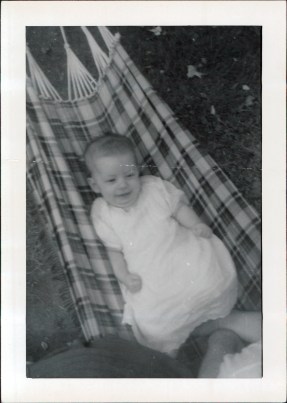
Here at a couple of months old I am already showing my preference for reclining in a hammock. As I near the end of my month of posts on diet and exercise, I have been pondering my resistance to exercise. Clearly as a child I was very active. In high school and college I did a great deal of walking in the course of my daily life. As a young mother I certainly was very active most of the time. Then middle age set in and I began to seek out opportunities to move as I have shown in my jogging, jumping, vaulting, swimming and Curve workouts. Today I go twice a week for a rigorous workout of weights and resistance exercises with a personal trainer.

But it has all seemed like work from that first necessity to “seek out opportunities to move.” Why has that been the case? I finally remembered Newton’s first law of physics. “A body at rest stays at rest.” It needs to be acted upon to move. As long as I had the need to move–to get somewhere for example–I got that body moving. But as soon as it was optional, as soon as I had to “make” myself move, the inertia proved stronger than the impetus to move.

All of this is very ironic since Newton’s also says that a body in motion will stay in motion unless acted on by an opposing force. My translation of this points out that once I start moving in the gym I find that I am actually enjoying myself and stop simply because I am exhausted. Somehow though I never hold onto that joy. The next time I imagine moving, I find that I prefer that my body “stays at rest.” It’s a paradox shared by many a non exerciser. Maybe we need a new law to explain it.

“Round and Around”

IMG_0559

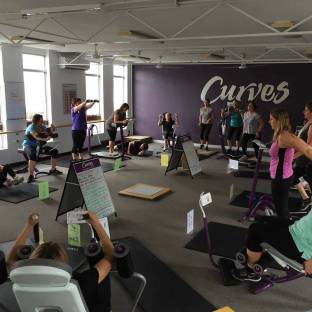
My last venture into trendy fitness programs came in early 2002 when I visited our local “Curves” franchise located near us. Curves was women only and based on a simple concept. Exercise equipment was spaced in a circle with a standing platform between each pair of exercise machines. Music played and you worked your way around the circle. Each station had a specific exercise and each standing platform was to allow you to step in place between the exercises. It reminded me of musical chairs except that there were enough places for each woman to work out. The whole routine took 30 minutes. By the end of that time you had worked all your major muscle groups and kept your heart rate in an aerobic level.

It was a lot of fun for a while, but then it became pretty boring. I suspect that was the reason that after an astonishing proliferation of Curves outlets across the United States, most of them went out of business after a few years. I only lasted a year at mine before I returned to walking and exercising at home. It had the advantage of being affordable, easy to learn and friendly. It was an safe way for me to move back into exercise. And it didn’t bother my knees!

If you are young, you probably wonder why I keep mentioning my knees. If you are older than forty, you already know.


“Kick It Up a Notch”

WORKOUT, (aka JANE FONDA'S ORIGINAL WORKOUT), Jane Fonda, 1982. ©Warner Home Video/courtesy Everett

Then came aerobics, here demonstrated by Jane Fonda. I remember this particular exercise well since it always seemed reminiscent of a male dog and a fire hydrant. Everyone I knew was trying aerobics with its pulsing music and, for the first time, exercise clothes. Leg warmers! I have no idea how anyone came up with the idea of wearing leg warmers to do aerobics, but they were a symbol that you took exercise SERIOUSLY.

After floor aerobics came step aerobics. Here you alternated stepping up and down on a little several inch high block. This new approach demanded that you buy a step, of course. Commercial firms were starting to see the market in exercise and were promoting “aids” that we needed to do aerobics. They hadn’t yet figure out that there were billions to be made in exercise clothing.

My knees were no more happy with step aerobics than they had been with jogging. In fact at forty I paid my first visit to a new specialty “sports medicine.” I learned that my knees didn’t track in a straight line thus causing me pain. I was given exercises and told that I would need to do them the rest of my life. Of course, once I stopped doing step aerobics my knees were fine and I quit doing them.

I never got involved with Jazzercise or Zumba, two aerobic fads that followed the Jane Fonda era. Nor did I ever take to Richard Simmons with his campy workouts. But tomorrow’s post details the next “thing” I tried.

“Jumping for Joy”

59D57820-83FB-407D-A731-70EFB2C50A77

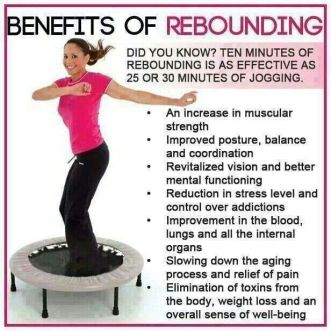
My next venture into exercise fads was the miniature trampoline. It had several advantages: it was inexpensive, it didn’t take up much room, it was fun and I could do it without needing a babysitter. I even bought a cassette tape with songs specifically timed to bounce to. One I will always associate with bouncing was “Bette Davis Eyes.” Why they chose this for the tape I’ll never know, but the beat was right.

I was impressed reading this ad for that little trampoline this morning. I had no idea of all the wonderful results it promised. I did it for fun and to let off steam. It worked for those two goals. I doubt that it came through with any of the other promises listed above. What amazes me forty years later is that I had the requisite balance to go up and down without falling out or over. Today I have to work to maintain my balance and would certainly hesitate to start bouncing on a mini trampoline.

I few years later I took a class at the YWCA(home of the pool and the fat jiggling machine) which included jumping on a full size trampoline. We also tried out vaulting over a horse(a piece of gymnastics equipment), walking on a balance beam, going across uneven parallel bars and standing on our heads. I amazed myself by enjoying it all, reminding me once again that I was still very fit in my 30’s.

And to think, all this took place without lycra or spandex! Without fancy workout gear a great time was still had by all.

“Run For Your Life”

8223E930-4D2C-4E4F-9357-7E573696C3DC

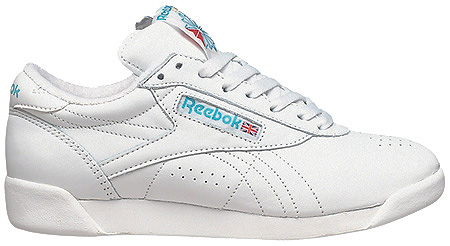
In 1980 I joined the thousands of women in their thirties who decided to fight aging by jogging. There were no spandex running outfits, no special sports bras, no countless choices for shoes. While Nike had been invented by Phil Knight in Oregon, supposedly by using a waffle iron to figure out the sole of his new shoe, I bought a pair of Reeboks, as seen above.

Jogging was pretty self explanatory, so I didn’t need a trainer, a video or a gym. I just needed to put on my Reeboks and shorts(just cotton, not nylon) and leave the house. I simply ran slowly around the neighborhood. While the practice seemed pretty silly to me, I did it faithfully for some time.

After a while friend asked me to join her in a 5K run. I agreed without really thinking it through. That Saturday I joined hundreds of other women in a run around Portland. I was nearly the last woman to finish and met my friend who had arrived long before and had begun to worry about me. It proved to me that I was not a candidate for running events. That was my first and last.

Eventually jogging and my knees had a disagreement and I had to find another way to get some exercise. That’s when I took up swimming, a sport I had always enjoyed, which took me to the YWCA, home of the fat jiggling machine.