“Proportions “

One of the strange aspects of looking out at the harbor is the contrast between the cruise ship and the other boats. The fishing boats seem to the eye to be in proportion to the landscape while the Rotterdam skews my sense of things.

I am frequently teased about my love for proportion, and I accept the ribbing. New England houses seem in right relation to their place in the landscape. Old ones at least. Of course I am bothered by new McMansions.

While I know cruise ship passengers help the local economy, their scale seems off. Which is ironic, since when I was on one it seemed just fine!

“One Morning In Maine”

D39C937E-D348-4012-AEEF-9B22E70D82B9.jpeg

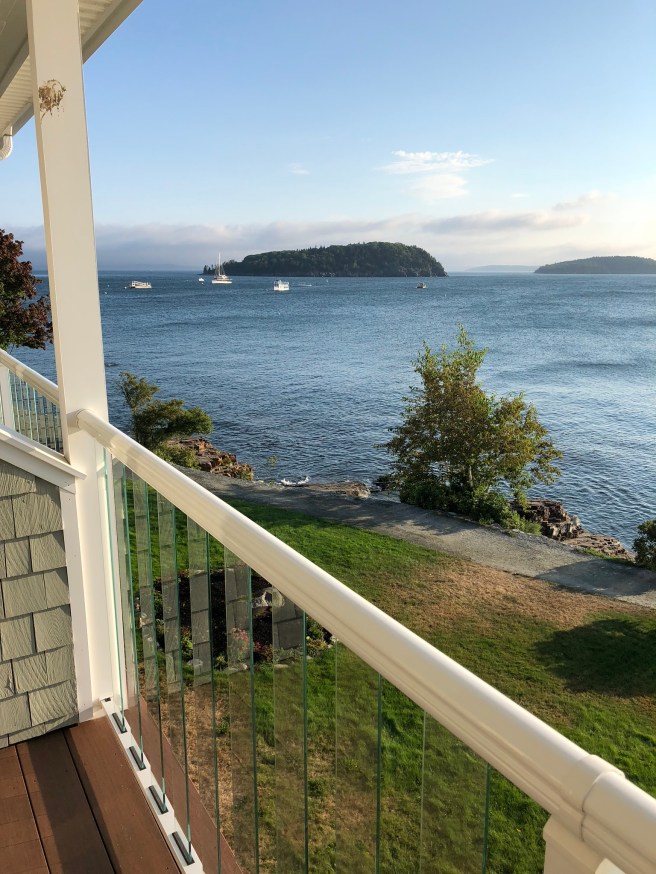
We are on our annual week long vacation, this time a return to Bar Harbor, Maine. It took us seven hours to drive here, after  factoring leaving our dog at the boarders, doubling back to the highway, stopping several times to snack a little and going through construction. We are staying in our favorite ocean side hotel with the balcony shown above,

Bar Harbor has more crowds than even five years ago. Partly they come from the huge cruise ships who stop here and taxi their passengers in for the day. Partly also, I think, because my generation of post War babies is now retiring and traveling. Born in 1947, I was one of the first of these, but each year there are lots more of us.

Fortunately, our old theory proves true: we can outwalk any crowd very easily. While near the pier Bar Harbor is filled with interesting shops, walking for over five minutes put us in lovely neighborhoods and took us to a quiet restaurant with superb—-get ready for it—-haddock. My long followers may remember I like a seafood focus each vacation. I had planned on scallops, but had haddock last night as an “early bird” special.

Bar Harbor’s only downside is that the news vendor doesn’t open until 9am. Missing the New York Times crossword with my breakfast is a small sacrifice compared with the chance to hear lapping waves as I drink my coffee.

“Back To School?”

Slide 1

For the majority of my life I followed a calendar tied to education. My year started the day after Labor Day(the first Monday in September) and ended in late May or early June. The first 22 years of my life followed this pattern, as did my graduate schooling and my profession as a college professor.Now that I am retired, the calendar year supposedly starts on January 1. New Year’s Day kicks it off and the cultural expectation is that it is a time to reassess and reevaluate one’s life. Resolutions supposedly begin on that day.

However, I have never adjusted my inner calendar to accommodate the external one. September always seems like the beginning of a new year. I go shoe shopping for a sturdy pair of oxfords for the fall. My interest in cooking dinner returns. While I don’t make formal resolutions, I think about areas of my life that could benefit from a little more attention. This year, for instance, I could use a little more room between my pants and my stomach! Lycra can only do so much.

So happy New Year to any of my readers who also feel revitalized by September. It’s bound to be a great year.

“Pie Perfection”

81F3A974-10A3-4915-BA53-2FD723E5BDD9.jpeg

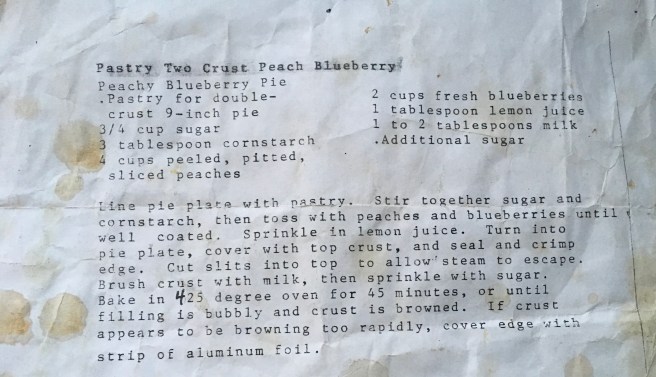
When my husband and I first dated, I told him about a marvelous peach blueberry pie that I had baked after I graduated from college. I had used a recipe from the food section of the local paper, but had long ago misplaced the clipping. He loves both peaches and blueberries and told me it sounded delicious.

Unbeknownst to me, he wrote the newspaper, gave them the approximate date of the recipe, and asked if someone could find it in the archives and send him a copy. This was in 1986, so there were no quick internet searches or ways to simply send him a link. Instead, the food editor actually searched, found the old recipe, and typed it out on a piece of paper which she sent to my husband.

Yesterday, during one of the few days each summer when you can find both peaches and blueberries at their peak(the fruit was local, but our own blueberries were gone so I purchased others), I baked that same peach blueberry pie. I had to quickly take a picture of it since, gleeful that he could have a hot piece of pie, my husband quickly ate one quarter of it.

I smile each time I take out that tattered typed copy of the recipe, remembering the effort it took both him and the editor to deliver it back into my hands. A lovely end to summer.

“Grateful Living”

G_00018A

Here in the summer of 1948 my 18 year old Aunt Cary holds me in the hammock at my grandparents’ farm in the country. It is a simple moment, no celebration going on, no one’s birthday or anniversary, no party clothes, no fireworks or lavish food spread. It is, in fact, the kind of moment that makes up most of our lives.

In her book “Radical Gratitude,” Mary Jo Leddy doesn’t suggest that we need to be content about every aspect of our lives. We can want to live in a safe neighborhood, with adequate food and shelter. We can want to feel better when we are ill. We can find fault with the people around us and with ourselves. But her main point is that we are missing the moment by moment chances to be grateful. For life. For family. For friends. For the sunshine. For the earth under our feet. Being alive is, after all, a rare gift, one often overlooked in our quest for more, better and different.

In a summer seventy years later, I am grateful for my aunt taking the time to just sit on the hammock with me. I have missed her every year since she took her life in 1969. She lost her struggle with a later onset mental illness. But for that afternoon we shared the joy of each others’ company. And I am glad we did.

“Tête à Tête

3AC1A08F-A56B-44D5-AA69-EEBA5EEBDCFA.jpeg

A close friend lives on the other side of the United States from me and together we form a book club. Yes, a two person book club. We talk for half an hour every week and have done so for a number of years. We alternate choosing books and feel free to abandon one if neither of us can stand to finish it.

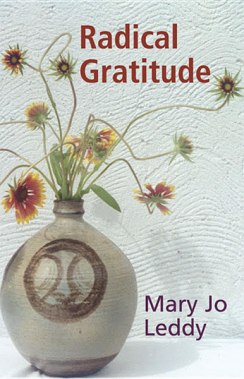
Right now we are reading the book pictured above written in 2002 by a Canadian woman who worked at the time at Romero House Community in Toronto settling refugees. I found the reference to her book in a fairly lightweight book about gratitude. Every time that author quoted Leddy, I found what Leddy had written was worth a closer read. So my friend and I each acquired a used copy of the book.

Leddy challenges what she sees as a North American refusal to be satisfied with the present moment. She says that we live in a consumer culture and that its effects run much deeper than most of us realize. She says that the constant advertising blitz we live in constantly tells us that we need “more,” “better,” and “improved.” While many of us believe we resist the pull to buy a new car every year, she thinks that we are being influenced at a profound level. She calls this state “perpetual dissatisfaction,” and writes that it permeates North American culture. It leads us to want more in every aspect of our lives, not only materially but also in other ways. We judge everything around us as not being good enough, whether it is our church, our marriage, our family or our very selves.

“Radical Gratitude” challenges me at a deeply personal level. Anyone wanting to be stirred to confront the miasma of “perpetual dissatisfaction” all around us would benefit from reading the book.

“Where To Begin?”

9F35A3BB-456D-40BE-8BF3-692E284776FC


54 years ago, I wrote a personal essay to accompany my application to Radcliffe College, now subsumed into Harvard University. At the time, girls applied to Radcliffe and boys to Harvard. Our classes were held jointly and our degrees were awarded by Harvard. Even at 17 I had difficulty trying to condense my achievements and hopes into a brief essay.

Now, as my 50th college reunion is next summer, I received the second of what I expect to be a series of gentle reminders to fill out the questionnaire mailed to me at the beginning of June. It sat unopened until I sat down to write this post, assuming–correctly–that I would be hard pressed to know how to respond to the queries.

For instance, “What do you consider your most important accomplishment of the past fifty years?” Or alternatively, “Looking back, have you done with your life what you thought you were going to do?” And, by the way, try to say it with “reasonable brevity!”

I have dutifully read our class reports which are issued every five years. As you might guess, given the alumni, they have been full of glowing achievements, awards, titles, fellowships, charitable board service and the like. I found myself as insecure reading them as I had felt when I first arrived, by train, at college at 18. But now we are mostly retired. Some have died. Some have dementia. Some have lost spouses and children.

What do I expect to read when I pick up the 50th annual  report?  Can I embrace the last fifty years free of comparison to the submissions of my classmates? Can I find a truthful way to answer the question? Where do I begin?

“What’s The Rush?”

Angry Driver C

Saturday I was waiting to turn left into the grocery store parking lot. I had arrived too late to trip the green arrow, so I had a plain green light as did traffic coming from the other direction. It seemed prudent to wait so I wouldn’t hit an oncoming car. Apparently, the car behind me had a different perception of the situation. He honked loudly at me. I guess his need to get to the store was more important than my need to avoid a collision!

Today on the way to get my computer fixed, I passed what I knew must be a fatal single car collision. Four lanes(out of five)of the freeway were closed and there was a tarp over the car. I have no idea what made the mother driving the car speed off the highway, hit a wooden barrier, flip her car and kill her 6 year old little boy. But I see single car fatalities too often here, and later it usually says “speed was a factor.” No one needs to be in that much of a rush. The consequences are tragic.

So I am that old lady driving more cautiously than you think I need to. I am actually waiting when it says “No turn on red” even when you think I shouldn’t be. I am waiting for pedestrians in crosswalks even when you think I should run them over.(I got honked at in just that situation two weeks ago.) I am slowing down when kids are playing in the street even if they shouldn’t be. On the other hand, I bet my auto insurance rates are lower than yours.

“A White Picket Fence and Thou”

2D583807-A05F-425C-883A-B37027AA393A.jpeg

Here one section of our fence holds a very verdant honeysuckle vine. The hummingbirds love the flowers, and it is nice to spot them from our deck. This fence was built by my husband to match some picket fence already present when we bought the house. Despite it being the an historic occasion for cynicism, I love white picket fencing and specifically asked him to build this portion. He figured out how to do it, only having to buy the fence finials that matched existing ones.

I hope you notice that this whole series of garden posts is a long expression of gratitude for my husband. He has made of our back yard a veritable garden of Eden.